‘Staggering’ health stats show KY ‘must do better’ by women, girls, say Democratic speakers
Mar 09, 2026 | 6:46 pm ET
Description
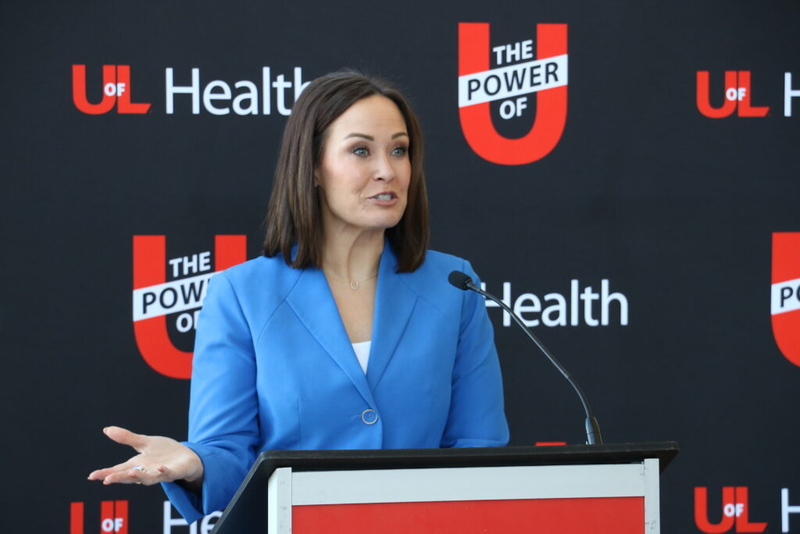
Democratic Lt. Gov. Jacqueline Coleman told a crowd at the UofL Health medical center in Louisville that a new report on women's health in Kentucky shows data that is encouraging in some ways and troubling in others. (Kentucky Lantern photo by Liam Niemeyer).
This story discusses suicide. If you or someone you know is contemplating suicide, please call or text the National Suicide and Crisis Lifeline at 988.
FRANKFORT — Most Kentucky women who died during or right after pregnancy did not have to, according to a new report released Monday as part of Women’s History Month.
From 2017–2021, 21% of new mothers in Kentucky were not screened for depression or anxiety, shows the report by the Kentucky Commission on Women and Cabinet for Health and Family Services.
Meanwhile, most — 89% — of all maternal deaths from 2017–2022 were preventable and 33% of maternal deaths had a mental health component.
Speaking about the report at UofL Health Medical Center in Louisville, Lt. Gov. Jacqueline Coleman said Kentucky women have “made progress” but gaps remain.
“Challenges still exist, like cancer diagnosis in Kentucky, cancer deaths in Kentucky. Those are still challenges that I know a lot of really good, smart people are working very hard to help us combat,” Coleman said. “Always, though, preventative is much better than reactive medicine, and so we’re still trying to figure out how to get in front of a lot of those statistics.”
Women make up slightly more than half of Kentucky’s population, according to the U.S. Census Bureau.
Findings
The two-page report shows:
- Nearly 17% of Kentucky women live in maternity care deserts, meaning an area that lacks maternity care options including hospitals providing obstetric care, birth centers and certified nurse midwives.
- In 2023, 16% of Kentucky babies were born in maternity care deserts.
- From 2017-2021, about 79% of new mothers reported that they were screened for depression or anxiety; 21% were not screened.
- Most — 89% — of all maternal deaths from 2017-2022 were preventable.
- 33% of maternal deaths had a mental health component.
- 82% of Kentucky’s women are white, 7% are Black, 5% are Hispanic, 2% are Asian and 2% are American Indian or Alaskan Native.
- A majority of women in Kentucky — 57% — have insurance through their employer. About 26% have Medicaid and 8% are uninsured.
- Almost 41% of Kentucky women ages 18-44 reported being told by a health care professional that they had a depressive disorder between 2022-2023.
- Nearly 22% of Kentucky women aged 18-44 reported their mental health was not good 14 or more days in the past 30 days from 2022-2023.
- Nearly 46% of Kentucky women in 2022 reported experiencing domestic violence or stalking in their lifetime.
- Nearly 43% of live births in Kentucky were covered by Medicaid, totaling 22,375 in 2024.
The report found for girls and teens in 2023:
- About 9% of Kentucky high school girls reported attempting suicide.
- Nearly 17% of Kentucky high school girls reported making a plan about how they would attempt suicide.
- Nearly 23% of Kentucky high school girls reported seriously considering attempting suicide.
- Nearly 42% of Kentucky high school girls reported feeling sad or hopeless almost every day for two weeks in a row so that they stopped doing some usual activities.
- About 30% of Kentucky high school girls reported their mental health was most of the time or always not good (including stress, anxiety and depression).
- About 14% of Kentucky high school girls reported taking prescription pain medicine without a prescription or differently than how a doctor told them to use it one or more times during their life.
The statistics around mental health are “one of the things that’s been most staggering to me,” Coleman said.
“Structural challenges” that “we all are well aware” of contribute to women’s poor mental health, Coleman said.
“And yet, we have leaders that have not chosen to act on that,” Coleman said. “Things like access to child care, to early childhood education, things that would take the stress and worry off of a lot of moms to know that they would have in Kentucky — we have not done enough in that arena.”
She cited social media usage as a driving force behind negative mental health issues for teens.
“That’s a relatively new phenomenon in the big scheme of things, but there’s a lot of challenges that it creates at our schools, with friend groups, on teams, in communities,” Coleman said. “I think that that has been a real challenge that adults and parents are still trying to figure out how to navigate.”
‘We must do better.’
Coleman used the report to criticize federal cuts to Medicaid that some analysts have said could put 35 rural hospitals at risk of closing. Medicaid is the federal-state program that pays for almost 1 in 3 Kentuckians’ health care.
“The timing of this report is just as important as the information that’s in it, because we all know that health care is under attack from Washington D.C. and we are now facing what could be devastating cuts to Medicaid across the commonwealth that could lead to 35 rural hospitals closing,” Coleman said. “And on top of those cuts, we could also be looking at skyrocketing health insurance costs that will disproportionately impact women in Kentucky.”
Dr. Lori Caloia, the medical director of the Louisville Metro Department of Public Health and Wellness, said it’s time for women “to focus on taking care of ourselves.”
“Women make up more than half of the population in Kentucky,” Caloia said. “We contribute in so many ways to the Kentucky workforce, to our economy, to the care of our children and to the formation of the values and success of generations to come.”
Patti Minter, a former Democratic state representative from Bowling Green who serves on the Kentucky Commission on Women, shared her story of preterm labor at 33 weeks in 2005. She had an “otherwise healthy pregnancy” but gave birth at 35 weeks, she said. Her son was “just a little small, and we both thrived.”
“It was terrifying to realize that sometimes you cannot control what’s going to happen no matter how much you try, no matter how good your care is,” Minter said.
She used her experience to emphasize the danger of cuts to Medicaid.
“What would have happened if I didn’t have a local hospital with a good (labor and delivery department) in it?” Minter said. “The next closest hospital was 30 minutes away, one that’s now perpetually on the list of places that might close if Medicaid availability continues to close, and Vanderbilt University was an hour and a half away. These hospitals took everyone because they took Medicaid patients, but currently, state legislatures, including ours, are making it harder for women and children to get on or remain on Medicaid.”
A 2026 bill from Rep. Ken Fleming, R-Louisville, would add copays on some Medicaid patients as a way to direct patients to primary, preventative care and away from the practice of using emergency departments for nonemergencies. Health advocates have criticized parts of the bill, saying it would put up barriers to care.
An analysis from the Kentucky Center for Economic Policy found the state budget bill approved by the House would underfund Medicaid by $690 million over the next two years.
“We must do better,” Minter said. “It’s time for our lawmakers to take infant and maternal care seriously.”
Liam Niemeyer contributed to this report.
Frankfort