South Dakota not liable for sinkhole under neighborhood, justices rule
Jul 10, 2026 | 6:01 pm ET
Description
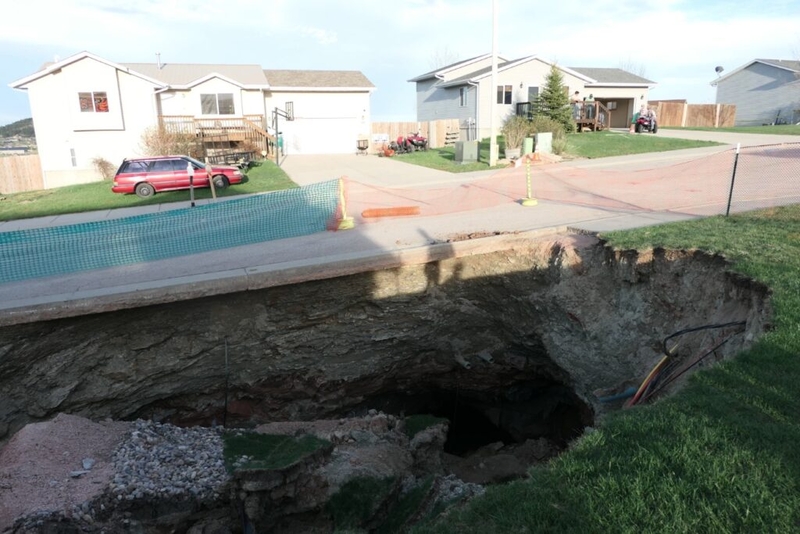
A spring 2020 view of a sinkhole in Black Hawk that opened near homes built atop a former gypsum mine. (Courtesy of Dan Austin)
Homeowners in Black Hawk whose properties were damaged by a sinkhole are not entitled to compensation from the state, the South Dakota Supreme Court ruled Friday.
The 30-foot-deep sinkhole yawned open in April 2020 in a neighborhood called Hideaway Hills, which was built on land reclaimed after a gypsum mine closed. It was the largest sinkhole to appear in the development. The first appeared in 2008.
Thirteen houses were evacuated, and homeowners learned they had been built on unstable ground. Other homeowners also saw damage to their properties.
The mine first opened in the western part of the state more than 100 years ago and was initially a private operation with a vast network of underground tunnels for gypsum mining.
Sinkhole victims ask Supreme Court to help them seek compensation from state
It was later purchased by South Dakota and mined for gypsum to send to the state cement plant but was only mined on the surface. Sixteen acres of the land were eventually reseeded, reclaimed and sold in 1994.
The family that bought those acres and the partnering developer disclosed the underground mining history to the homebuilders, according to the Supreme Court’s ruling. But the homebuyers were not made aware of that history.
Multiple lawsuits against Meade County, the land’s developers and the realtor who represented the homebuilders were dismissed.
In a separate lawsuit against the state, homeowners representing 164 properties argued that the state put them at risk when it failed to properly backfill the land, and that the failure amounted to an unjust “taking” of their private property for the public use of mining. They also alleged the state reopened tunnels in search of more gypsum, which the state denied.
A lower court ruled against the homeowners, saying the lawsuit was about liability for poor reclamation.
The circuit court agreed with the state, which asserted that it’s immune from liability claims under the state constitution.
The homeowners appealed.
The Supreme Court once again ruled in favor of the state but for a slightly different reason.
The state is not immune from liability when it takes private property for public use, the justices ruled, and the state constitution includes damage to property in its definition of “taking.” Under the state constitution, any taking by the government for a public use requires just compensation.
The issue, the justices ruled, is that there was no taking. The state owned the land in the 1980s, when it conducted surface mining in the area and reclaimed the land that would eventually become Hideaway Hills. Nothing the state did impacted private property.
The homeowners argued that the state maintained subsurface mineral rights to the land when it sold the property.
The homeowners’ lawyers wrote in their court filings that since it’s possible for mining to resume at some point in the future, the state had an “ongoing duty” to maintain the subsurface integrity of the land.
The justices rejected that argument. The homeowners “failed to show any general public benefit from the state’s ownership of the mining rights.”
“We acknowledge the devastating and sympathetic circumstances,” the justices wrote, but the homeowners don’t have a legal claim to assert that would open the door to questions of liability and responsibility for the state.
Michael Beardsley, the South Dakota attorney representing the homeowners, did not return a message for comment on Friday.
Terra Larson, who represented the state, said “the court’s decision resolves the legal issues presented in this case.”
“The state thanks the court for their hard work and coming to a well-reasoned decision, and conclusion consistent with what the South Dakota Constitution dictates,” Larson said in a statement.

Pierre, SD