Alaska gas pipeline developer says it’s open to price controls on natural gas for Alaskans
Jun 05, 2026 | 4:11 pm ET
Description
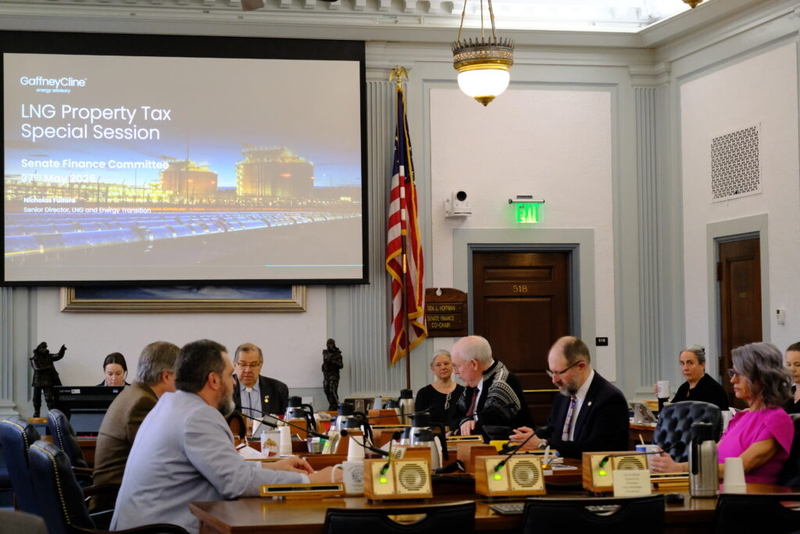
Members of the Senate Finance Committee convene on the first day of a special legislative session on the proposed LNG gas line project on May 27, 2026. (Photo by Corinne Smith/Alaska Beacon)
The firm developing the proposed trans-Alaska natural gas pipeline has proposed limiting the price for natural gas sold through the pipeline to Alaskans.
If accepted by legislators, the limit would prevent the cost of gas from rising if the pipeline costs more than expected.
The new proposal from pipeline developer Glenfarne comes as the Alaska Legislature continues meeting in a 30-day special session, considering a major tax break to support the AKLNG pipeline project. That project aims to build an 807-mile pipeline to bring natural gas from the North Slope to Cook Inlet for export and in-state use.
A price cap could resolve one sticking point in negotiations over the proposed tax break, but with half of the special session gone, a variety of other issues remain unresolved.
Those include basic elements about the tax break, including its size and length, as well as how municipal governments will be compensated for the impacts of construction, which is expected to bring as many as 12,000 new workers to the state temporarily.
The House Finance Committee is expected to begin voting on possible solutions to those issues next week.
Natural gas is the primary fuel for home heating and electricity in Southcentral Alaska, but officials estimate that by the end of the decade, local production from gas fields beneath Cook Inlet will be insufficient to meet demand.
Prices are already rising, and several gas-import projects have been proposed. The AKLNG pipeline is another possible solution, but because the pipeline and supporting infrastructure are so large, the project would need to also sell gas overseas in order to offset costs.
If the pipeline is built but no exports take place — something that could happen if the pipeline costs more to build than expected — the Alaska Department of Revenue has estimated that AKLNG gas would be much more expensive than imported gas.
In legislative hearings, that risk has caused some lawmakers to question the project.
Speaking to the Senate Finance Committee on Wednesday, Glenfarne Alaska LNG president Adam Prestidge said the company is on the verge of finalizing a firm, 30-year contract with Enstar, the largest natural gas utility in Southcentral Alaska.
That fixed-price arrangement would guarantee natural gas at no more than $16 per MMBtu, a measurement of heat capacity.
If the pipeline costs more than expected, cost overruns would not be passed on to consumers, said John Sims, Enstar’s president, when speaking to the House Finance Committee on Monday.
“Enstar’s agreement has a fixed price, and Enstar does not care if the project goes over cost. It does not impact in any way, shape, or form the price that we would be charging customers as a fixed price,” he said.
Rep. Alyse Galvin, I-Anchorage, immediately responded to Sims’ comment.
“A lot of us are very excited to say, yes, I 1,000% support this, because I want to keep low prices,” she said.
Capped price would be cheaper than imported gas
The figure given by Prestidge is equivalent to about $16.59 per thousand cubic feet of natural gas, using a standard conversion. That is cheaper than the forecast price of imports.
Dan Stickel, chief economist for the Alaska Department of Revenue, told legislators in late May that the department’s estimate for the cost of imported gas in 2033 — AKLNG’s planned completion date — “came to about $17 per thousand cubic feet price range.”
Sims told legislators on Monday that Enstar currently expects a “total, all-in cost between $16-22” per thousand cubic feet for imported gas.
Enstar’s current cost of gas is $10.80 per thousand cubic feet, but that will rise in coming years as production declines in Cook Inlet.
The $16 per MMBtu figure is a maximum, Prestidge said. If the pipeline is developed according to plan, exports would subsidize the cost of in-state gas, dropping it as low as $5 per MMBtu, he said.
Glenfarne’s $16 figure could rise with inflation, Prestidge said, but it wouldn’t be affected by cost overruns on building the pipeline.
Prestidge told the Senate Finance Committee that Glenfarne is open to applying a price cap on gas sold to other utilities and industries that might use natural gas.
“Glenfarne is supportive of language being added to any property tax bill that prohibits cost overruns on the project from being borne by either the state or the regulated ratepayers who are buying gas off the pipeline,” he said.
While a final deal between AKLNG and utilities is subject to approval by regulators, a price cap would directly address legislators’ concerns about affordability.
“I think putting that (cap) in a bill would provide a ton of reassurance, because it substantially mitigates your risk in a low-volume scenario,” said Rep. Zack Fields, D-Anchorage.
Sen. Kelly Merrick, R-Eagle River, listened in person to Prestidge on Wednesday.
“I don’t know if $16 is the perfect cap, but it’s addressing a significant concern and protecting Alaska ratepayers,” she said.
Long-awaited pipeline cost estimate met with mixed reaction
On the same day that Prestidge discussed the price cap, he also disclosed updated cost estimates for the pipeline project, saying the first phase of the project is now expected to cost between $13.2 billion and $16.9 billion.
Building facilities needed for gas exports would raise the cost to between $44.5 billion and $54.5 billion, Glenfarne estimates.
Legislators have previously criticized a lack of updated cost estimates, saying their absence is hampering their ability to work on a tax break.
Sen. James Kaufman, R-Anchorage, said the new data and the proposed cost cap “was kind of a tipping point” in discussions.
“I think it gives us more information to do our due diligence,” said Sen. Lyman Hoffman, D-Bethel and co-chair of the Senate Finance Committee.
Alaska currently levies a 2% tax on oil and gas property. Cities and boroughs are permitted to claim some or all of that tax on property within their boundaries.
To incentivize AKLNG investors, Dunleavy proposed replacing the property tax with an “alternative volumetric tax” of 6 cents per thousand cubic feet of gas shipped through the pipeline. The change would effectively result in a 90% tax break, and there would be no tax during construction, because gas isn’t yet being shipped.
The impact of the switch would be heaviest on municipalities. They would have to deal with the consequences caused by having thousands of extra people living nearby, but they would have little (or no) new tax revenue to cover the resulting costs.
The North Slope Borough funds most of its services through the petroleum property tax and has opposed Dunleavy’s proposed change.
Rep. Robyn Niayuq Frier, D-Utqiagvik, represents the North Slope. She has deep concerns about the switch to a volume-based tax and thinks Glenfarne’s new cost estimates are still too low.
“I think there are a lot of people who are having these conversations who think that there’s no way this is actually going to happen, that this is a pipe dream,” she said of the pipeline project.
The House and Senate Finance committees are considering whether to set the natural gas tax at something like 40 cents per thousand cubic feet — or higher — and how long the switch from a property tax to a volumetric tax should last.
That would reduce the size of the break that Dunleavy requested and increase the amount the state and boroughs would collect in revenue.
Dunleavy has suggested that the new tax should last the life of the project. Other legislators, including Frier and Sen. Bert Stedman, R-Sitka, are suggesting shorter terms.
Lawmakers are also debating the size of a proposed “impact fund” that Glenfarne would provide to cover the costs that cities and boroughs would incur as thousands of workers gather to build the pipeline.
Legislators also haven’t decided what communities would be eligible for the fund or how the money would be distributed.
The House Finance Committee is scheduled to begin debating the unresolved issues on Monday and could advance a bill to the House floor as soon as the second half of next week.
The Senate could take up that measure on the week of the 15th, but with the special session ending on June 19, there’s a real risk that legislators will run out of time before they decide the multibillion-dollar issues at stake.
“We have to find a product that meets the polar opposite forces that are out there,” said Speaker of the House Bryce Edgmon, I-Dillingham.
“The needle’s not been threaded yet, and if we don’t get the needle threaded … I think ultimately, then the 30 day special session is — I don’t know what’s going to happen. I just, quite frankly, don’t know.”
Correction: This article has been updated to clarify that legislators are considering taxes per thousand cubic feet of gas, not per cubic foot. The initial version of this article included incorrect units in one sentence.

Juneau