Some may call Oklahoma lawmakers’ special election plan shrewd manipulation. I call it cowardly.
Apr 06, 2026 | 6:29 am ET
Description
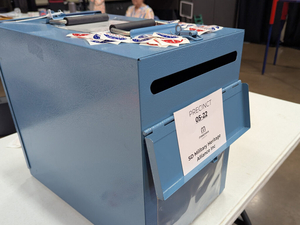
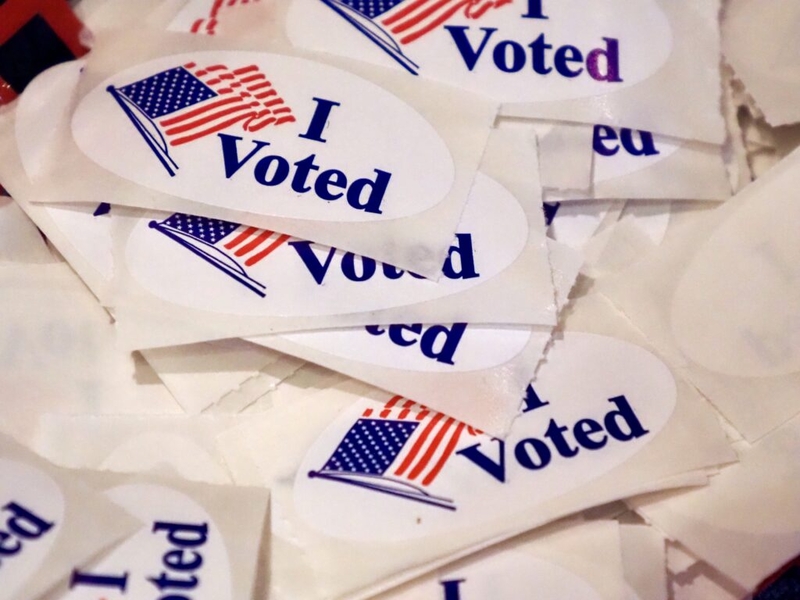
A basket of "I Voted" stickers sits on a table at a polling location in St. Luke's Methodist Church in Oklahoma City. (Photo by Nuria Martinez-Keel/Oklahoma Voice)
During a busy campaign season like Oklahoma finds itself in, it could be easy to miss key details like the timing of an election with all the political noise.
And Oklahoma’s Republican leadership seems to be counting on you being distracted.
That’s because the Legislature is working now to sneak ballot measures that would undo laws constituents already put in place by scheduling elections almost guaranteed to see lower turnouts.
Some might call that shrewd maneuvering. But I call it cowardly.
We suddenly find ourselves stuck with a bunch of cowards who have decided to try to slip some of their most controversial plans aimed at overriding their constituents’ wills by calling a special statewide election on the same date as the primary runoff election.
One measure they’re trying to sneak through would undo the will of voters, who in 2020, bucked the desires of the Legislature by voting to enshrine Medicaid expansion into the state Constitution. By doing so, voters expanded health care access to hundreds of thousands of working, but lower-income Oklahomans. House Bill 4440, which would remove expansion from the Constitution, would make it easier for lawmakers to curtail who receives Medicaid benefits through voter-approved expansion or eliminate it entirely.
Republican legislators insist they have no interest in undoing the will of the voters by undoing expansion, but then why run a second, separate state question, House Joint Resolution 1067? It would allow them to decline to cover the cost of Medicaid expansion if the federal match drops below 90%?
Let me say the quiet part outloud: It’s because they want permission to screw around with voter-approved expansion. They can’t touch it with a 10-foot pole as long as it’s guaranteed in the Constitution.
Lawmakers also plan to put House Joint Resolution 1076 on the August ballot. That’s their plan to restructure how the Tobacco Settlement Endowment Trust functions. The plan proposes abolishing the board of directors, which oversees the $2 billion fund, and redirecting some of TSET’s money, which currently pays for health needs, toward college scholarships.
Voters approved the creation of the TSET “lockbox” in 2000, and have repeatedly rebuffed legislative efforts to take control of the money amid justified fears that lawmakers will just squander the settlement to pay for their priorities of the day. (You know, like an unnecessary, nonpartisan special Aug. 25 election.)
Legislators also want to enshrine into the state Constitution an existing state law that requires voters to show proof of identification to vote.
Nobody in Oklahoma is proposing eliminating that requirement, so I’m puzzled why Republican leaders think their GOP colleagues would want to do this in future years.
Apparently, they’re not confident that the majority of voters would support any of their state questions, so they want to try their luck with a much smaller pool of voters during the very lowest turnout election. These days those who turnout in these partisan runoffs are mostly motivated Republicans whose chosen candidate is fighting for their life.
Adding insult to injury, all partisan primaries are closed to independent voters this year, and the last time Libertarians had a runoff contest was in 2018.
So in order to know that a nonpartisan statewide election is taking place during a traditionally partisan showdown, someone is going to have to be pretty politically astute or plugged in.
People generally aren’t driven to the polls by state questions.
It’s so unusual to create a statewide election like this that lawmakers had to take a special votes on each of these measures in order to do it.
Talk about conniving.
Lawmaker’s maneuver to tack a special nonpartisan statewide election on to the existing Aug. 25 date, by the way, is expected to cost taxpayers $550,000. That’s in part because election secretaries now must print hundreds of thousands of separate nonpartisan ballots, and try to guess how many people are likely to turn out at the polls.
These are the same Republicans who have vowed to cut all waste and abuse from our state budget, yet apparently have enough disposable income to call an unnecessary election. That $550,000 could be spent to increase student literacy or on training programs that bolster our workforce.
Thankfully, in recent years, Republican legislators have wisely avoided calling unnecessary elections that waste our time and money. They’ve let November voters decide the fate of their state questions.
That’s how it should be. And the Republicans who came before should be commended for that restraint.
November’s general elections generally see the highest turnout because they’re open to everybody regardless of partisan affiliation. And people know that.
We should want the outcome of the proposed legislative state question to be fully vetted and considered. Because to put them on a ballot, lawmakers only need a majority of their colleagues to agree.
In a Legislature that’s supermajority Republican, that’s a super easy threshold to meet.
While legislators often know what their constituents want, putting those issues on the ballot helps ensure they’re steering the ship in the direction that voters want.
Sometimes they’re in tune with the will of voters. Sometimes, much to their surprise, they find themselves at odds with them.
Legislators wanted to overhaul how alcohol sales functions in our state. Voters did too.
Lawmakers wanted to clearly bar noncitizens from voting in our elections. Voters did too.
Legislators wanted to create special infrastructure districts. Voters did not.
And they wanted to repeal a portion of the state Constitution that prohibits using state property and money for religious purposes. Voters did not.
You know what all those legislative state questions had in common? They were all crafted by Republicans and all appeared on a November general election ballot.
It’s problematic that this crop of lawmakers are refusing to do the right thing and put their own state questions on the November ballot too. No matter the issue or party in charge, legislative state questions should always be on the November ballot and not snuck through like a dirty secret.
Because that’s what their constituents expect and deserve. And that’s what builds trust in government and our democratic process.
Oklahoma City, OK