Sioux Falls man on parole for manslaughter is charged with providing drugs that killed his niece
Jun 18, 2026 | 4:49 pm ET

Description
From left, U.S. Attorney for the District of South Dakota Ron Parsons Jr., South Dakota Division of Criminal Investigation Special Agent in Charge Mike Hockett, U.S. Attorney for the Northern District of Iowa Leif Olson, and Sioux Falls Police Chief Jon Thum appear at a June 18, 2026, press conference in Sioux City, Iowa, on the death of 14-year-old McKenna Wendel. (Photo by John Hult/South Dakota Searchlight)
SIOUX CITY, Iowa — A Sioux Falls man on parole has been charged with federal crimes related to the death of his 14-year-old niece amid ongoing debates about parole reform that have led to stricter supervision standards in South Dakota.
A grand jury in the Northern District of Iowa indicted 51-year-old Mark Milk on Wednesday with five felony counts tied to allegations that he provided the cocaine that killed McKenna Wendel on March 14, gave her THC, took her across state lines to engage in illegal sexual activity and acted to conceal evidence.
The grand jury also indicted a Brookings man who was on parole at the time of Wendel’s death, 38-year-old Jon Rogness, on two felony counts for allegedly helping Milk conceal evidence.
Rogness was released on parole supervision in 2024 after serving 16 years of a 45-year sentence for manslaughter. He was charged with felony drug possession and felony drug ingestion in January, but was free on bond and awaiting trial on those state-level charges in March, when the alleged crimes took place. Rogness is incarcerated at the South Dakota State Penitentiary in Sioux Falls.

Milk was sentenced to life in prison in 1994 for beating a man to death after a fight in Winner. Then-Gov. Kristi Noem commuted his sentence in 2023, making him eligible for parole. The commutation came after Milk went through a formal application process and earned a unanimous recommendation from the Board of Pardons and Paroles. The board released him the following year after a parole hearing. Wendel was at the hearing and asked the board to support his release.
Milk is in custody at the Minnehaha County Jail in Sioux Falls, and has been since March 17, when he was arrested for allegedly driving drunk and fleeing police.
Federal court records did not list an attorney for Milk or Rogness as of Thursday afternoon.
The state Department of Corrections’ Division of Parole Services has tightened its supervision of people on parole since Wendel’s death. Gov. Larry Rhoden announced the state’s intention to reform parole through what he called a “Smarter Supervision Initiative” on April 7.
Three weeks later, a Sioux Falls police officer was shot and injured, allegedly by a man on parole. By the end of that week, Rhoden announced “additional parole reform solutions” that included the hiring of five new parole agents, swifter sanctions and parole violations for drug users, and the creation of an “enhanced compliance unit” to monitor parolees on nights and weekends.
Few details offered at press conference
U.S. Attorney for the Northern District of Iowa, Leif Olson, appeared at a press conference in the Wendel case on Thursday at his office in downtown Sioux City. He and others at the press conference referred to Wendel by name, although she’s identified by initials in the indictment.
He lauded the work of the multiple law enforcement agencies involved in the case in both South Dakota and Sioux City, read through the charges, and declined on multiple occasions to provide further details.
When asked if the crimes took place in Iowa’s Lyon County, for example, he said “that’s something that we will prove at trial.”
Olson also declined to comment on the relationship between Rogness and Milk.
Disappearance draws attention
Wendel’s case became a source of public fascination in the three months between her death and her uncle’s indictment. A Facebook group called “Justice for McKenna Wendel,” launched in mid-March and now peppered with posts filled with speculation about Milk and Rogness, has 3,400 members. It linked to a livestream of her funeral at the end of March, and on Thursday linked to livestreams of the Iowa press conference.
Wendel’s name also emerged at public forums, such as a remembrance vigil for missing and murdered Indigenous people in Pierre last month. Wendel was a member of the Rosebud Sioux Tribe.
South Dakota Attorney General Marty Jackley was on the scene when Wendel’s body was discovered on March 19 near Brookings, and told reporters the following day that he’d spoken to her family to assure them that all the agencies involved were working together to find answers.
Sioux Falls Police Chief Jon Thum was in Sioux City on Thursday for the announcement of charges and addressed the public’s interest and impatience.
“It takes time to get to where these charges were announced today,” Thum said. “Good investigations and good work take time, and they take solid efforts to dot i’s and cross t’s.”
Body found in Brookings County
Wendel lived with her grandparents in Sioux Falls. She left home on March 13 and did not return. Her grandparents reported her missing on the morning of March 15, and Sioux Falls Police Capt. Terrance Matia said in a March press conference that officers began a search that led them to Brookings County, as well as to Rock County, Minnesota, and Lyon County, Iowa.
Her body was discovered just after 9 a.m. March 19 in rural Brookings.
Numerous social media posts had proliferated by then suggesting that Milk might be involved in Wendel’s disappearance and death.
Milk’s brother is listed as a surviving relative in Wendel’s obituary. Milk is not listed.
Milk was arrested mid-morning on March 17, four days after Wendel went missing and two after she was reported missing.
He’d been driving a Toyota Camry near 16th Street and South Summit Avenue in Sioux Falls when an officer tried to pull him over on suspicion of drunken driving, Lt. Nick Butler told South Dakota Searchlight via email in late March.
Milk allegedly sped away instead of pulling over, but the officer who’d attempted the traffic stop did not pursue. Milk only made it a few blocks before allegedly running a stop sign and colliding with another vehicle, driven by a female in her 50s.
Milk was charged with aggravated eluding and driving under the influence. At Milk’s bond hearing on March 19, Minnehaha County Deputy State’s Attorney Zachary Stanton told Judge Sara Pokela that Milk’s vehicle wound up in someone’s yard, that Milk had tried to flee on foot, but that multiple officers were able to run him down.
“At that point, the defendant began yelling at the officers to shoot him,” Stanton said, according to a transcript of the proceedings. “He refused to comply with commands and ultimately had to be tased.”
Stanton noted that Milk is on parole, had refused to take a urine test for drugs and had “been lying about where he was living” and had been “noncompliant with parole.”
Pokela granted Stanton’s request that Milk be held on a $10,000 cash bond. Milk, who replied it “doesn’t matter” when Pokela asked if he planned to hire a lawyer, did not make any arguments on his own behalf.
He appeared for a pretrial conference earlier this month in that case, but no trial date was set.
Milk was granted clemency in 2023
Much of the online chatter about Milk zeroed in on the nature of his previous crime and the circumstances surrounding his release.
Milk got a life sentence in 1994 for manslaughter out of Tripp County. Milk and the man he killed, Shawn Peneaux, had “several altercations” on Oct. 3, 1993. During the second fight, Milk stabbed Peneaux and kicked him in the head with steel-toed boots, killing him.
While incarcerated, he spent years working for Metal Craft Industries, a private company where inmates earned market wages. Until early 2024, Metal Craft’s operations took place in a shop inside the South Dakota State Penitentiary’s Jameson Annex, which houses maximum security inmates and those in administrative segregation.
At his commutation hearing in November 2022, board members heard how Milk had helped lead powwows for inmates and their family members while he was incarcerated, and served as a role model for younger inmates through the Alternatives to Violence program.
State will pay extra for county jail space amid crackdown on alleged parole violations
The Argus Leader newspaper ran a story about those family events in 2018 that featured and quoted Milk and his parents. The story included a photo of Wendel, then 6, sitting on Milk’s lap and laughing during one of the events. Wendel and her grandparents, Milk’s parents, visited Milk “on a regular basis,” the story said.
At his commutation hearing, both his parents said they’d visited him weekly, often with Wendel, because Mark “likes to see his little niece,” according to a video of the hearing obtained by South Dakota Searchlight.
Wendel’s mother, Milk’s sister, wept as she pleaded with the parole board to offer him a chance to be released from the institution where he’d been held since she was a child.
“The guards, they’ve seen me grow up here, and I’m 29 years old, almost,” Milk’s sister said. “I just love him very much. I hope to see good things coming.”
The board voted to recommend that the governor commute Milk’s sentence from life to 240 years.
Noem issued the commutation on Feb. 2, 2023, making Milk eligible for parole at the board’s discretion. In June 2024, Wendel testified on Milk’s behalf at his parole hearing.
In an interview with South Dakota Searchlight just under two years later, Milk said the contributions he’d made to his family “was one of the things that really stood out” to the parole board.
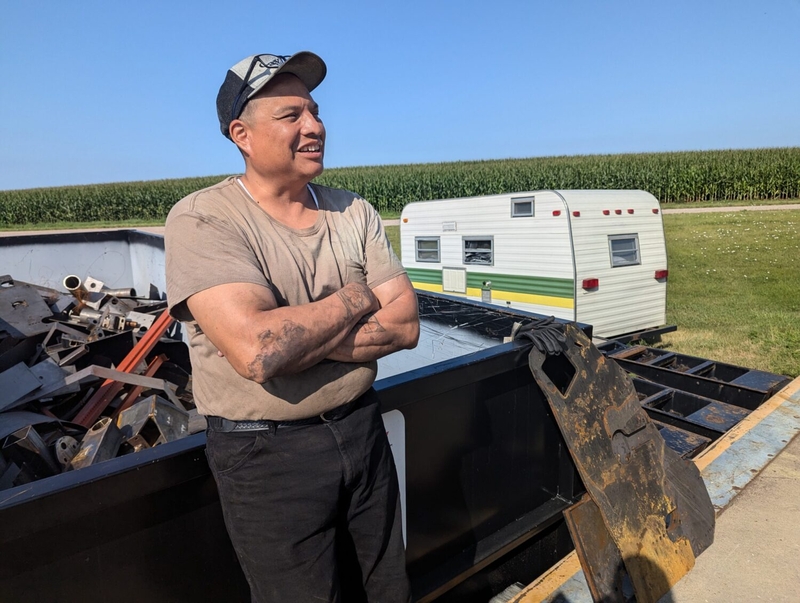
Milk spoke to Searchlight shortly after his release on the grounds of the Metal Craft Industries location near Baltic, where the company moved its operations when its partnership with the Department of Corrections ended. Milk worked there a while after his release, but Metal Craft’s owner, Terry Van Zanten, fired him several months before the incident that landed Milk back in jail on March 17.
“He was doing really well. But after a couple of months, he got a girlfriend, and we could tell he was going the wrong direction,” Van Zanten said.
Milk was married last summer. His wife, when contacted by South Dakota Searchlight on Thursday, declined to comment.
Van Zanten regularly hires inmates, including those who worked for him while the business was still located in the penitentiary. Most do well, in his experience, even those who’ve served time for serious offenses, as Milk had.
“He was one guy who we thought was going to make it,” Van Zanten said.
State Department of Corrections spokesman Michael Winder confirmed Thursday to Searchlight that Milk had been working as a dishwasher in the kitchen at a restaurant.
“Parolees can work in the restaurant or kitchen area of a business that sells alcohol with their agent’s approval,” Winder said in an email.
Clemency granted under typical procedure
Gov. Larry Rhoden was Noem’s lieutenant governor. When asked about the reasons for the Milk commutation, Rhoden’s spokeswoman Josie Harms said the governor “cannot provide comments on why decisions were made by previous administrations.”
Harms went on to note that Rhoden only considers positive recommendations from the Board of Pardons and Paroles when considering clemency.
More than half the inmates Noem released early without parole board review have been re-charged
Noem issued commutations to some inmates who hadn’t been screened by the parole board around Christmastime, in 2022 and 2023. The family of one victim, Calvin “C.J.” Shields, told South Dakota Searchlight in 2022 that they hadn’t been consulted before Noem commuted the sentence of his killer, Whitney Turney. The parole board’s staff reaches out to victims’ family members as a matter of policy before holding commutation hearings.
Milk’s commutation went through the typical screening. He sent his application to the parole board, then had a hearing and received a positive recommendation from its members.
After board members review commutation candidates, a recording of their hearing is forwarded to the governor, along with a commutation file containing a person’s criminal and correctional record. The files also contain any supporting documentation, such as letters of support or opposition.
The board granted Milk parole more than two years after Noem signed the commutation its members had recommended. By that time, Milk had served three decades in prison.
Noem has not responded to multiple requests for comment on her commutations, including on Thursday.
Supervision terms, violations
The exact terms of Milk’s parole supervision are not publicly available. Parolees must adhere to a standard set of rules, but may also have additional requirements based on their circumstances.
When asked about Milk’s behavioral expectations on parole, Winder directed South Dakota Searchlight to a copy of the agency’s standard parole terms and its policy for violations.
The standard supervision agreement includes prohibitions on parolees’ use of alcohol or drugs and on entering bars or casinos, as well as promises not to possess or use weapons, to maintain employment, to be reachable by their parole agent and to tell agents if they leave their home area.
The violation policy was last updated March 15 and signed by Corrections Secretary Nick Lamb.
It says parole officers “will respond to every violation detected in order to hold offenders accountable for their actions.”
Enough parole infractions will earn parolees a violation, a term that signals their return to prison. Losing touch with a parole agent is an automatic violation, the policy says, while entering a bar or failure to maintain employment is a low-level infraction that may result in more contact with a parole agent.
In March, Winder did not respond to questions about whether Milk had any parole infractions prior to his arrest that month.
On Thursday, Winder said Rogness returned to prison for failing a drug test and losing contact with his parole agent. Winder would not say if either Rogness or Milk would have been eligible for the enhanced supervision that began rolling out after the announcement of Rhoden’s parole reforms.
“The enhanced compliance unit and other parole reforms announced on April 30 are to hold parolees accountable and improve public safety,” Winder wrote. “Each parolee is evaluated as part of their reentry plan to determine what level of supervision is appropriate.”
- 6:54 pmThis story has been updated with additional information confirmed and offered by the Department of Corrections.

Pierre, SD