SC had 500 Rosenwald schools for Black children. Nonprofits want to save the 44 that remain.
Feb 27, 2026 | 3:52 pm ET
Description
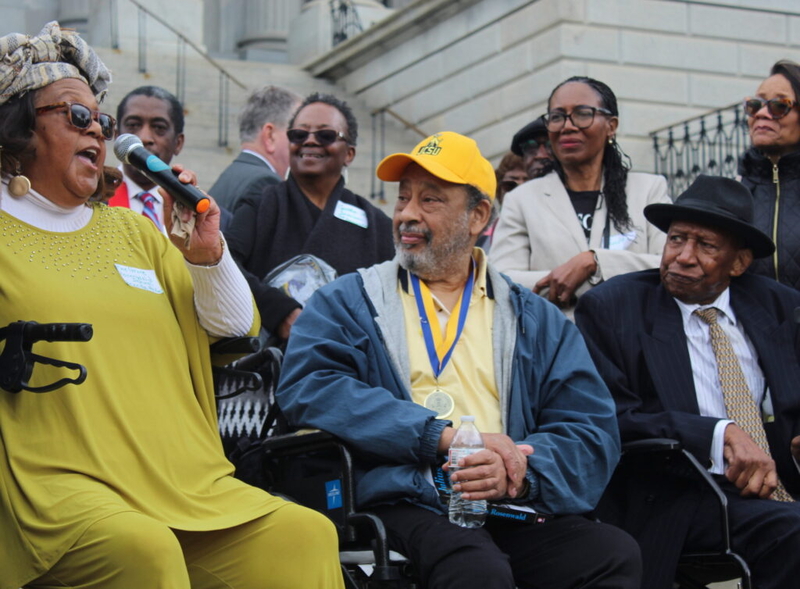
From left to right, Brenda McGrif, Julius Rosenwald Cobb and Truman Humbert speak on the Statehouse steps in Columbia, S.C., on Wednesday, Feb. 25, 2026. (Photo by Skylar Laird/SC Daily Gazette)
COLUMBIA — Julius Rosenwald Cobb fondly remembers his time at Chapman Grove School, one of nearly 500 Rosenwald schools in the state, which were once a beacon for Black students.
Cobb, who was named after the schools’ founder, had to walk to school barefoot, sometimes in the rain without a raincoat, while fending off the white drivers trying to run him off the road. Still, “it was nice,” to have somewhere to learn, the 88-year-old told the SC Daily Gazette.
Just 44 of the schools, which were founded in the early 20th century to give Black children a high-quality education, remain standing, according to nonprofits studying them.
Historic preservation nonprofits, alumni of the schools and legislators want to preserve the remaining schools to make sure future generations know their history, they said this week.
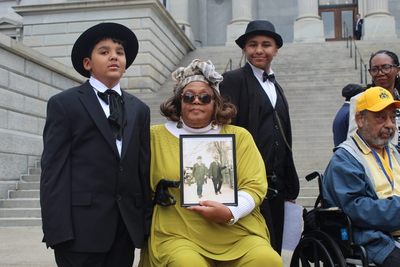
Julius Rosenwald, best known for founding department store chain Sears, partnered with Tuskegee University founder Booker T. Washington to create the schools in the early 1910s. Their goal: Give rural Black children in the South another place to learn, outside their churches or sometimes the pricey private academies open to them.
With the support of local communities, who offered money, land and resources, the two built nearly 5,000 of the schools throughout the South.
By 1928, Rosenwald schools accounted for one-fifth of rural schools in the South and taught one-third of all Southern Black students, according to a history compiled by the National Trust for Historic Preservation.
“We all stand on the shoulders of the Rosenwald schools,” said Truman Humbert, a 77-year-old who attended Greenville’s Chapman Grove School in first grade.
Humbert’s first year at the school, which was just around the corner from his family’s cotton farm, was also his last.
The school shuttered in 1954, the same year the U.S. Supreme Court issued its landmark Brown vs Board of Education ruling that separating schoolchildren based on their race was unconstitutional, he said.
Schools in the South wouldn’t fully integrate for years to come, but the decision caused most of the Rosenwald schools to shut down. Neglected and often forgotten by surrounding communities, the schools, which once represented opportunity for rural Black communities, were left to crumble.
“These structures, a symbol of community pride and educational resilience, face neglect and potential ruin,” said Aydin Soner, a Columbia ninth grader who gave a presentation on the schools’ history while dressed as Rosenwald during a Wednesday news conference at the Statehouse.
With $300,000 from the state, nonprofits WeGOJA Foundation and Conservation Voters of South Carolina studied six of the schools that are still standing, in the hopes of preserving them and opening them up to the public.
Through the study, which finished last summer, the groups formed a goal of one day creating a trail system that passed all six schools, operated through the state’s parks department.
Those schools could also become museums, teaching visitors about the history of the schools, said Dawn Dawson-House, executive director of WeGOJA Foundation, which advocates for preserving African American history in the state.
Eventually, the goal is to expand the project to as many remaining structures as possible.
But the original study centered on six Rosenwald schools that represented different styles of architecture and different parts of the state, she said.
Some are one-room schools, some have two rooms. Some still have teachers’ houses and shops built along with the schools standing. All feature large windows that were typical of schools during that time, she said.
Most importantly, those were schools whose owners the nonprofits could track down and work with. Many of the properties are on private land, or the nonprofits haven’t been able to track down an owner, creating additional bureaucratic hurdles for any sort of preservation work, she said.
The schools sit in various states of ruin. Some sit decaying, but others, including Pine Grove School in Richland County and Chapman Grove School in Greenville, already have preservation projects underway, with support from local governments and communities.
Any moves forward will require funding, in a to-be-determined amount, which Dawn-House hopes will come from the state.
Rep. Annie McDaniel, chair of the Legislative Black Caucus, said she and several of her colleagues plan to help secure whatever help the groups need.
“Thousands of Black children walked miles to attend these schools,” the McDaniel, a Winnsboro Democrat, said. “We cannot allow their legacy to disappear.”
WeGOJA and the Conservation Voters are asking for ideas from the community as to what should happen with the schools.
Whatever that looks like, Cobb hopes the schools will teach children of the future the importance of getting an education by any means necessary. The schools meant so much to his family, his parents named him after the founder, he said.
“It’s very important that we know where we came from,” Cobb said. “If you don’t know where we come from, we don’t know where we’re going.”
Columbia