Rhode Island’s Lao community left reeling after deportations
Jan 20, 2026 | 5:45 am ET

Description
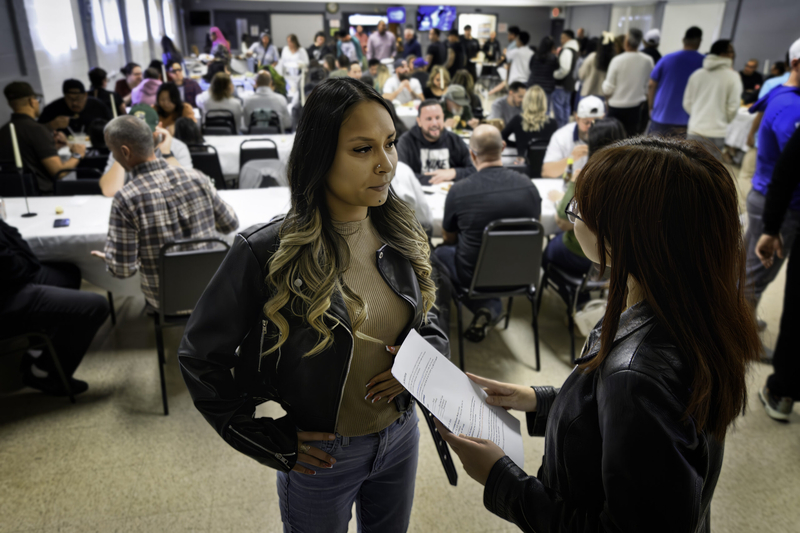
Olivia Detsavanh holds her phone so that Marcos Beato can talk to her uncle, Mike Detsavanh, during a fundraiser at the Brightridge Club in East Providence on Oct. 19, 2024. Both Beato and Mike Detsavanh were barbers at a barbershop on Smith Street in Providence. Mike Detsavanh and Olivia’s father John Detsavanh were being held at the Wyatt Detention Center in Central Falls at the time. (Photo by Michael Salerno/Rhode Island Current)
To someone passing by the East Providence banquet hall one Sunday in October, it may have looked like a birthday or engagement party.
There were balloons, a DJ playing uptempo music, a line of people waiting with plates at the buffet. A table was piled with boxes and wrapped gifts, including Nike sneakers, restaurant gift cards, and bottles of whiskey and tequila.
And there was Olivia Detsavanh carrying her phone around the room so people could offer greetings to the two guests of honor who couldn’t be with the 100 or so people in attendance.
Olivia’s father, John Detsavanh, 52, and her uncle, Mike Detsavanh, 50, were calling from custody at the Wyatt Detention Facility, the maximum security federal detention center in Central Falls. They had been held at the Wyatt since Sept. 11 when ICE agents picked up the brothers separately in Providence. Olivia’s dad John was on his way to work; her uncle was driving Olivia’s younger sister to school.
The gathering at the Brightridge Club was a fundraiser for the brothers. All the items on the table were prizes in a raffle to raise money for their legal advocacy and other expenses. At one point, the music stopped, and Olivia took the microphone. She described her father as a funny and generous man who is quick to offer help. Her uncle, Mike, she said, was “selfless, dependable and loyal.”
Their detention had shattered her family, she said. Her younger sister will now have to finish high school and navigate life without two strong male figures. Her older sister canceled her upcoming wedding because her father wouldn’t be able to walk her down the aisle. Their grandmother, in ailing health, no longer had her son Mike to diligently take care of her.
“This fight is not over,” Olivia said. “We can’t give up on trying to get them, not only back home, but justice.”
But three weeks after the fundraiser, the brothers were deported to Laos, a country that they left as child refugees.
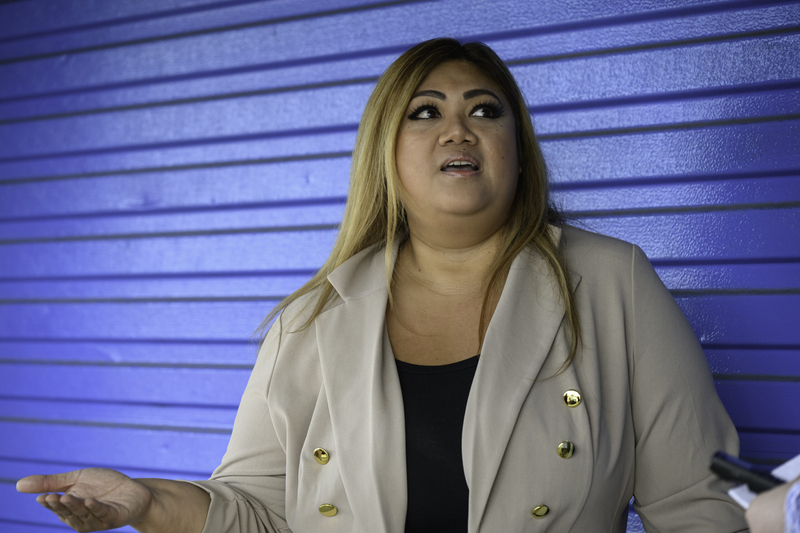
Lao community in shock
In the first year of the second Trump administration, the United States deported more than 100 people to Laos, the rural, mountainous Southeast Asian country where the U.S. conducted a “Secret War” from 1964 to 1973. During the entire four years President Joe Biden was in office, the number was just six, according to data from the Southeast Asia Resource Action Center in Washington, D.C.
In Rhode Island — which has been a settlement area for Southeast Asian refugees since the 1970s — at least six Rhode Island men of Lao descent were deported by immigration authorities in 2025. All of them arrived legally in the U.S. as children and were granted refugee status. All of them were subsequently convicted of crimes that led to removal orders.
But those orders were never carried out for years, even decades.
In the 1990s, the Detsavanh brothers pleaded guilty to felony charges for their part in a series of gang-related robberies of local restaurants as teenagers in Florida. They moved to Rhode Island after prison, started fresh, and settled into lives with regular check-ins with enforcement authorities. Neither has had a run-in with the criminal justice system since. During that time, John got married, had kids, and volunteered with PrYSM, a Providence advocacy organization focused on the Southeast Asian community. Mike became a popular barber in Providence. All told, 29 years passed between their deportation orders and actual removal from the country in November..
The wave of recent deportations to Laos has left Rhode Island’s Southeast Asian community reeling. Supporters have held protests, and launched fundraisers. They have held campaigns to call and email ICE and elected officials to urge intervention in these cases. Family members of deportees — pressed unexpectedly into public positions of advocacy — have participated in interviews, forums, and documentaries to try to raise awareness.
“Everybody’s scared,” PrySYM Deportation Defense Director Theary Voeul told Rhode Island Current. “I get calls every day from folks that [ask], ‘Theary, is it safe for me to even go outside?’”
It no longer mattered that these deported men had come to the United States as refugees from the most bombed country in the world per capita. And that the United States is the very country that dropped more than 2 million tons of bombs on Laos, more than were dropped on Germany and Japan combined during World War II.
And it no longer mattered that they had turned their lives around. The Detsavanh brothers had the longest stretch between their deportation orders and their removals among other recent Rhode Islanders deported to Laos. The others had remained in the U.S. between five months and 18 years since their ordered removal.
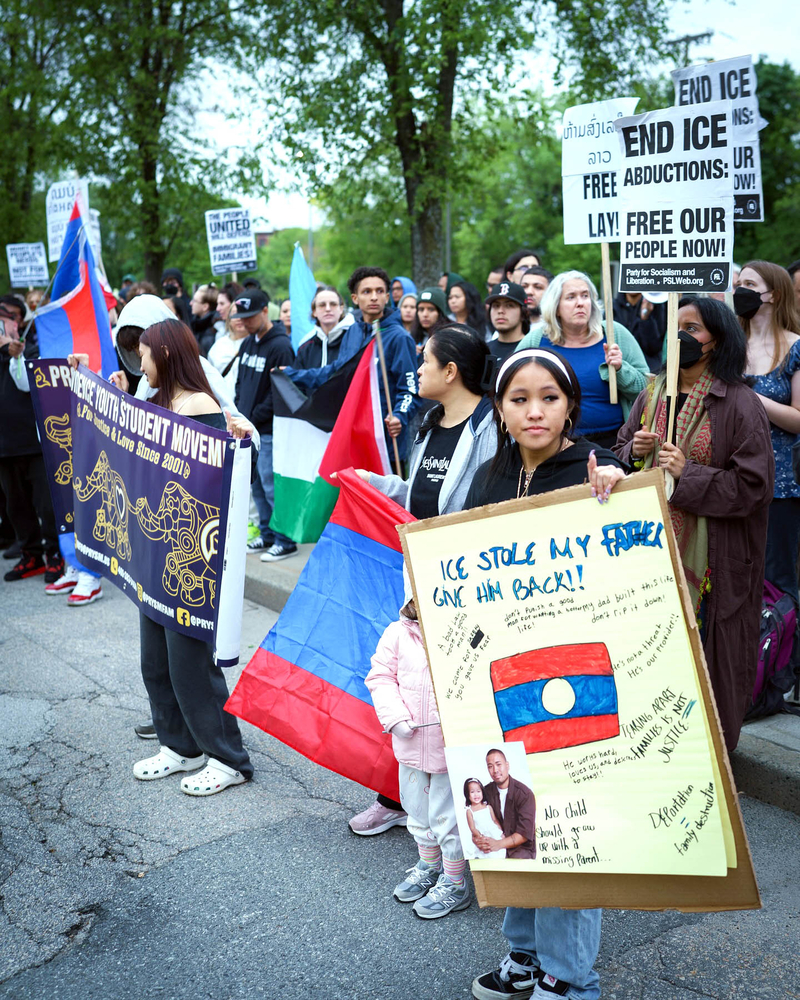
‘Ripped out from under them’
The deportations reflect what Providence-based immigration attorney Zachary Lyons calls a new “extreme enforcement posture” by the Trump administration. Previously, various factors, including limited ICE resources or a lack of a formal repatriation agreement between countries, might keep a person in the U.S. years after their ordered removal, Lyons says. (The U.S. still has no formal repatriation agreement with Laos, according to the Asian Law Caucus.) Now, people are being arrested in the streets, at work, or detained at check-in appointments with ICE they went to for years without incident.
Because those targeted had been here for so long, the impact of their removal has been more pronounced. The U.S. government has allowed them to remain and have children, go to school, perhaps marry or start a business. “Now all of that is being ripped out from under them…in an instant,” Lyons said.
In May 2025, community members rallied at the Wyatt Detention Facility to call for the release of three Laotian men – Khek Choummala, Manoutham Phommachan and Vanhhatdy Souvannaxa – who had recently been detained. All had previous convictions for criminal charges, but had served their sentences. In each case, supporters launched fundraisers and petitions to try to stop their loved ones’ deportation. But all three were eventually deported.
In response to questions about their cases, ICE spokesman Christopher Celozzi stated that the three men had “entered the United States lawfully; however, they violated the terms of their lawful admissions.” Phommachan’s charges included felony firearm possession and felony possession of a controlled substance. Souvannaxa had been convicted for knowingly receiving and possessing a pipe bomb and maliciously damaging by means of fire and explosive materials a building resulting in personal injury, both felonies. Celozzi confirmed all were deported on May 25, 2025.
Rhode Island Current reached out to Souvannaxa and Phommachan, as well as their spouses, but received no response. In an August 2025 interview with Ocean State Media (formerly The Public’s Radio), Souvannaxa’s wife, Cassie, described her husband as “somebody who has already done their time, and they’re still treated like a criminal.” In a short documentary film released in October, Phommachan’s wife, Saroeur, described him as a “great husband” and “wonderful father.” Rhode Island Current was unable to contact Choummala or a representative.
‘Dropped into poverty’
Southeast Asian refugees landing in Rhode Island after the Vietnam War ended in 1975 primarily settled in Providence and Woonsocket. In 2022, the Rhode Island Laotian population was 2,890. New arrivals faced a long list of challenges, including separation from family members, memories of horrific violence, a new language and culture, and dramatically different climate.
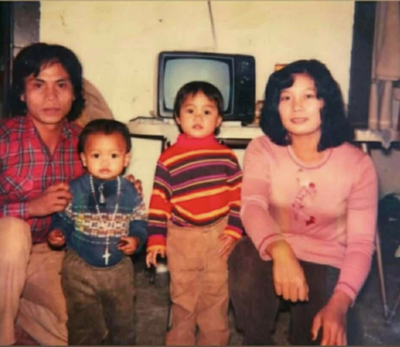
Phaykham Phrachanhsiri, 46, grew up in Providence after his family arrived in Boston legally as refugees in 1981 when he was 2 years old and his sister Phayvanh was 5. Their father had fought against Communism in Laos during the Vietnam War. When the war ended and Communists took over the country, his dad was arrested and beaten and tortured in custody.
Phaykham went by the nicknames “Ai” and “Eggroll.” His parents struggled with English and worked a lot, sometimes two jobs. His sister, Phayvanh Phrachanhsiri, who now works as an emergency department nurse in Houston, said she and her brother were essentially left to navigate this new country alone.
“We were dropped into poverty,” she said.
In 2005, in Texas, Ai Phrachanhsiri pleaded guilty to one federal charge of involving use of a phone in connection to a drug deal, as part of a broader sting related to the trafficking of ecstasy. He served two years of a 37-month sentence and was released from prison in late 2007. As part of his punishment, he was also ordered to be deported. The order was never carried out.
Eighteen years passed between his ordered removal and his arrest and deportation by ICE in 2025. In that time, he moved back to Rhode Island and stayed out of trouble. He found work at various body shops in Rhode Island. He most recently worked at a West Warwick shop where he ran a concierge collision recovery program that handles pick-up and drop-off for the damaged car, rental car arrangements, and logistics coordination with insurance providers.
On Aug. 18, ICE agents arrested Ai Phrachanhsiri at his job. He was deported in early November.
“Ai is not just someone being deported,” read a testimonial on a GoFundMe campaign launched after his arrest. “He is a brother, a son, a friend, and a man with a heart of gold.”

The GoFundMe campaign ended, and the page has since been taken down.
When Phayvanh heard the news of her brother’s deportation, she said she couldn’t stop crying. Her brother had come to the U.S. legally, as a toddler. Now, he was “leaving America in shackles,” she said.
In a statement, ICE Boston spokesman James Covington acknowledged that Ai Phrachanhsiri entered the country legally, but violated the terms of his lawful admission.
“Phaykham Phrachansiri is an illegal alien from Laos whose criminal history includes a conviction for using a communication facility during the commission of a drug trafficking crime,” Covington said.
In a phone interview Monday from Laos, Phrachanhsiri said he considers himself lucky to have an uncle and cousins in Laos who have helped him with the transition.
But his new life remains difficult. He has no citizenship and no driver’s license. He cannot read or write in the local language. He hasn’t yet landed a job. And he misses his family and friends in the U.S. An avid fisherman who loved to fish for striped bass and flounder off the coast of Rhode Island, he’s tried fishing in landlocked Laos but said it’s not the same.
“There’s no ocean over here,” he said. “It’s just all ponds.”
Legislation aimed to offer special case exceptions
In recent years, members of Congress introduced legislation that would carve out deportation protections for certain Southeast Asian refugees, acknowledging the population’s unique experiences and their reasons for living in the U.S.
Minnesota U.S. Rep. Betty McCollum introduced the “Hmong and Lao Refugee Deportation Prohibition Act of 2020,” which called for a six-year stoppage of deportations to Laos so that people with final orders of removal could have their cases reassessed. Two years later, California U.S. Rep. Alan Lowenthal introduced the “Southeast Asian Deportation Relief Act of 2022,” which aimed to establish limits on DHS’s authority to deport refugees from Vietnam, Laos, and Cambodia who arrived in the U.S. before 2008.
Neither bill passed.
Quyen Dinh, the executive director of the Washington-based Southeast Asia Resource Action Center (SEARAC) recommends legal representation for Southeast Asian folks facing deportation. “The odds of success really increase,” she said. “But the legal field has been so inundated that it’s really hard to find an attorney, period.”
Dinh calls the jump in deportations to Laos from the Biden administration to the first year of Trump’s second term an “exponential” and “astronomical” shift.
In Rhode Island, PrYSM has published a Google doc called the “Lao Deportation Toolkit: A Guide for Lao Individuals Facing Deportation,” outlining what to expect upon arrival in the country. It includes information about the state-run compound in Laos where U.S. deportees are held until securing a sponsor to officially enter the country, the sponsorship process, and warnings on how to avoid exploitation.
The toolkit links to Facebook groups for deportees and their families; shares a visitor’s guide to the country’s capital, Vientiane; and offers guidance on local access to transportation, housing, banking, and health care. One section advises that many employers in Laos are hesitant to hire people over the age of 40. “Many folks are finding jobs in the service industry,” the toolkit said. “Our advice is to look into getting certified as an English teacher.”
The document states it was developed “out of PrYSM’s experience in supporting Rhode Island community members as they’ve navigated detention, deportation, and resettlement in Laos.”
‘Prioritizing public safety’ vs. social justice concerns
The Department of Homeland Security says detentions and deportations during Trump’s second term are about keeping people safe.
Asked to comment on the deportation of the Detsavanh brothers, Covington pointed to their convictions on three counts of armed robbery and noted that the felonies violated the terms of their admission as refugees. Mike’s deportation order was in 1995 and John’s in 1996.
John Detsavanh’s daughter, Olivia, says her father and uncle were wrongly convicted.
In an interview posted to Instagram, she said as teens her father and uncle were “nerds” who were bullied and threatened into participation in the crimes for which they were convicted. When they were interrogated by the police, they weren’t offered the presence of a lawyer or parent, she said.
In her view, there were three stages to the injustice her father and uncle endured at the hands of the United States. The first was the country’s military intervention in Laos that made them refugees in the first place. The second was what she believes was their wrongful conviction. The third is their detention and deportation by ICE.
Olivia described herself as normally private and reserved. But because her father and uncle would do anything for anybody, she feels compelled to do anything she can for them.
“I had to speak out for at least my father and my uncle, since they don’t currently have a voice,” she said.
Providence, RI