‘Respect Nebraska Voters’ effort begins signature gathering, meets early pushback
Jan 06, 2026 | 9:49 pm ET
Description
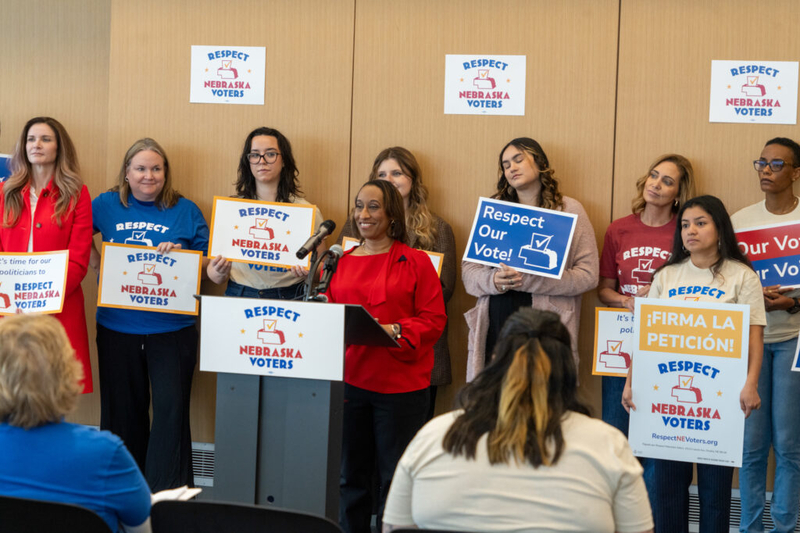
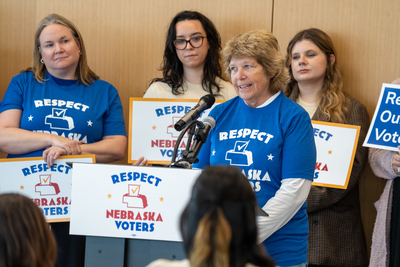
Advocates for a proposed amendment to the Nebraska Constitution hope to make it harder for legislators to tweak ballot measures approved by voters. Advocates, including ballot co-sponsor Jo Giles at podium, host a launch event in Omaha. Jan. 5, 2026. (Zach Wendling/Nebraska Examiner)
OMAHA — Advocates seeking an amendment to the Nebraska Constitution to “protect” and make it harder to tweak citizen-initiated laws, such as those around payday lending, gambling, minimum wage, paid sick leave and medical cannabis, will start gathering signatures this week for the 2026 ballot.
Proponents see the changes as necessary in light of recent legislative action or inaction on voter-backed laws. But some advocates of recent ballot measures and a few state senators said they worry about unintended consequences.
The new group, “Respect Nebraska Voters,” kicked off its 2026 campaign this week in Omaha. If successful, the effort would increase the threshold of lawmakers required to change voter-approved laws from 33 state senators (two-thirds) to 40 (four-fifths).
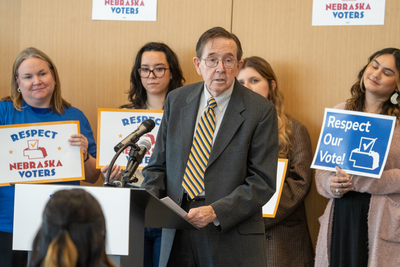
Nebraska’s officially nonpartisan one-house Legislature has 49 state lawmakers.
Former State Sen. Al Davis, a Sandhills rancher, helped lead a 2020 measure to cap payday lending rates. It passed with about 83% of the vote. He is now a co-sponsor of Respect Nebraska Voters and said the push could be important for the future of ballot measures.
“I fear we’re now in the unfortunate place where many everyday Nebraskans are left wondering if initiatives matter at all, or if lawmakers will simply reach for the eraser after every election,” Davis said. “I believe we can restore trust and do better by putting more power in voters’ hands.”
Petition specifics
If successful, the higher threshold for changes would apply to any ballot-passed laws approved since 2004 or beyond.
In 2004, voters set a threshold to tweak voter-enacted laws at 33 for any changes, no matter the magnitude, rather than 25 (a simple majority). The ballot measure passed with 55% of the vote. Thirty-three votes is the same threshold to shut off debate on contentious issues.
Constitutional amendments, which can’t be changed by the Legislature without a statewide vote, would largely remain unaffected. That includes a 2024 ballot measure banning most abortions after 12 weeks. Petitioners seeking constitutional amendments must secure more signatures than efforts around state statutes.
Attorneys with Respect Nebraska Voters confirmed the Legislature, under that amendment, could further restrict abortion with 25 or 33 votes, regardless of whether the 40-vote threshold is approved.
‘Didn’t come out of nowhere’
Dawn Essink, another sponsor of Respect Nebraska Voters and a previous volunteer for the minimum wage and paid sick leave campaigns in 2022 and 2024, said the effort “didn’t come out of nowhere.” She pointed to 2025 legislation to weaken both laws she fought for.
“They think Nebraskans don’t understand,” Essink said of senators. “They have said that we didn’t really know what we were voting for, or, even better, that the ballot language was confusing. That says a lot about what they think of the people they’re supposed to be representing.”
Under the group’s proposal, only legislation to facilitate and “safeguard” voter-enacted laws, and which “advance a compelling state interest by the least restrictive means,” could be passed by the Legislature after a successful ballot measure. That could set up new legal challenges.
The effort also constitutionally seeks to prevent the Legislature from making ballot measures tougher to run with new state laws. It would not address constitutional requirements for signature gathering.
“Such laws may include neutral, ministerial and administrative laws necessary to facilitate the fair, orderly and efficient administration of these powers, but no law shall be valid that conditions, restricts, burdens or otherwise impairs the exercise of these powers,” the proposed constitutional amendment states.
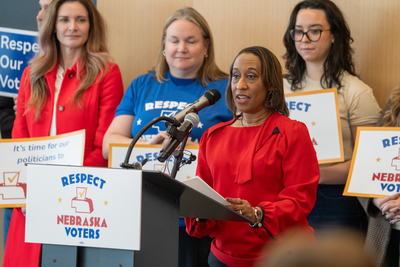
Jo Giles, executive director of the Women’s Fund of Omaha and the third of the group’s sponsors, said the effort is needed to protect Nebraskans’ rights to decide for themselves. Giles was one of the ballot sponsors for the paid sick leave campaign in 2024, which would have guaranteed paid sick leave for all workers beginning Oct. 1, 2025, until lawmakers stepped in.
Raising the threshold, Giles said, is a “common-sense safeguard that will ensure elected officials respect the will of voters.”
“The bottom line is simple: Nebraskans know what’s best for our communities. We make thoughtful decisions at the ballot box,” Giles said. “This amendment will ensure those decisions are respected.”
‘Responsible implementation’
Shelley Gillen, a medical cannabis advocate for more than a decade with Nebraska Families 4 Medical Cannabis, said she worries the effort could instead lock in legislative gridlock on complex issues. She helped the successful 2024 push to legalize and regulate the medicine.
She said when voters are unhappy, the answer isn’t to “freeze” policy or create additional barriers that could slow progress for patients and voters.
“We believe in respecting voters, but respecting voters also means ensuring their decisions can actually be implemented,” Gillen said. “On issues like medical cannabis, this amendment would make responsible implementation and necessary adjustments far more difficult.”
State Sen. Beau Ballard of Lincoln had worked with paid sick leave supporters and some businesses for “minor adjustments” in 2025. A spokesperson for the paid sick leave campaign said the group was “not concerned with” Ballard’s original proposal.
Broader changes from State Sen. Paul Strommen of Sidney that he said were needed to make the law “workable” later merged with Ballard’s bill. The package passed 33-16 and ultimately helped spur Respect Nebraska Voters.
‘Double-edged sword’
State Sen. Ben Hansen of Blair continues to work with medical cannabis advocates to try to aid implementation of the 2024 laws. A 2025 bill fell short 23-22, well short of the current 33-vote threshold.
In 2026, Hansen said he’s still working to get to 33 for some tweaks, such as ensuring the voter-created Nebraska Medical Cannabis Commission has a proper rollout and doesn’t further hinder Nebraskans’ ability to get medicine. Hansen’s 2025 efforts faced stiff opposition from Nebraska Attorney General Mike Hilgers and U.S. Sen. Pete Ricketts, R-Neb., among others.
“It’d be hard enough to get 33 people to vote for it, let alone 40,” Hansen said of medical cannabis proposals. “It’s kind of a little bit of a double-edged sword.”
Giles, asked specifically about medical cannabis, said she and other coalition members feel similar frustration over medical cannabis implementation and hope legislators act.
“We know that elected officials can do the right thing at any time, and so we hope, for them, that there is an easier process to upholding the will of voters,” Giles said.
80% threshold for voters?
State Sen. Kathleen Kauth of Omaha, chair of the Legislature’s Business and Labor Committee, which forwarded the proposed changes to the minimum wage and paid sick leave initiatives to the full Legislature in 2025, said lawmakers are watching the Respect Nebraska Voters campaign.
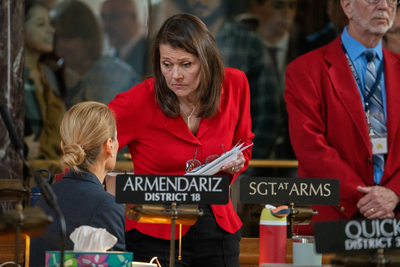
If an 80% threshold is good for lawmakers, Kauth wondered Tuesday whether lawmakers should require ballot measures to pass with at least 80% of the vote, too.
Since 2004, just one ballot measure exceeded 80%. That was in 2020, to cap payday lending costs.
A ‘single subject’
Legalized gambling advocate Lance Morgan, the president and CEO of Ho-Chuck, Inc., the economic development wing of the Winnebago Tribe, said he also had concerns about the Respect Nebraska Voters effort.
Morgan’s company helped fund 2020 ballot measures to authorize casino gambling and games of chance. He said it was one of the most economically impactful ballot measures for the state, but there was room for tweaks.
Changes to voter-approved laws might also be necessary with the Nebraska Constitution’s requirement that ballot measures, as well as legislative bills, can only deal with a “single subject,” Morgan said.
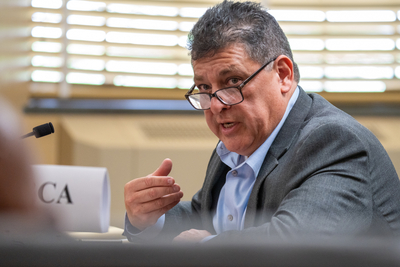
In 2020, there were three gambling measures on the ballot — one constitutional amendment and two state laws — and the Nebraska Supreme Court invalidated a medical cannabis constitutional amendment on “single-subject” grounds.
The justices have given greater deference in defining a “single subject” with legislation than with initiatives.
As a result, ballot measures are often broader than legislative bills likely would be, absent the legislative negotiations and compromises and facing an up-or-down statewide vote at the ballot.
“I think that, given the situation in Nebraska, the fact that you have a really hard single-question rule, you’re going to need to have some sort of flexibility built into the system,” Morgan said Monday. “Or you’ll have trouble actually implementing what you want to do.”
State Sens. Eliot Bostar, Jason Prokop and Stan Clouse pushed for the Legislature to act in 2025 on sports betting for a narrower bill, and earlier legislative proposals for paid sick leave and medical cannabis that stalled were similarly narrow at first.
If the Legislature doesn’t act in the next few months, Morgan said he and supporters of legalizing online sports betting will pursue the 2026 ballot.
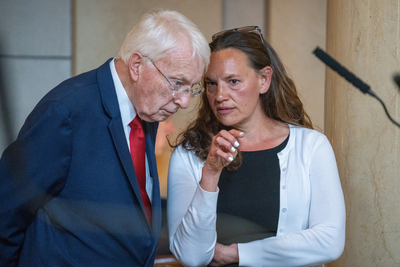
Morgan said the Respect Nebraska Voters effort might be a “step too far” and acknowledged making tweaks “shouldn’t be easy, but it shouldn’t be impossible, either.”
State Sen. Danielle Conrad of Lincoln told 10/11 News in December she’s unsure whether Respect Nebraska Voters could be targeted over the single-subject clause. Giles had said she thinks the group is OK, as the focus is on increasing the vote threshold for ballot initiatives.
Referendums, legislative operations
Conrad had also said an existing “remedy” is a referendum campaign or voting out lawmakers. She told 10/11 she worries Respect Nebraska Voters could make it harder to fix technical flaws or address implementation, or spur competing initiatives.
Paid Sick Leave for Nebraskans, for example, elected not to pursue a referendum in 2025.
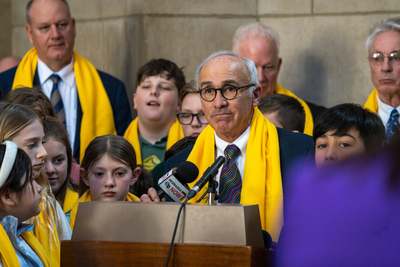
The Respect Nebraska Voters changes would not prevent lawmakers from reinstating measures that voters repealed in referendum campaigns. Voters have reversed three legislatively passed laws since 2004: bills to dissolve Class I schools (2006), end the death penalty (2016) and set aside tax dollars for private school costs (2024).
Hansen said he wonders about a “slippery slope” in ballot measures dictating legislative operations, such as moves to prohibit secret ballots for legislative leadership or change the threshold needed to pass contentious legislation over minority opposition.
‘Unexpected consequences’
Davis, a one-term senator from Hyannis, said a legislator’s job is to write laws, though he said there are “rare circumstances” where it might be appropriate to amend past voter-enacted laws.
“But only after seeing them take effect and noticing unexpected consequences,” Davis said.
Giles and supporters estimated the changes under the Ballard-Strommen bill removed voter-approved paid sick leave protections for roughly 140,000 workers, including 14 and 15 year olds, workers in businesses with fewer than 10 employees and temporary or seasonal agricultural workers.
Employers can still choose to offer paid sick leave to those employees.
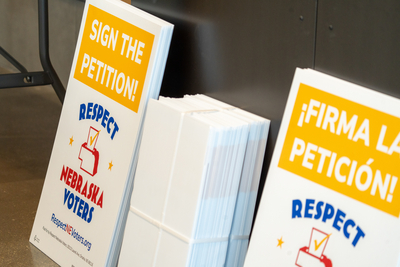
Giles said it’s “pretty clear” there was not a compelling interest in a bill that “gutted” earned time off.
Asked whether the 40-vote threshold was a risk worth taking, as it would require another ballot measure or 40 votes to expand paid sick leave, Giles said, “I don’t think it’s a sacrifice. I think it is respecting the will of the people.”
Giles and Essink said opponents of the 2024 paid sick leave campaign didn’t fund an opposition campaign, and the measure passed with 75% support among voters. Giles said business and “special” interests then went to “friends” in the Legislature to fight.
Minimum wage and campaign finance
Giles acknowledged the group’s effort would likely increase campaign spending on the front end, a prospect that worries State Sen. Jane Raybould of Lincoln.
Raybould, a former grocery store executive now in her 16th and final year of public service, is lead sponsor of a bill to cap annual increases to the minimum wage, changing what voters approved and set to begin next year and aimed at matching increases in the cost of living. Raybould’s bill would instead lock in minimum wage bumps at 1.75%, smaller than average inflation in recent years, though a guaranteed increase, saying it would make the increases easier for businesses to handle.
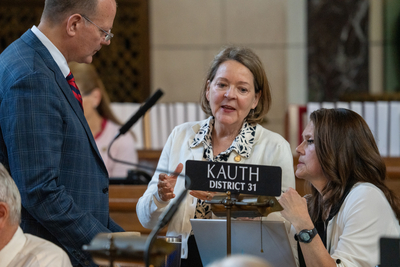
The bill remains one vote away from passing and, if it maintains its supporters, would have 33 votes to pass in 2026. She described her bill as having an “incredibly compelling economic impact.”
Speaking with the Examiner on Monday, Raybould said she worries the new ballot initiative “ties the hands of the Legislature,” which works with voters who are often described as Nebraska’s “second house.”
“I thought we were a co-equal branch of government,” Raybould said, “working together, collaboratively and cooperatively, for the benefit of the majority of our fellow Nebraskans.”
Raybould said no senator disrespects the “will of our voters,” whose choices at the ballot box also empower Nebraska’s 49 senators to govern. She worried about future harmful ballot measures lawmakers might have a harder time counteracting, if needed.
‘Proteger nuestra libertad de votar’
Lu Turco, a current junior at Millard North High School, asked voters Monday to get out and help young workers through Respect Nebraska Voters, teens he said are “first” on lawmakers’ list to roll back pay. Raybould’s minimum wage bill would create a “youth training wage” for workers aged 14 or 15.
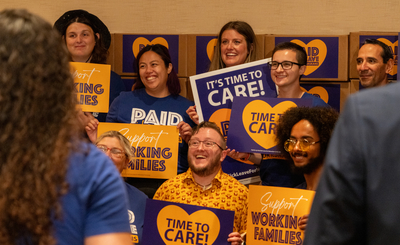
Turco said the ballot measure could make a difference for the next generation.
“Labor is labor, regardless of who is doing it,” he said. “Unfairly undercutting young workers is harmful, especially after voters made it clear that they wanted these rights and wages for everyone.”
Perla Ochoa, a South Omaha community organizer with Heartland Workers Center, said Tuesday: “Estar recolectando firmas para proteger nuestra libertad de votar sobre los temas que afectan a nuestras comunidades. Esto se trata de proteger los derechos y los salarios de los trabajadores y mucho más.”
It means, “We are collecting signatures to protect our freedom to vote on the issues that affect our communities. This is about protecting workers’ rights and wages, and much more.”
Other supporters of the campaign include the Nebraska State AFL-CIO, League of Women Voters of Nebraska, Nebraska Appleseed, Civic Nebraska, Voices for Children in Nebraska, Nebraska Civic Engagement Table and Second House Collaborative.
Respect Nebraska Voters would need valid signatures from 10% of registered voters by July 2, or at least 125,000. The signatures must include at least 5% of registered voters in 38 of Nebraska’s 93 counties.
Asked why the 40-vote threshold plus additional constitutional language is the solution, Giles said it’s already a “huge lift” to reach the ballot.
“It should also be a huge lift for lawmakers to undo the will of voters.”

Reaching the ballot in Nebraska
Nebraska has two types of statewide ballot measures: initiatives and referendums. Initiatives create or amend state laws and constitutional amendments, while referendums repeal all or part of recently passed state laws. Both types are voted on during general elections in November.
Signatures for initiatives are due four months before the election, while signatures for referendums must be gathered within 90 days of the end of a legislative session in which a targeted law was passed.
Minimum signature thresholds are different for referendums and initiatives:
- To repeal state laws: 5% of registered voters (if 10% or more, the law is suspended until the election).
- To amend or create state laws: 7% of registered voters.
- To amend or create state constitutional provisions: 10% of registered voters.
All ballot measures also require geographic distribution of gathered signatures, from 5% of registered voters in 38 of Nebraska’s 93 counties, in addition to the bulk requirement.
As of Jan. 1, there were 1.25 million registered voters in Nebraska. The total signatures needed are calculated when signatures are due. That’s July 2 for 2026 initiatives, for state laws or constitutional amendments.
Source: Nebraska Constitution; Nebraska Secretary of State’s Office
Lincoln, NE