Republicans created Missouri’s redistricting mess. Now they’re furious about it.
Sep 07, 2026 | 6:50 am ET
Description
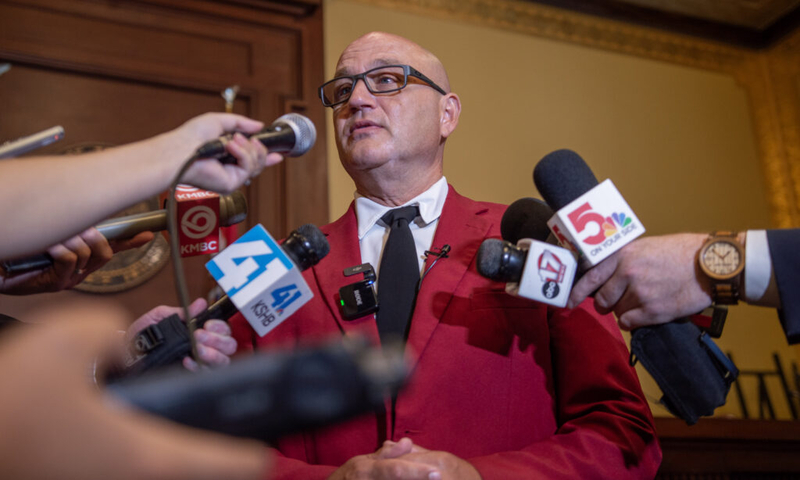
Missouri Secretary of State Denny Hoskins speaks to reporters following Missouri Supreme Court arguments Sept. 2 (Annelise Hanshaw/MissouriIndependent).
Attorney General Catherine Hanaway opened her response to Thursday’s Missouri Supreme Court decision with a quote from Benjamin Franklin
“A republic, if you can keep it.”
Things went downhill from there.
Hanaway declared Missouri to be in a “full-fledged constitutional crisis,” accused the court of disenfranchising every voter in the state and promised an immediate appeal to the U.S. Supreme Court.
Secretary of State Denny Hoskins joined in the revolutionary rhetoric (ironic for a guy whose trademark is a red coat), declaring: “We may have lost the battle today, but the war to preserve our constitutional republic is far from over.”
Constitutional crisis may be a little hyperbolic. But Missouri unquestionably has a mess on its hands.
We held a congressional primary last month using gerrymandered districts drawn by Republican lawmakers in 2025. The state Supreme Court now says those districts never legally took effect because enough signatures were gathered to hold a referendum. Come November, unless the U.S. Supreme Court intervenes, Missouri will return to the congressional map used in 2024.
Candidates who spent months campaigning in one set of districts will finish the election in another.
But before we start shopping for powdered wigs and declaring the republic lost, it is worth asking a simpler question: How did we get here?
The answer isn’t especially flattering to the GOP officials expressing the most alarm.
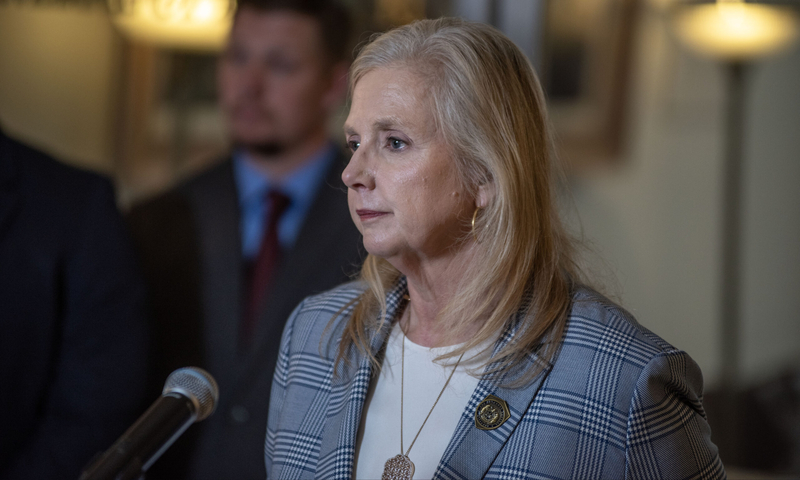
Hoskins declared the referendum insufficient on Aug. 4, arguing Missouri voters had no constitutional right to force a vote on congressional redistricting. He made the same argument in federal court in December.
Eight months earlier.
Opponents of the new map had already turned in more than 300,000 signatures in December. And a federal judge pointed directly at the problem now being described as a constitutional emergency: If the referendum qualified, the new congressional map could be frozen and the 2026 election disrupted.
Hoskins had authority to rule the petition insufficient once it was filed. If no number of signatures could make the referendum legal, there was nothing left to wait for. The constitutional argument was sitting right there. The same federal judge said as much, noting there was “no apparent reason” for Hoskins to incur the significant cost of signature verification given his stated belief that the petition was constitutionally deficient.
Hoskins waited.
In May, the Missouri Supreme Court again made clear that nobody could know which congressional map was actually in force until Hoskins made his decision and the courts reviewed it.
Hoskins waited some more.
His office sent hundreds of thousands of petition signatures to local election officials for verification. He asked them to check every one — rather than use the random sample state law allows — pushing the verification deadline from February to the end of July. The state proceeded toward the August primary using the new map.
Then, around 4 p.m. on Aug. 4, roughly an hour before his legal deadline expired and while voters were casting ballots in the primary, Hoskins finally declared the referendum unconstitutional.
Nothing had changed. Hoskins acted on the same legal theory the state had been advancing since December.
And on Thursday, the Missouri Supreme Court called him on it.
The judges, all but two of whom were appointed by Republican governors, unanimously ruled that Missouri’s Constitution gives citizens the power to refer “any act of the General Assembly” to voters unless the constitution expressly says otherwise. Congressional redistricting is an act of the General Assembly. There is no exception for it.
And when Hoskins complained about the confusion, cost and logistical difficulty of changing maps after the primary, the court was notably unmoved.
Those arguments were “particularly misplaced,” Judge Ginger Gooch wrote, because “the secretary’s delay created the confusion, expense and practical difficulties of which he complains.”
For what it’s worth, Gooch was Hanaway’s law partner at Husch Blackwell before joining the bench in 2022.
It boils down to this: Missouri officials knew in December that the legality of this referendum could determine which congressional map would govern the 2026 election.
Hoskins had eight months to make his call. The state had eight months to press the legal argument it had already chosen. They waited. Now they are complaining about the consequences of their own delay.
Jefferson City, MO