Report highlights benefits of Maine’s free community college program
Oct 05, 2023 | 4:51 am ET
Description
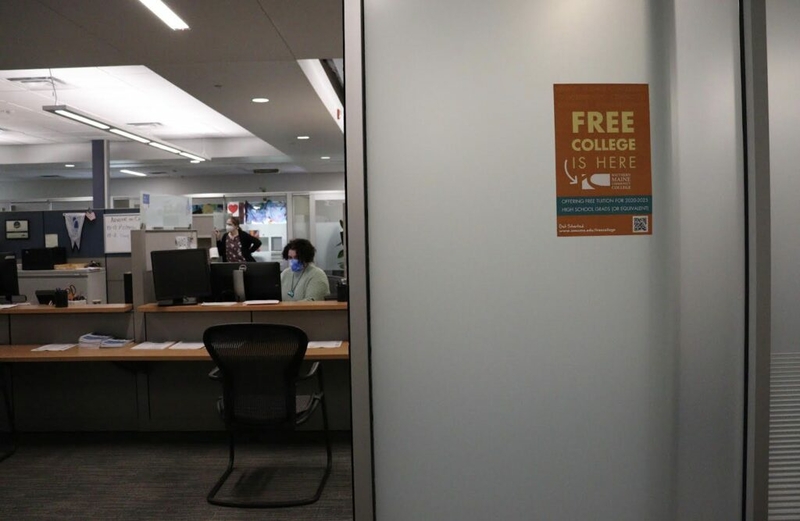
Southern Maine Community College is one of seven colleges in the state that students can attend for free through the scholarship. (Emma Davis/Maine Morning Star)
When Alex Morin found out about the animal care and management degree at York County Community College in Wells, Morin studied the syllabus, digging into each class and the career opportunities projected to follow.
“I know the kind of genre of what I want to do, but I don’t know exactly,” Morin said of their career plans. The degree will allow Morin, who lives in Kennebunk and graduated high school in 2023, to figure out where within the scope of working with animals they want to land — and Maine’s free college scholarship will cover the cost.
According to the first report on the free college scholarship, sent to Gov. Janet Mills and the Joint Standing Committee on Education and Cultural Affairs this week, Morin is joining a larger trend of students opting for community college. The Maine Community College system, which authored the study, reported increased overall enrollment the past couple of years, though some student groups have grown more than others.
The free community college program was first announced by Mills in February 2022 to boost enrollment after the COVID-19 pandemic and applied to high school graduates from 2020 to 2023. The state budget signed in July continued scholarship funding for graduates in 2024 and 2025.
While low-income students saw boosted enrollment in the program’s first year, enrollment increased more so among middle-income students who otherwise would not have had tuition covered by financial aid. Also, MCCS classes typically have more students who identify as female than male, but the split became closer to 50/50 during the first free college year. There were also higher fall-to-spring retention rates for those with the free college scholarship compared to those without, although year-to-year retention has yet to be analyzed.
While free college was nixed on the national stage, it’s been growing on the state level, particularly for community colleges but also some four-year universities. Now, more than half of states offer some form of free community college. With initial findings pointing to boosted enrollment, Maine community college leaders say they intend to push for the scholarship to continue.
Preliminary findings show boosted enrollment
After large enrollment declines in the wake of the pandemic, national community college enrollment grew slightly overall in the spring of 2023, up .5% from the previous spring — but to a much lesser extent than Maine’s system. In 2022-23, MCCS saw enrollment increase by 12%, and early fall enrollment this year was up 18%, with an increase of 2,233 students to make enrollment 14,449 across the system. Enrollment remains slightly below pre-pandemic levels.
The report cautions that it’s not possible to say whether the free program is the direct cause of the enrollment increase. Maine’s colleges eased pandemic-era restrictions — such as reauthorizing roommates in certain dorm rooms — around the same time free college began. MCCS also expanded the capacity of its nursing program by 200 spots last year and added other new aid programs, including awarding 723 new scholarships for short-term workforce graduates who subsequently enroll in degree and certificate programs.
However, MCCS president David Daigler pointed to the system’s high enrollment rates compared to national data as an indicator that free college is a major factor in the increasing number of students.
MCCS has among the lowest tuition in New England, averaging $3,700 a year for an associate degree. Students eligible for a federal Pell Grant, a form of need-based financial aid, could get most if not all tuition and mandatory fees covered before the free college scholarship (that is assuming students are aware of and complete the aid application). Students whose families make too much to qualify for a Pell Grant, but are living just within their means, may not have thought of college as an option, said Southern Maine Community College interim president Tiffanie Bentley.
“The group of people that free college really opens up the world of college education to is the people who are just above that threshold,” Bentley explained.
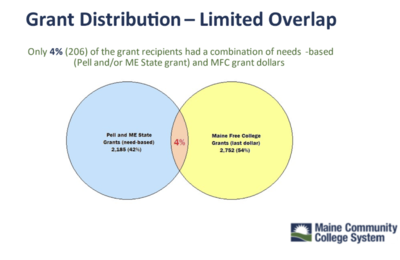
Findings from the initial report show that the free college scholarship funds covered most recipients’ full tuition and mandatory fees, indicating most did not otherwise qualify for need-based aid. Only 4% of recipients were eligible for both the scholarship and need-based aid.
Free college also appears to be leveling the gender gap in college attendance. Young women are more likely than young men to be enrolled in college in the U.S., which has typically been the case at MCCS, too. The split in the free college population has become more even, with 51% female and 48% male enrollment, compared to all degree seeking students from the first free college year, with just over 58% female and 41% male students.
The program also seemed to open up the possibility of an advanced degree for many students who graduated during the height of the pandemic. According to National Student Clearinghouse data, 749 free college students from the classes of 2020 and 2021 had never attended college before enrolling at a Maine community college in Fall 2022.
“It’s bringing out students who just didn’t think that college was their thing,” Daigler said.
National research shows free college programs are associated with large enrollment increases of first-time students, with the largest increases in enrollment among Black, Hispanic and female students. Maine has not seen any significant changes in the race of students enrolled since the scholarship, although MCCS has historically had a more diverse student body than the state as a whole.
How does ‘free college’ work?

When Morin thinks about college, they immediately consider the price tag. Morin has seen peers shell out money for universities only to switch career paths and lose non-transferrable credits. Having entered adulthood after high school during the COVID-19 pandemic, the state of the economy is also top of mind for Morin.
Cost is consistently cited as the biggest barrier to enrollment for many prospective college students.
Maine’s Free College Scholarship covers 100% of tuition and mandatory fees at any of the seven community colleges across the state. When it began in 2022, the state allocated $20 million for high school graduates of the classes of 2020 through 2023.
During the first academic year the scholarship was available, MCCS used $10.2 million for scholarships and distributed another $1 million among its seven colleges to hire additional advisors. MCCS has again committed $1 million to retain advisors during the current academic year and will continue to reevaluate on an annual basis, said Noel Gallagher, MCCS director of communications and public affairs.
Maine’s scholarship only requires a high school diploma or equivalent degree, making it more generous than some other free college models that require benchmarks, such as a certain GPA, for qualification, said Taylor Odle, assistant professor of educational policy studies at the University of Wisconsin-Madison, who studies free college and admissions barriers nationally.
Maine’s scholarship is what is referred to as a “last dollar” scholarship. It covers tuition and fees, but only after other federal and state grants have been applied. Some free college programs use a first dollar model, where tuition and fees are wiped out right away and any additional aid can be put toward the cost of books, transportation and expenses not covered by the scholarship.
Last-dollar scholarships such as Maine’s are generally more cost effective for the system, Odle said.
“It’s financially cheap for states because they’re basically leveraging all these other existing dollars and they’re only paying for students who don’t have these other scholarships or grants, whether they’re need-based or merit-based,” Odle said. “But that also means at the same time that students aren’t able to benefit from getting other dollars potentially in excess of what would be charged.”
The report states that the last-dollar model in Maine was used to stretch the state’s allocation over a long period of time. During the first scholarship year, free college students collected more in federal Pell Grants ($11.4 million) than in free college scholarship money ($10.2 million). Free college students also collected $4.9 million in state grants.
It's bringing out students who just didn't think that college was their thing.
Janet Sortor, vice president and chief academic officer for MCCS, said requiring students fill out the Free Application for Federal Student Aid (known as FAFSA) in order to qualify for free college was an important part of the initiative. When students hear “free,” they now think they can afford college, but “maybe they could have all the time, because they could get a Pell Grant,” Sortor said.
Students who graduated from high schools outside of Maine are also eligible, as long as they are living in Maine when enrolled in college. The report shows 95% of free college students were from Maine during the first scholarship year, comparable to its non-free college population.
While students initially had to be enrolled full time to be eligible, they can now be enrolled part time — a change Daigler said was made after advisors voiced concern about some students struggling with full-time enrollment and fearing losing the scholarship if they needed to drop a class.
Students now have to graduate within 200% of completion time, meaning two years for a certificate and four years for an associate degree. The time elapsed between high school graduation and enrollment was also expanded to two years, which has provided Morin the wiggle room they needed.
“I was initially pretty worried about it,” Morin said of taking off a semester before enrolling in York County Community College. Morin recently returned from a trip to visit their stepfather in Liverpool, England, and has had the breathing room to find the best post-graduation option for their current needs and future goals.
“Not everybody’s journey is linear,” Morin said.
Beyond community college
While Maine’s community colleges have seen increased enrollment, the University of Maine System has seen decreases, which some blame, at least in part, on free college.
Studies of free college programs in other states have raised concern about “undermatching,” when a student who chooses a two-year school has the academic credentials to access a more selective four-year institution, which data shows typically have more resources and higher completion rates.
In 2015, MCCS established a block transfer agreement with the UMaine System to guarantee credits would transfer to its 15 public institutions. This year, MCCS is in the process of ensuring its programming fits the New England Board of Higher Education New England Transfer Guarantee program to broaden the number of four-year institutions community college graduates can access.
“We do anticipate more transfer opportunities,” Daigler said, “but when you look at the numbers around that, recognize that the vast majority of our program is built around the occupations.”
Maine’s community colleges were not built as transfer institutions, Daigler said. The system began with the founding of the Maine Vocational Technical Institute in Augusta, originally established to help veterans returning from World War II prepare for reentry into the workforce.
Morin, for example, is interested in York County Community College specifically for its occupational skill building and doesn’t intend to transfer. But with free college, Morin does not have to bet their savings on sticking to that decision.
“I don’t have to feel like I need to worry about pushing myself to do a specific thing,” Morin said. “It’ll also let me see all my options.”
Augusta, ME