Red snapper fish fight highlights Florida governor’s disdain for science
May 28, 2026 | 12:05 am ET
Description
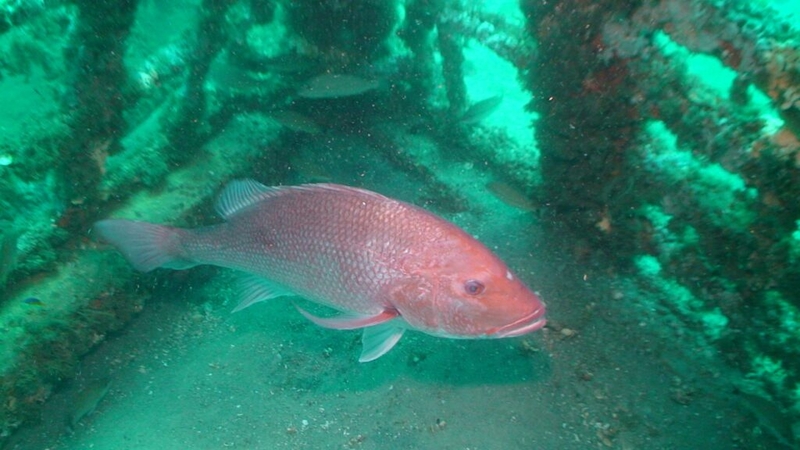
The red snapper is a popular fish to catch, but Florida's attempt to get an exemption that allows recreational anglers to reel them in for 39 days ran afoul of a federal judge. (Photo via FWC)
One of the great joys of living in Florida is our access to fresh seafood — shrimp, scallops, grouper, you name it. I grilled some on Memorial Day and it was delicious!
The source of all this bounty, the sea, may look like a limitless expanse, but it’s not. We have to be careful about taking too many fish from the ocean. Otherwise, we won’t have enough for our future, much less that of our children.
This is why there’s a large-scale fish fight going on in Florida right now. It involves commercial fishermen, recreational anglers, lawyers, charter boat captains, seafood dealers, politicians, scientists, environmental activists, restaurants — and it’s all over red snapper.
The Palm Beach Post had a story on it last week with a headline so wild that it made me holler, “Holy mackerel!” — “Florida red snapper season erupts into chaos as judge blocks permits.”
Fasten your seatbelts, kids, we’re in for a bumpy boat ride! Here’s the first paragraph:
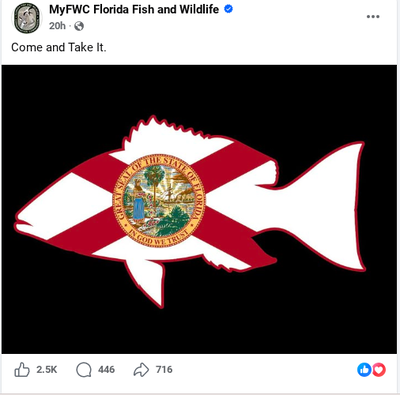
“Florida’s Atlantic red snapper season was thrown into disarray on opening day after a federal judge stalled special permits and the state rebelled, calling him ‘rogue’ and posting a teasing message on social media with a red snapper and the statement ‘Come and take it.’”
Since the snapper is red, I had to double check whether the state called the judge “rouge” or “rogue.” When I made a deep dive into the case, I got hooked. Here’s what’s going on:
There are rules, based on science, for how much red snapper can be caught during the season. Nobody is fighting over that. Instead, the fight is over exemptions from the rules — loopholes, in other words.
The exemptions would benefit recreational anglers from Florida and three other states, allowing those recreational anglers to catch a lot more fish and to do so on a lot more days.

Commercial fishermen and environmental activists objected. An organization that represents commercial fisherman, seafood dealers, and seafood restaurants sued. A federal judge named Rudoph Contreras listened to the legal arguments, then slapped a temporary freeze on the exemptions.
And where did those exemptions come from? Take a wild guess.

“It’s all about politics,” said Capt. Bob Zales, executive director of the Southeastern Fisheries Association in Panama City, which represents nearly all of the domestic seafood industry in Florida. “The governor went out and stuck out his chest and told all the recreational fishermen that he was going to provide a recreational red snapper season for the Florida East Coast.”
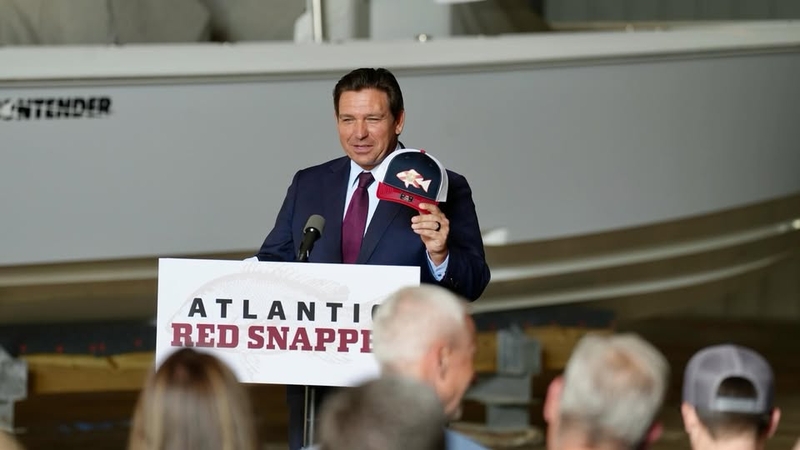
Instead of acknowledging this fine kettle of fish is his fault, Gov. Ron DeSantis blasted the judge for messing up Memorial Day weekend plans for wealthy boaters.
“I just think it’s really disrespectful to try to pull the rug out from under them,” DeSantis said during a Jacksonville news conference, “especially given there’s so many fish in the sea.”
A history of overfishing
Floridians have been catching and enjoying red snapper since at least the 1840s.
If you’ve ever caught and consumed one, you know why. They put up a big fight on the line, but their meat has a mildly sweet flavor and a lean, beautifully flaky texture. That’s why they’ve always been too popular for their own good.
In the 1800s, a big commercial red snapper industry grew up in my hometown, Pensacola. But the boats kept having to go farther and farther into the Gulf of Mexico to find enough to supply the growing demand. By the 1930s, they had to go all the way to the Yucatan to catch enough to make the trip worthwhile.
Mexico objected to all the American anglers taking their snapper. In the 1970s, Mexico prohibited Americans from fishing for snapper in their waters.
By then, Congress was ready to step in and regulate the fisheries in American waters, too. In 1976, it passed the Magnuson-Stevens Fisheries Management Act to prevent overfishing, rebuild depleted populations, and protect habitat.
Magnuson-Stevens governs the actions of the National Marine Fisheries Service. Among other things, the service has to provide Congress with an annual scientific report on the status of American fisheries.
The news has been anything but golden for red snapper.
In the 1990s and early 2000s, overfishing drove the spawning population to just 11% of its historical levels. As a result, federal regulators reduced the length of the seasons as a rebuilding plan. The rebuilding process is set to last through 2044.
Everyone says a smart angler learns to be patient. But some anglers don’t want to wait until 2044 to snag some snapper.
Too young to spawn
The South Atlantic red snapper fishery has been in hot water for a while.
To build the fish population back up, the feds have kept the recreational fishing season in the Atlantic short. Some years, there was no season at all. Last year’s lasted just two days, July 11 and 12.
Recreational anglers kicked up a fuss about that. You could say they made a big splash.
They persuaded the current crop of feds to listen to their woes. The federal officials who lately have been busy stripping legal protections from endangered whales and sea turtles agreed to hand over to a few states the right to claim exemptions from the red snapper rules.
North Carolina, South Carolina, and Georgia anglers would get 62-day fishing seasons. Florida, meanwhile, requested a 39-day season, starting on May 22.
This is more than just a normal exemption, the kind the law allows only rarely for experimental purposes, said environmental groups.

“This is a way to deregulate the fishery,” said Andrea Treece, senior attorney for Earthjustice’s oceans program.
Recreational angler groups contended that the old, stringent regulations were too cautious. After all, they said, anglers have been catching lots of red snapper out in federal waters. Clearly, the population was bouncing back, right?
“They’re starting to come back,” Meredith Moore, director of fish conservation for The Ocean Conservancy, told me. “But a lot of the fish that they’re catching are young fish.”
Too young to spawn, in fact.
Red snapper can live more than 50 years, she explained. Unlike us humans, “their reproduction gets more successful as they get older.”

Moore’s organization used the feds’ own data to see what impact the exemptions would have. The annual catch limit for recreational anglers is 22,797 fish. Last year’s two-day red snapper fishing season in Florida resulted in 24,885 landed fish, which exceeded that limit.
Give Florida anglers 39 days and they’re likely to reel in as many as 485,000 fish, they found. That’s a number that’s sure to spawn a lot of trouble for the species.
All those “fish in the sea” that DeSantis bragged about? Right now, most of them are much too young to produce offspring.
Catch too many and you wipe out the future of the species.
Who’s the rogue?
The judge’s ruling — which makes perfect sense once you understand the threat to the fish population — apparently caught the Florida Fish and Wildlife Conservation Commission off guard.
On its Facebook page, a few minutes before midnight on May 21, the FWC posted a long message that began this way:
“On May 21, 2026, a rogue federal judge sided with activists in an attempt to block Floridians from exercising their right to fish through the recently approved Exempted Fishing Permit (EFP) for Atlantic Red Snapper issued by NOAA Fisheries earlier this month.”
A lot of people who commented on the post pointed out that calling a federal judge “rogue” is not a good look for a Florida state agency that’s not supposed to be political. In other words, the real rogue was the FWC, not the judge.
A few also pointed out that commercial fishermen, seafood dealers, and seafood restaurants are not exactly what people picture when you sneeringly blame all this on “activists.”
But what caught my attention was the mention of Floridians “exercising their right to fish.”
Speaking as someone who wielded a mean cane pole back in my younger days, I stumbled over that phrase. Right to fish? The way I was raised, you had to get permission to drop your line in someone’s pond. You couldn’t claim to have a right to do so.
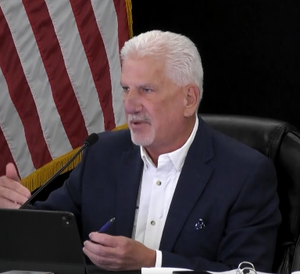
But then I remembered: In 2024, the chairman of the wildlife commission, a developer named Rodney Barreto, helped lead the charge for a strange state constitutional amendment that said hunting and fishing are recognized as “rights” under Florida law.
The measure was sponsored by Sanford state Sen. Jason Brodeur, who’s such a chum to the Florida environment that he won a 2021 award from the Florida Home Builders Association (now THERE’S a bunch of activists). It drew a lot of big-money support, too, far more than the opponents did.
Everything about this amendment seemed kind of fishy, because no one in Florida was calling for a ban on either hunting or fishing. But some people opposed this amendment because it also said that, if passed, hunting and fishing would become the “preferred method” of wildlife management.
Hunting and fishing did not save the bald eagle, the manatee, the alligator, the sea turtle, the Key deer, or the panther. To give those practices preference in wildlife management seemed like a sneaky way to tie the hands of scientists.
The measure passed handily, though, and in short order the FWC was pushing for a new bear hunt. An environmental group called Bear Warriors United filed suit to try to stop it, pointing out that holding a hunt in 2025 ran counter to science. The wildlife commissioners contended they didn’t have to follow science.
This claim that there’s a right to a longer-than-ever recreational fishing season for red snapper seems to be in line with the current anti-science bent of both our wildlife agency and its boss, the most anti-science governor we’ve had in at least a century.
What the governor means
After the ruling, DeSantis went on quite a lengthy rant about it in Jacksonville. As usual, he accidentally told us a lot about himself, not about the situation.
Fortunately, I have my handy DeSantis-to-English translator app.
For instance, he said of the judge who imposed the injunction, “This is a judge in Washington, D.C., probably doesn’t know the first thing about fishing.”
My DeSantis translator app says that means: “I didn’t do my homework and thus have no idea that Judge Contreras is a Cuban-American who grew up in Miami and got his undergraduate degree from Florida State. He may be the most qualified federal judge who doesn’t live in Florida to rule on a Florida case.”
Here’s what the governor said about the origin of this dispute: “I talk to fishermen! I talk to people out there! There’s so many of these fish! Some federal bureaucrat will act like there’s no fish! There’s massive snapper!”
My translator app says he means: “I played golf with some rich campaign contributors who own big boats, and they told me that when they go fishing in the Atlantic, they catch a lot of young red snapper while trying to catch other fish. They don’t want to just throw them back, so they told me to fix it so they can keep them.”
As for how he almost pulled this off, the governor said: “So, we work with the Trump administration to get delegated to us the same authority we’ve been given for red snapper in the Gulf to do that in the Atlantic.”
My translator app says he means, “I think conditions in the Gulf of Mexico are exactly the same as conditions in the Atlantic when they’re as different as Sopchoppy is from Fort Lauderdale. Also, I am ignoring the fact that there are reports that the red snapper population in the Gulf is showing signs of a decline in both size and numbers due to too much recreational fishing, so maybe the state isn’t doing such a great job there either.”
As for the opponents, he said, “You know who brought the charges were the commercial fishermen. They don’t want recreational anglers to be able to go out and fish. They want it all for themselves.”
My translator app says what the governor means is, “Commercial fishermen are just a bunch of blue-collar people who depend on a healthy ocean for their living, and they didn’t give lots of money to my campaign. Therefore, I don’t care about them any more than I care about the science behind these decisions.”
Perhaps when the judge tosses out these “exemptions” as illegal, someone with a similar translator app will provide DeSantis with the real meaning of the ruling: “I didn’t swallow your flimsy arguments hook, line, and sinker. Your FWC’s red snapper management stinks like a truckload of dead fish after three days.”
Tallahassee, FL