Raw sewage intentionally pumped into New Orleans storm drains, records show
Jul 17, 2025 | 6:00 am ET
Description
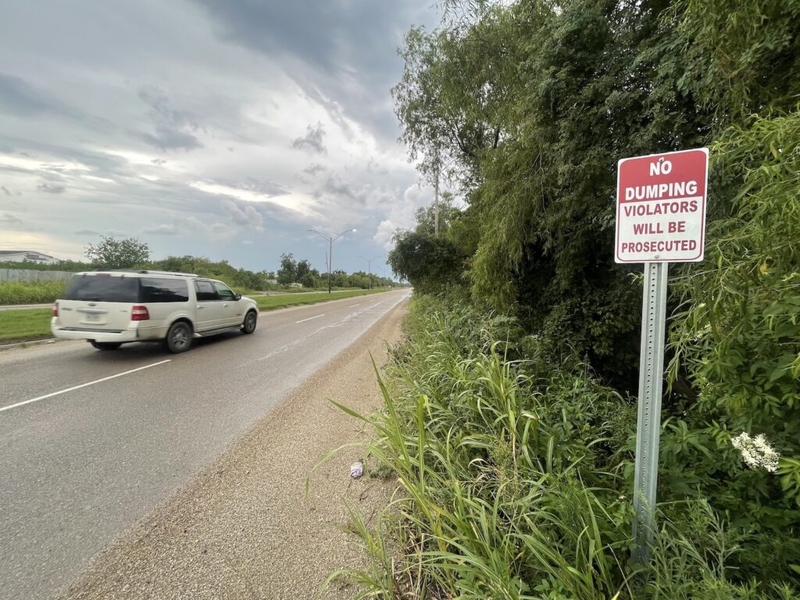
A sign warns against dumping on Almonaster Avenue in New Orleans East near where the Sewage & Water Board intentionally dumped thousands of gallons of raw sewage. (Photo: Greg LaRose/Louisiana Illuminator)
Over several days in May, the Sewerage and Water Board of New Orleans approved the intentional disposal of thousands of gallons of raw sewage into the city’s stormwater drainage system, according to records from state regulators and the local utility.
Documents the Illuminator obtained from the Louisiana Department of Environmental Quality show the agency received an anonymous complaint May 16 from a citizen who reported that SWBNO workers were pumping untreated sewage into ditches on both sides of Almonaster Avenue, in a sparsely populated area on the city’s outskirts. The ditches are meant to carry stormwater runoff — not raw sewage.
“Thousands of gallons of sewage have been dumped in the roadway for the past three days,” the complaint stated. “There are people driving down Almonaster with their windows down … It is a health hazard and a public safety hazard.”
According to LDEQ records and SWBNO maintenance logs, the incident started May 12 after a sewer main broke below the neutral ground in the 11000 block of Almonaster Avenue between Read Boulevard and Paris Road in New Orleans East. The busted pipe flooded the roadway with fecal matter and spread unpleasant “odors in all directions.”
The stormwater drainage system in the area flows to the Gulf Intracoastal Waterway and to Lake Pontchartrain. Raw sewage is supposed to flow to the city’s wastewater treatment plants, where it goes through a multi-stage process to filter and decontaminate it into clean water.
The cleanup of a sewage spill normally calls for vacuum trucks to remove the waste material and bring it to a treatment facility, but records show the SWBNO chose to pump it all into the roadside ditches because an official believed there was simply too much sewage for the vacuum trucks to handle.
When an LDEQ emergency response inspector conducted a site visit on May 21 — five days after the complaint was filed and nine days after the sewer line break — his inspection report indicates he found a crew of SWBNO contractors from CMG Pipelines in a 10-foot deep hole working on the busted pipe. The inspector noted “frothy brown foamy water” in Almonaster Avenue’s north side ditch, but the contractors told him they were hired only to fix the pipe and did not handle cleanup of the sewage spill.
Scientific dispute over using sewage to restore Louisiana’s wetlands turns political
The inspector then called SWBNO Utility Services Manager Peter Brown to ask why untreated sewage was pumped into the ditch.
“Mr. Brown replied that it was too much volume for vacuum trucks to handle,” the LDEQ inspector’s report said.
Most sewer vacuum trucks can hold between 1,000 and 3,000 gallons. The SWBNO has a fleet of those trucks, though it’s unclear how many are in operation. The utility did not respond to a request for comment.
SWBNO’s routine sampling of wastewater at its East Bank treatment plant — about 15 miles from the sewer line break on Almonaster Avenue — detected concentrations of fecal coliform bacteria measuring 1,000 colonies per sample a day after the incident. State regulators consider 200 colonies per sample a safe maximum for recreational waters.
John Day, an environmental scientist at LSU, said raw sewage is teeming with bacteria and contaminants harmful to humans and other living organisms.
“It’s like we’re descending into a third-world state,” Day said when he learned of the incident.
Generally, dumping untreated sewage into a roadside ditch puts people and wildlife at risk of catching diseases, though it’s hard to accurately assess that threat without some scientific analysis, he said.
LDEQ ended its investigation into the incident May 23, and the agency is currently evaluating whether the Sewerage and Water Board will face any consequences for the pollution.
“While the complaint has been closed, this does not mean that the Department will not address the release through appropriate enforcement action if violations are identified during the CEI [Compliance Evaluation Inspection],” said LDEQ spokesman Matthew Day, who is not related to the LSU scientist.
Baton Rouge, LA