Issue spotlight: North Dakota’s US House candidates weigh in on elections, mail-in voting
May 26, 2026 | 6:00 am ET

Description
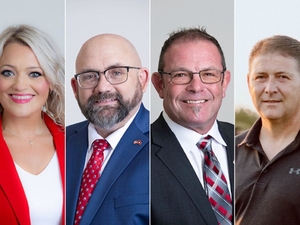
From the left: U.S. Rep Julie Fedorchak, R-N.D., Republican U.S. House candidate Alex Balazs and Democratic-NPL U.S. House candidate Trygve Hammer. (Photos courtesy of the candidates)
North Dakota U.S. House candidates differ on whether noncitizens voting in elections is a significant problem and the potential need for voter registration in the state’s future.
Republican Rep. Julie Fedorchak voted in April in support of the SAVE America Act, a bill that would require photo ID to vote in federal elections and proof of citizenship to register to vote. North Dakota already requires voters to present certain kinds of ID and is exempted from the voter registration requirements included in the bill because the state does not have voter registration.
“The states are responsible for running elections, but the federal government has a role to play in ensuring that American citizens are voting in American elections,” she said.
Passing the bill would improve election integrity in the U.S. and restore faith many people have lost in the election process, she said.
Examples of noncitizens voting are rare and “statistically insignificant” in U.S. elections, according to an analysis conducted by the Fair Elections Center. The study showed noncitizen voting typically occurs between the hundredths to thousandths of a percent in total votes cast in the states examined.
The bill is under consideration in the Senate.
Fedorchak approves of the application process for mail-in ballots in North Dakota, which can verify citizenship and eligibility. She’s also in favor of a recent update to state law that allows only ballots received by the Secretary of State’s Office on or before Election Day to be counted.
Issue spotlight: Where North Dakota US House candidates stand on the Iran war
North Dakota used to accept mail-in ballots that were postmarked the day before Election Day and received up to 13 days later. Lawmakers changed the requirement in the 2025 session to align with an executive order from President Donald Trump. Starting with the June primary, mail-in ballots must be received by the time polls close on Election Day.
“Having weeks on end, or an indefinite period of time, for the mail to come in and count the ballots, that’s not appropriate,” she said. “That could result in some integrity issues, so we need to have those deadlines in place.”
Fedorchak said she has no “big desire” to require voter registration in North Dakota because the system has worked well without it for decades.
When asked if President Trump won the 2020 general election, she said the issue has been exhausted and she wants to move forward.
Balazs open to voter registration without convention process
Republican U.S. House candidate Alex Balazs said he would support implementing voter registration in North Dakota if the state eliminates allowing candidates to access the ballot through a party’s endorsement. Lawmakers defeated a bill making that change in 2025 but it’s already being discussed for possible reintroduction in 2027.
“In our primary, anybody can vote for any party. You don’t have to be registered,” he said. “It’s not actually a good measure of whether conservatives want a certain person, because Democrats can cross the line.”
He also said he wants paper ballots used in North Dakota elections, which the state does. Balazs expressed concerns about public distrust of ballot tabulation machines. He said he does not think there’s a problem with North Dakota’s machines, but he believes unannounced tests of the machines could restore some lost voter confidence.
“We need absolute assurance in what people think of our voting process, not just whether it works or not,” he said.
Balazs said he doesn’t believe hand counting ballots could be completed in a timely manner.
He supports the SAVE Act as a way to earn back voters’ trust and confidence in the nation’s elections. With support from states, he said Congress could pass a national voter ID law like North Dakota’s, along with other measures to ensure election integrity.
“I think we’re on that trend right now,” he said.
When asked if Trump won the 2020 general election, Balazs said he respects the results. He also said the issue is clouded by fraudulent votes that have been found since the 2020 election was certified.
In a months-long investigation of six battleground states for potential voter fraud, The Associated Press found fewer than 475 instances of fraud after contacting more than 300 local election offices. The number of disputed ballots would not have changed the results of the election, the AP found.
Hammer: Elections are secure, SAVE Act meant to reduce voters
Democratic U.S. House candidate Trygve Hammer said mail-in voting, completed on a paper ballot, is as secure as in-person voting.
“It’s secure here, and it’s secure everywhere,” Hammer said. “I think it’s leadership malpractice to be casting all this doubt on the electoral system.”
North Dakota’s election processes are working “perfectly fine,” Hammer said.
On voter registration in North Dakota, Hammer said “let’s not fix what isn’t broken.”
He does not support the SAVE Act. It is not only a voter ID bill, he said, and it would cause confusion and uncertainty during the 2026 election. It would also place administrative burdens on localities without any additional funding, Hammer said, and penalize election officials.
“The idea is to get people unregistered and to have fewer people vote,” he said.
The states run elections, Hammer said, and the only role the federal government should play in those elections is providing the states with the necessary resources to conduct those elections.
When asked if Trump won the 2020 general election, Hammer said, “Yes, full stop. Zero doubt.”
All three candidates said they would trust the results of the 2026 election in North Dakota.
North Dakota Monitor reporter Michael Achterling can be reached at [email protected].
Bismarck, ND