Grand Rapids community demands answers after Guatemalan man dies fleeing attempted ICE stop
Sep 25, 2026 | 6:05 am ET
Description
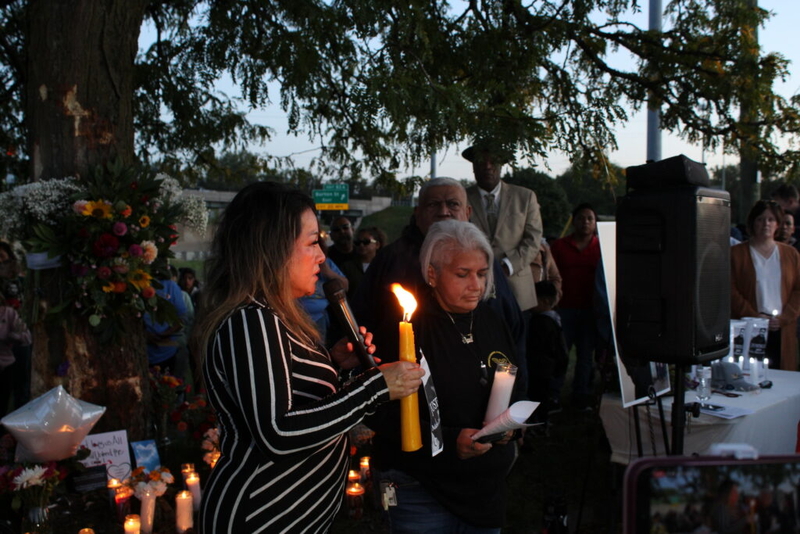
Karla Barberi (left) and Gema Lowe (right) with Movimiento Cosecha GR spoke at a vigil for Mario David Coronado Juárez on Thursday, Sept. 24. (Photo by Emma J Nelson/Michigan Advance)
Dozens gathered in Grand Rapids Thursday to demand justice for Mario David Coronado Juárez, a 35-year-old undocumented immigrant from Guatemala who died days earlier after fleeing when ICE agents attempted to stop his vehicle.
On the morning of Sunday, Sept. 20, ICE agents allegedly attempted a traffic stop on Coronado Juárez. He fled, colliding with a tree near the corner of Century Avenue and McKendrick Street and dying at the scene.
A community-led vigil was held at the tree where Coronado Juárez’s vehicle crashed, and the evening was filled with music and calls for “Justicia para Mario.”
Karla Barberi, a volunteer with Movimiento Cosecha GR, knew Coronado Juárez personally and is advocating on the family’s behalf to have his remains returned to Guatemala.
“We’re humans. We’re not disposable,” Barberi said at the vigil. “To the agents who were involved, I pray that you don’t have a second of peace.”
Barberi said the family of Coronado Juárez was not contacted by the Grand Rapids Police Department about his death until Monday, more than 24 hours after the fatal crash.
The U.S. Department of Homeland Security posted a statement on X Thursday, saying there was no car chase.
“As officers attempted the stop to confirm the identity of the driver, the driver of the vehicle fled at a high rate of speed,” the DHS statement said. “In the interest of public safety, ICE officers immediately discontinued the enforcement action.”
Grand Rapids police say ICE was the first to arrive at the scene. Michigan State Police have been tasked with investigating the incident.
Rep. Hillary Scholten (D-Grand Rapids) sent a letter to acting ICE director David Venturella, requesting information on the federal agency’s involvement in the crash. The letter asks for a written response by Sept. 27, and for all footage of the incident to be preserved.
Scholten was previously criticized for not taking a strong enough stance against ICE’s presence in Grand Rapids, including a joint statement released in August by nine Kent County elected officials.
“As constituents, community leaders and elected officials in Michigan’s Third Congressional District, we reject Congresswoman Scholten’s framing of ICE as a vehicle for public safety in our community,” the statement said.
Movimiento Cosecha GR activist Gema Lowe echoed the sentiment at Coronado Juárez’s vigil.
“She was an immigration lawyer, so she knows exactly what laws need to be changed,” Lowe said.
However, Lowe said federal support isn’t enough when Movimiento Cosecha GR has been struggling to get through to even local politicians.
“The mayor is saying, ‘Oh, ICE is people too,’” Lowe said. “He’s choosing which people he’s on the side of.”
While Grand Rapids Mayor David LaGrand has not publicly said as such, he has not agreed to Movimento Cosecha GR’s demands for Grand Rapids to be made a sanctuary city.
In a statement issued Thursday, LaGrand wrote, “We cannot keep federal agencies out of our city, however they act. But let me be clear: no law enforcement entity that traffics in fear is welcome here. ICE’s national pattern of intimidation, harassment, and killing has to stop.”
“While we don’t know what Mario was thinking and feeling, we know that his death happened in the context of a national effort to create fear among our immigrant neighbors,” LaGrand wrote. “The elevated activities of ICE across our country have been central to this increased fear.”
Viviana Rubio said Scholten’s letter to Venturella isn’t enough.
“The people we put in positions of power should be listening to the community,” Rubio said. “At the end of the day, they’re public servants, and I feel like they forget that a lot.”
Rubio, who attended the vigil Thursday, said she’s been in a constant state of anger since she learned about the crash on Sunday.
“I fear for my family, more than anything,” she said. “I fear for my community. I hate seeing people have the fear of going outside. They’re not doing anything wrong. They’re going to work. They’re going to school.”
Despite being aware of ICE’s presence in the community, Rev. Mwaya Wa Kitavi, the founder of the African Community Fellowship Church in West Michigan, said he hadn’t heard about Coronado Juárez’s death before driving past the vigil Thursday.
“Humanity knows no color,” he said. “Humanity knows no race. When one of us is hurt, we are all of us hurt. And injustice continues when good people see it and do nothing. So by these people, all of us, coming out here, we are making a statement.”
Kitavi added, “[ICE] should not be in the community. For what? We have the police.”
GRPD has previously faced criticism and accusations of cooperating with ICE agents in the past.
GRPD policies state that “Officers may provide assistance to federal immigration authorities when there is an emergency posing an immediate danger to the public safety or to federal agents,” and that “the department may provide available support services, such as traffic control or peacekeeping efforts, upon approval of the Chief of Police or a Deputy Chief of Police” if federal agents request non-emergency assistance.
Activists with GR Rapid Response to ICE, No Detention Centers in Michigan and Movimiento Cosecha GR say this level of support goes against the mayor’s previous assertions that the city is not partnered with ICE.
Lansing, MI