Poll: Whitmer remains popular as Michigan voters worry about inflation, jobs and the economy
May 26, 2026 | 4:00 am ET
Description
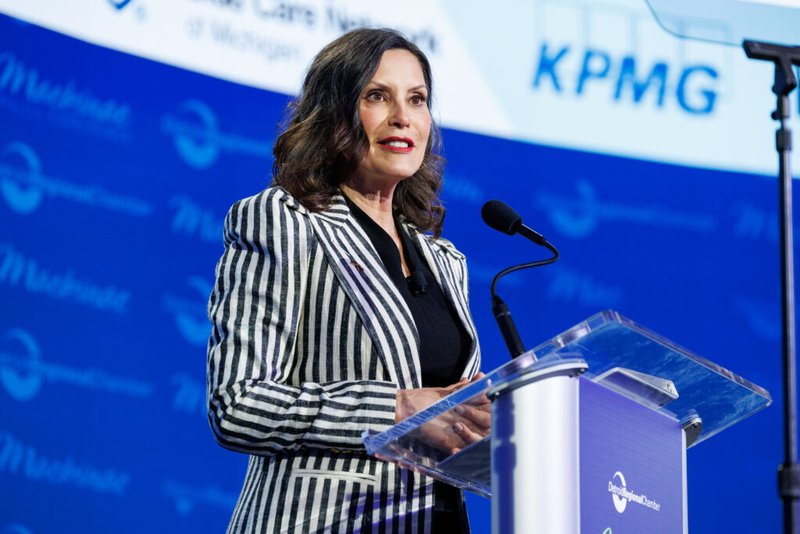
Michigan Gov. Gretchen Whitmer delivers a keynote address during the third day of the Mackinac Policy Conference at the Grand Hotel on Mackinac Island, Mich., on May 29, 2025. (Photo by Andrew Roth/Michigan Advance)
As Gov. Gretchen Whitmer rides a high approval rating in the final months of her administration, several challenges exist for Michigan on the horizon, including the regulation of data centers, voter displeasure with the two-party system, concerns about jobs and runaway inflation.
Those were the findings of a new Detroit Regional Chamber poll conducted by The Glengariff Group, released Tuesday ahead of the organization’s annual Mackinac Policy Conference on Mackinac Island.
Economic fears were most pronounced as the chamber noted that for the first time since January 2025, more people expect a recession within the next year as opposed to a growing economy, with fears of inflation reaching their highest point in any year the chamber has polled ahead of the conference.
Inflation fears climbed to 49%, which is also at its highest point since 2023. Only 46.3% of registered voters say good jobs are available to them — that figure was at 62.7% in May 2024.
Just 48.5% of those surveyed said Michigan is on the right track; 42.5% said Michigan is on the wrong track.
Another 60% of voters now see a weakening economy. That figure is up from 56.8% since February of this year.
Whitmer approval stays strong in final stretch
With that as a backdrop, the poll’s findings were particularly positive for Whitmer, who still hasn’t made her post-gubernatorial plans known. Glengariff polled 600 registered voters between April 28 and May 1 this year, and found that Whitmer’s approval rating is at 52.2% among those surveyed.
Only 39% of voters surveyed disapproved of Whitmer’s job performance as governor in the twilight months of her second term.
Of note, the chamber said that the average net approval rating of governors in their second terms declines by 13 percentage points. Whitmer’s approval rating has increased more than 15 percentage points since the start of her first term.
“As we welcome Gretchen Whitmer for her final appearance at the Mackinac Policy Conference as governor, she is one of the most popular governors in the nation, particularly among those in their second term,” Sandy K. Baruah, president and chief executive officer of the chamber, said in a statement. “Her authenticity, accessibility, and willingness to tackle big challenges in a bipartisan fashion are reflected in her strong popularity and lend a perfect voice to our Conference theme of ‘A Quest for Common Ground.’”
The Morning Consult survey also found that Whitmer ranks fifth-highest in terms of overall approval rating among the current 27 second-term governors across the nation.
From the chamber’s perspective, Whitmer has served Michigan well. Her leadership during the COVID-19 pandemic and her willingness-to-work-with-anyone attitude was laudable, the chamber said, even when that action dismayed her own political party. Democrats were roiled with her new willingness to work with President Donald Trump in his second term rather than openly oppose him as she had during both of their first terms. But that bridge building has been credited with the Selfridge Air National Guard base getting a new F-15EX fighter mission.
Whitmer’s focus on expanding higher education and certifications, with programs like Michigan Reconnect, the Michigan achievement scholarship and Futures for Frontliners, has been considered ground-breaking for the state, the chamber added. The chamber was a partner with Whitmer on each program.

Data center blitz demands strong regulations – or voters won’t support
The chamber’s polling also found 58% Michigan voters see no real connection between their personal electronic device usage and the need for new data centers in the Great Lakes state, and by proxy are demanding that the state take regulatory control over facility proliferation.
If politicians and business leaders want voters to support data centers, the regulatory piece is imperative, the chamber’s poll found. When asked, those surveyed by the chamber said that regulations on data centers are “crucial,” especially if voters are asked to live within 25 miles of a facility.
Three proposed regulations scored above 80% with survey respondents:
- Cost of electricity protections, no rate hikes for other residential or business customers and data center paying for grid upgrades;
- State and local governments should not be allowed to provide additional tax incentives or benefits to attract a data center, and no government official can sign an NDA; and
- Data centers should be required to use a closed-loop water system for cooling.
When the same group of voters were asked if they support data centers in their region, the overwhelming majority said “no.” By a margin of 48.7% to 41.3%, a plurality of voters said they would consider one within 25 miles of their homes if the proposed regulations were in place.
The polling data aligns with much of the opinion seen across Michigan related to data centers, which has become a unique horseshoe issue for both rural and urban residents. Still, some voters see the value of advancing data centers and AI technology. By a margin of 53.3%-35%, Michigan voters believe data centers are important to retaining the automotive industry.

“Michiganders recognize that the future of the automotive industry and AI are intertwined,” Glenn Stevens Jr., executive director of MichAuto and the chief innovation and automotive officer of the chamber, said in a statement. “Michigan’s success requires us to stop polarizing economic policies and work together to embrace the innovation economy.”
From the chamber’s point of view, AI and the need for data storage are only going to increase, and a limited number of hyperscale data centers will end up being built in the U.S.
Michigan must choose, the chamber said, if it will be part of that development or not.
“The reality is that a connected, smart phone, AI-reliant world requires massive data storage capacity, which is driving major investment worldwide,” the chamber said in a news release. “There will be an estimated $6.7 trillion in global investment in data centers by 2030, and 40% of that is expected in the U.S. Proximity to data centers is critical as tech companies look to locate within 150 miles of data centers, which include AI labs, cloud providers, financial services, and health care services. Data centers provide opportunities for local communities to significantly increase tax revenue.”
The two-party duopoly is not faring well
Voters surveyed by the chamber were also asked about the two-party system in the U.S. The overwhelming majority — 68.7% — believe it is no longer serving America well.
There was also bipartisan agreement on the lack of the two-party system’s utility in modern times, and 75.5% of those surveyed said they do not think the Democratic Party has the same values it did 20 years ago. For Republicans, 69.2% said the same.
In February, the chamber’s polling showed that 91% of voters had a large desire for compromise between the parties. The chamber’s February 2025 poll showed that a majority of voters no longer believe that either party is producing the type of candidates who can deliver results.
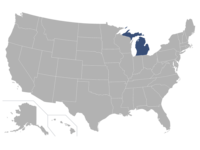
Lansing, MI