Planned Parenthood of Wisconsin files constitutional challenge to state abortion restrictions
Sep 11, 2026 | 4:15 am ET

Description
Planned Parenthood of Wisconsin's Water Street Health Center in Milwaukee. (Photo courtesy of Planned Parenthood of Wisconsin)
Planned Parenthood of Wisconsin is challenging state laws that restrict abortion access, arguing they unconstitutionally infringe on Wisconsinites’ right to “liberty and bodily autonomy.”
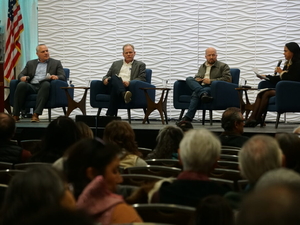
Tanya Atkinson, president and CEO of Planned Parenthood Wisconsin, said during a virtual press conference Thursday that the case seeks to address a “powerful promise” in the state Constitution. The Wisconsin Constitution states that “all people are born equally free and independent and possess inherent rights, including life, liberty, and the pursuit of happiness.” The organization is seeking to establish a constitutional right to abortion with the suit.
The lawsuit was filed Thursday by Planned Parenthood of Wisconsin in Dane County Circuit Court on behalf of its staff and patients against Dane County District Attorney Ismael Ozanne, the state Medical Examining Board and the Board of Nursing.
It challenges two restrictions in Wisconsin law: one that requires that only physicians provide abortion care and one that requires patients to wait 24 hours between a consultation appointment with a physician and an abortion appointment with the same physician.
“In this case, we ask our Court to recognize what we believe that promise means — that our constitutional freedom includes the ability to make deeply personal decisions about our reproductive healthcare without unnecessary government interference,” Atkinson said.
Since Roe v. Wade was overturned by the U.S. Supreme Court, access to abortion has been in flux in Wisconsin. Planned Parenthood first ceased providing abortion services due to an 1849 law interpreted as a near-total abortion ban that was later declared invalid by the state Supreme Court. It again paused abortion services in Wisconsin due to federal changes included in President Donald Trump’s “One Big Beautiful Bill” law, though it has since resumed those services.
“Whether you can receive healthcare shouldn’t depend on what happened in court that morning. It shouldn’t depend on whether your appointment happens to fall before or after the latest political fight,” Atkinson said. “We cannot continue allowing access to essential healthcare to be this fragile, and that’s why today isn’t simply about defending what we have, but about moving forward… There’s an entire generation of young people growing up who have never experienced reproductive freedom that many of us once took for granted. We have an opportunity to change that trajectory.”
This is not the first time Planned Parenthood of Wisconsin has sued to establish a constitutional right to abortion.
It previously sued to establish a constitutional right to abortion in a challenge to the 1849 law. The case was dismissed by the state Supreme Court after it overturned the 1849 law in a different lawsuit on the basis that the law was invalid due to subsequent laws that had been passed to regulate abortion, including the ones now being challenged.
“None of our courts have decided whether or not the Wisconsin Constitution, in fact, protects this fundamental freedom,” Atkinson said. “We believe it does.”
The new lawsuit argues the restrictions unconstitutionally limit access to healthcare.
“Through this case, we are asking Wisconsin courts to recognize that these restrictions conflict with the freedoms and protections guaranteed to each of us under our state’s Constitution, and if we are successful, this will be a generational step forward for reproductive freedom in Wisconsin,” Atkinson said.
There are a handful of state laws that require a physician to provide abortion care including one that says it is a Class I felony for anyone who is not a physician to perform an abortion. Atkinson said there are other healthcare providers who could safely provide abortions including advanced practice nurse practitioners, physician assistants and certified nurse midwives.
The 24-hour waiting period, which requires a delay between a face-to-face consultation with a physician and the induction of an abortion, was implemented in 1996 under a law signed by Gov. Tommy Thompson.
Allison Linton, a board-certified OB-GYN, the Chief Medical Officer of Planned Parenthood of Wisconsin and plaintiff in the lawsuit, said during the press conference that the restrictions may be presented as medically necessary, but they are not and can be a hindrance to patients accessing care. She said she sees patients every week who struggle to make time for two separate trips to the office for care.
“They tell us, ‘I don’t have another sick day. I just started this job. I’m afraid I could lose my job if I ask for more time off. I don’t have someone who can watch my children again. I have to get home,’” Linton said, adding that she has cared this week for patients who traveled from Texas and Michigan’s Upper Peninsula. “These burdens fall especially hard on people who already face barriers to healthcare — people who work hourly jobs, people with limited financial resources, parents who need childcare and patients who have to travel long distances to reach us.”
Planned Parenthood of Wisconsin has three clinics in the state that provide abortion services — in Milwaukee, Madison and Sheboygan. According to the complaint, Planned Parenthood sees patients five days a week at its Madison and Milwaukee centers. However, due to restrictions that require patients to undergo a physical exam and ultrasound, receive information and provide consent, the facilities only offer medication and procedural abortions two to three days per week on average. The Sheboygan location provides a limited number of medication abortion appointments about one day a week.
Michelle Velasquez, the chief strategy officer for Planned Parenthood of Wisconsin, said a successful lawsuit would not necessarily mean there would be no limits on abortion access in the state.
“Many other states have state-recognized constitutional rights,” Velasquez said. “We see those states still involved in litigation as their state legislatures pass different laws related to abortion, and so the limits of that constitutional right would very much still be in play and dependent on the type of review that would be applied to this right, and then, of course, testing various laws that may be passed in the future up against that state constitutional right. I would anticipate that if the state courts in Wisconsin do in fact affirm that there is this fundamental right to bodily autonomy that an entire sort of new body of law will develop over time.”
The lawsuit comes as control of Wisconsin’s governor’s office and the Legislature is up for grabs, though Atkinson said the fact that it’s an election year did not play a role in the suit.
“To have the elections be a calculus in when we file a lawsuit, just underscores how normalized it is to have abortion and politics mixed together. The reality is abortion is healthcare. People need access across the state, and for too long, women have had incredible barriers in the state of Wisconsin because of politics,” Atkinson said.
Wisconsin’s abortion laws could change depending on how the elections go. Democrats, if they gain control of both houses of the Legislature and the governor’s office, hope to advance legislation that would roll back restrictions.
One proposed bill from Democrats, which Assembly Minority Leader Greta Neubauer (D-Racine) recently promoted on X, would roll back a number of restrictions including the provider ban, the 24-hour waiting period, an ultrasound requirement for women seeking an abortion and healthcare coverage restrictions.
Milwaukee County Executive David Crowley, the Democratic nominee for governor, celebrated the lawsuit in a statement, saying it is “a reminder that Wisconsin must elect a governor who will protect reproductive rights and keep politicians out of private medical decisions.”
A group of about 11 Republican lawmakers, including Rep. Lindee Brill (R-Sheboygan Falls), Sen. Romaine Quinn (R-Birchwood) and Sen. Cory Tomczyk (R-Mosinee), condemned the lawsuit in a statement, saying that it is an attempt to “usurp the duty” of the state Legislature.
“If pro-abortion radicals want to change the law in Wisconsin, they should go through the legislative process,” the lawmakers said. “However, Planned Parenthood has not deigned to proceed that way due to their impatience and desperate urge to encourage a culture of death.”
U.S. Rep. Tom Tiffany, the Republican candidate for governor, said in a statement that he would “uphold Wisconsin’s current laws” if elected. Tiffany previously supported legislation to restrict abortion access during his time in the state Legislature and in Congress. He voted in 2015 while in the state Senate for the state’s ban on abortion after 20 weeks. In Congress, Tiffany cosponsored a bill in 2023 that would have made it a crime for doctors to perform abortions after about six weeks of pregnancy.
Madison, WI