Ohio governor’s race: Where the candidates stand on education issues
Sep 11, 2026 | 4:00 am ET

Description
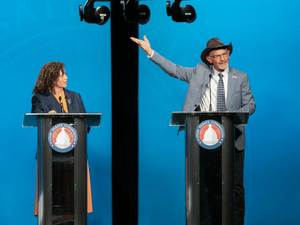
Vivek Ramaswamy and Amy Acton. (Photo by WEWS.)
Ohio’s candidates for governor have differing ideas when it comes to the future of education — from funding public schools to school vouchers and teacher pay.
Ohio Democratic candidate Amy Acton, Ohio Republican candidate Vivek Ramaswamy, and Ohio Libertarian candidate Don Kissick are running for governor in the November election. Ohio Gov. Mike DeWine is term-limited.
Acton’s campaign did not respond to specific questions sent by the Ohio Capital Journal, but instead sent a statement.
“Growing up in Youngstown, public schools and libraries saved Dr. Acton’s life,” said Addie Bullock, spokesperson for the Acton campaign.
“Dr. Acton knows firsthand how important it is to invest in Ohio’s public education system to ensure that all of our kids get a great education. … Fully funding and protecting Ohio’s public schools benefits all of us.”
Acton has been endorsed by both state teachers unions — the Ohio Federation of Teachers and the Ohio Education Association.
Ramaswamy’s campaign did not respond to questions sent by the Ohio Capital Journal.
As the campaign season has gone along, the gap between the candidates when it comes to various education issues has become clear.
Private school vouchers
Acton’s campaign website states she will “bring reform to our corrupt school voucher system,” and that “public money should be for public schools.”
Ramaswamy has spoken in favor of school vouchers, even saying Ohio should “go further in the direction of school choice,” during an interview last year with Columbus television station WCMH.
“I think it’s the civil rights issue of our time,” he said. “I think kids in our inner cities or in rural parts of Ohio deserve to go to the best possible schools they can.”
Ohio lawmakers increased the EdChoice private school expansion eligibility to 450% of the poverty line in 2023 through the state budget — creating near-universal school vouchers.
This means K-8 students can receive a $6,166 scholarship and high schoolers can receive a $8,408 scholarship funded by the state.
Ohio spent more than a billion dollars on private school vouchers in the 2025 fiscal year, the second full year with near-universal eligibility, according to data from the Ohio Department of Education and Workforce. Nearly half of the money — $492.8 million — went toward the EdChoice expansion.
“Acton calls out the voucher program as unaccountable, and on the other hand, Ramaswamy seems to want to give even more funding to vouchers,” said Piet van Lier, deputy director of the advocacy group Honesty for Ohio Education.
Kissick supports EdChoice, but would examine “whether assistance can be better targeted toward families facing the greatest barriers to educational choice,” according to an email sent by Kissick’s running mate, James Mills.
“School choice should create genuine educational mobility and encourage schools to compete on quality, rather than simply becoming another subsidy for families who already have access to alternatives,” Mills said.
Fair School Funding
Acton has said she will continue to implement Ohio’s Fair School Funding Plan. The funding model was initially passed in 2022 with bipartisan support, and was designed to fund schools based on actual need for each school district.
The Fair School Funding Plan almost made it through its six-year phase-in, but Ohio Republican lawmakers decided to abandon the plan during last year’s budgeting process.
The most recent state operating budget included a $226 million increase in school funding, but the Fair School Funding Plan model needed at least triple that amount to maintain its initial projections and keep up with inflation.
Kissick’s campaign said he supports “the goals of making school funding more equitable and predictable.”
“As we work to reduce and ultimately eliminate reliance on property taxes, we would protect school funding while first examining what schools actually need, what Ohio already collects, where it is being spent, and what can be redirected before simply replacing one tax with another,” Mills said.
Math and literacy
Acton’s campaign said she will “invest in new, 21st century approaches to math and literacy and create workforce training programs.”
Ramaswamy’s campaign said he will “raise academic standards with a focus on 3rd-grade literacy, 8th-grade numeracy, and 12th-grade civics.”
He has said would bring back the recently ended policy that required the state to hold back students if they struggle to read.
Kissick’s campaign said he supports continuing funding the Science of Reading model for Ohio schools, which is based on decades of research that shows how the human brain learns to read and incorporates phonemic awareness, phonics, fluency, vocabulary, and comprehension.
“The state should provide good evidence and resources, measure outcomes transparently, and give qualified educators the freedom to apply those tools to the students in their classrooms,” Mills said.
DeWine wants his successor to continue the literacy work he started, including the Science of Reading.
School meals
Acton supports free school breakfasts and lunches.
“No child in Ohio should go hungry,” her campaign website reads. “Providing this support ensures that all of Ohio’s kids have the fuel they need to learn and thrive.”
Ramaswamy’s campaign website said he promotes “healthy meals and daily physical education.”
Teacher pay
Ramaswamy has said he wants to “pay our best teachers more by rewarding excellence and attracting top talent into the profession.”
Acton is advocating for raising teacher pay across the board, according to van Lier.
Higher education
The next governor will appoint trustees for Ohio’s colleges and universities.
Ramaswamy previously said he wants to consolidate Ohio colleges and universities. After receiving much push back, Ramaswamy clarified and said he never wanted to close the colleges, but rather close programs within the colleges.
Just this week, incumbent Gov. Mike DeWine told a crowd of community college leaders that a plan like the one Ramaswamy proposed wouldn’t happen in Ohio.
Follow Ohio Capital Journal Reporter Megan Henry on X or on Bluesky.
Columbus, OH