Pennsylvania pitches plan for U.S. Space Academy with $285 million state investment
Nov 16, 2026 | 3:10 pm ET
Description
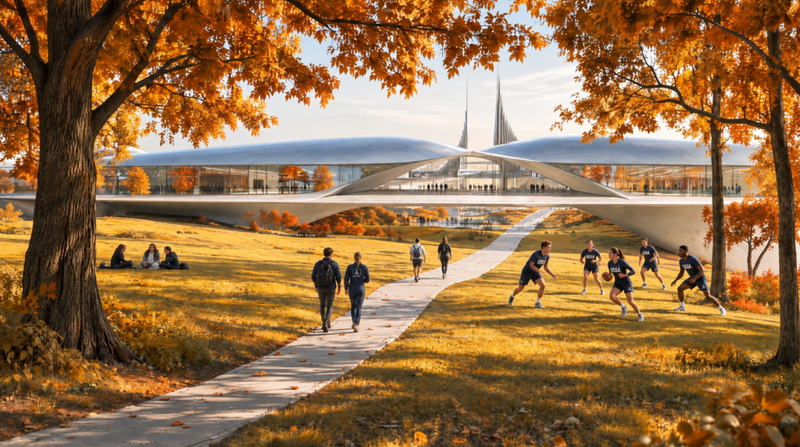
A campus-level view of U.S.Space Academy at Southfield, the proposed main campus for residential, academic and athletic life at Pittsburgh International Airport.
(AI-assisted visualization courtesy of
Penn State / Cocoziello Institute of Real Estate Innovation)
Southwestern Pennsylvania could become the home of the United States Space Academy under a proposal Gov. Josh Shapiro and U.S Sen. Dave McCormick announced Monday.
The pitch, which includes 300 acres of public land adjacent to Pittsburgh International Airport and a $285 million investment by the commonwealth, is in response to an executive order by President Donald Trump and a request for proposals by NASA, the U.S. space agency.
The new school, eventually enrolling up to 4,000 students, would be the nation’s sixth service academy. The U.S. Army War College is in Carlisle, Cumberland County.
Trump signed the order in August stating space is a critical domain for national security, economic growth, scientific discovery and technological innovation. It continued that the United States must train the next generation of astronauts, scientists, engineers and warfighters to ensure they’re capable of advancing American interests in space.
“The Commonwealth of Pennsylvania powered the first industrial revolution nearly 200 years ago and made the arsenal of democracy the most powerful manufacturing base in the world. Pennsylvania is now uniquely positioned to welcome the United States Space Academy – building off our robust space industry and world-class research universities,” Shapiro said in a statement.
Shapiro added that Pennsylvania’s application to host the space academy is backed by a bipartisan team of leaders. It includes support from Penn State University, the Keystone Space Collaborative and Pittsburgh International Airport.
The commonwealth also included the Bellwether District in Philadelphia – the former site of the Philadelphia Energy Solutions oil refinery – as an alternative site.
“Pennsylvania has the talent, technology, and industrial strength to help America win the race for space dominance,” McCormick said. “Bringing the U.S. Space Academy to Pittsburgh would build on those strengths, create new opportunities for Pennsylvanians, and train the next generation of leaders who will ensure America remains the world’s leader in space.”
Students would learn under a curriculum led by Penn State and six other research universities across the commonwealth. Research and instruction would center on artificial intelligence, robotics, life sciences, advanced manufacturing and other space-related areas. Carnegie Mellon University and University of Pittsburgh both have research and teaching programs focusing on space engineering, AI and robotics.

“Working in collaboration with research institutions across Pennsylvania, we can provide the framework needed to train the next generation of astronauts, scientists, engineers, operators, entrepreneurs, and civil servants,” said Penn State President Neeli Bendapudi “Our proposed curriculum would provide students with critical hands-on experience and the skills they need to meet the rapidly changing workforce needs.”
As the federal government sought proposals for the new academy, Defense Secretary Pete Hegseth recently announced an effort to strip civilian influences from the nation’s military curricula.
In March, Hegseth ordered a 90-day review of the six senior service colleges including the war colleges of the Army, Navy, Air Force and Marines and the National Defense University and the National War College. It resulted in a memorandum outlining directives to rid the colleges of “relics of 19th century academia” and better prepare officers for modern warfare.
“In the profession of arms, nostalgia is fatal,” he said. “When our war college graduates walk across the stage and take command, their minds cannot be anchored on the strategic consensus of a vanished world.”
A new campus
Pennsylvania’s proposal would site the new campus on 300 acres of public land in the Southfield Business Park beside Pittsburgh International Airport.
The academy would break ground in 2027 and could formally open for 1,200 students in fall 2031.
The Shapiro administration said the commonwealth would benefit from billions of dollars in combined public and private investment that could bring thousands of new jobs.
The state’s $285 million investment would include $30 million for site preparation, $11 million for water infrastructure upgrades, and $45 million for regional transportation improvements and a commitment to raise a $200 million private endowment.
As the new academy site is renovated and developed, the first class of 300 students would be taught at the former Pittsburgh Technical College in North Fayette Township in Allegheny County, a few miles from the airport. The college, which closed in 2024, has housing for nearly 400 students.

Upon completion of the space academy campus, the former technical college would become an “innovation district” with residences for faculty and students’ families, additional laboratory and environmental testing space, classrooms and space for expansion.
Pittsburgh International Airport already has a military presence with the 171st Air Refueling Wing of the Pennsylvania Air National Guard and the Air Force Reserve 911th Airlift Wing sharing the airfield with commercial airline operations.
“Our airport is known around the world as an innovation leader. Coupled with our abundant real estate options and proximity to two military bases on-site, this proposal presents a compelling opportunity to develop a transformational campus,” said Pittsburgh International Airport CEO Christina Cassotis.
Pennsylvania’s space economy generated $8.6 billion in economic activity supporting 556 businesses in the space supply chain, according to the Shapiro administration. The Pittsburgh region is home to 126 of those businesses.
“This established industrial and innovation base gives the Academy immediate access to the companies, technologies, specialized manufacturing capabilities, and research partnerships needed to educate the next generation of space leaders — and to translate their work into American economic strength, technological advantage, and national security,” the administration said in a release.
Allegheny County Executive Sara Inamorato noted the academy would bring new jobs, significant investment and opportunities for residents and businesses.
“Allegheny County has a proud history of building what’s next, and the United States Space Academy represents an incredible opportunity to carry that legacy forward,” she said.
Harrisburg, PA