Minnesota AG allows Allina Health acquisition by California-based Sutter Health
Nov 16, 2026 | 2:37 pm ET
Description
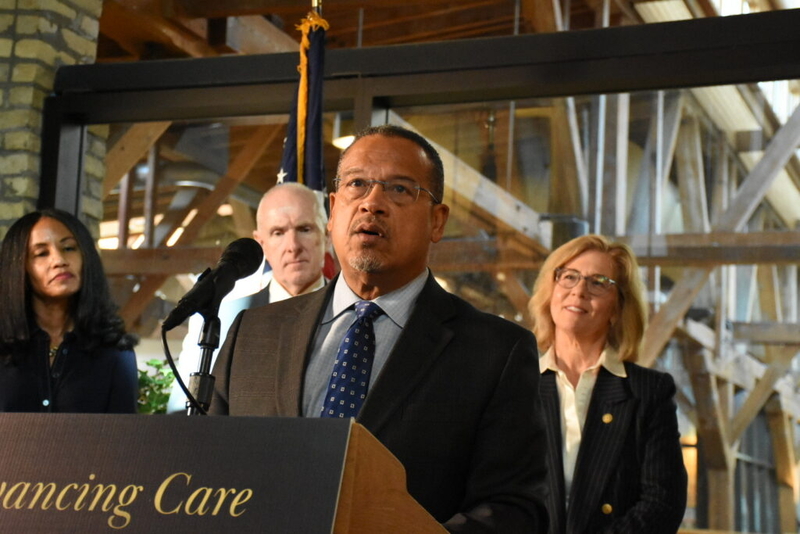
Minnesota Attorney General Keith Ellison speaks at a press conference alongside Sutter Health CEO Warner Thomas and Allina Health CEO Lisa Shannon at Allina's Bandana Square Clinic in St. Paul, Minn., Monday Nov. 16, 2026. (Photo by Alyssa Chen/Minnesota Reformer)
The Upper Midwest health giant Allina Health is set to be acquired by Sutter Health, a far larger California system, after the nonprofit health systems signed a 10-year oversight agreement with the Minnesota Attorney General’s Office.
The consolidation, first announced in March, is set to take place in January. It will create a combined $26 billion system with 39 hospitals serving more than 5 million patients in California, Minnesota and Wisconsin. Under the combined system, Allina would maintain its Minneapolis headquarters and become the Upper Midwest Division of Sutter Health, with Allina CEO Lisa Shannon remaining in leadership of the division.
The joining reflects a broader trend of health care consolidation — hospitals and clinics combining into sprawling health systems. In Minnesota this year, consolidation transactions are being proposed at what Erin Conti of the Minnesota Attorney General’s Office called a “breakneck pace” during a state Senate committee hearing.
Substantial evidence has shown that healthcare consolidation has led to higher prices, mainly because larger health systems have more power when negotiating their prices with insurers. Evidence on the effects on quality of care is mixed “at best,” according to a brief from KFF, a health policy research organization.
The Minnesota Attorney General’s Office was bestowed with expanded regulatory powers over healthcare mergers by the Legislature in 2023. It’s now able to analyze and sue to block hospital mergers if they are against the public’s interest — for example if they increase healthcare costs for patients.
“After this thorough review, we have concluded that the integration of Allina and Sutter has met the public interest standard and Minnesota’s health care transaction law,” Attorney General Keith Ellison said at a Monday press conference at Allina Health’s Bandana Square clinic in St. Paul.
At the press conference, Shannon said that challenges in the healthcare landscape — rising input costs, reduced reimbursement for care and widening gaps in the safety net — have led to financial losses for the health system, though Allina officials previously told the Star Tribune that the merger was not a financial rescue.
The signed oversight agreement binds Sutter to maintain Allina Health’s core services for five years, which refers to primary care, family medicine and internal medicine; mental health; cardiovascular services; emergency room services; ICU services; and stroke services.
Sutter committed $2.5 billion to complete Allina’s overhaul of its Abbott Northwestern campus; modernize Allina’s IT systems; and build out an outpatient care network, among other capital investments.
The agreement, summarized on the AG’s website, also includes labor protections, including a ban on noncompetes reflecting state law; and explicit investments into workforce training and rural healthcare.
The agreement does not include explicit guardrails to limit price growth, which is the central concern of many health economists when it comes to hospital consolidation, though Minnesota state law forbids health systems from entering into a transaction that substantially lessens competition.
Sutter, the fourth biggest health system in California by number of staffed patient beds, has previously been accused of driving up costs for Californians through anti-competitive behavior in two lawsuits brought by unions, employers, individuals and California’s attorney general. Sutter denied wrongdoing in the lawsuits’ settlements.
The Minnesota Attorney General’s Office gave the thumbs up to the acquisition of North Memorial Health by South Dakota-based Sanford Health under another 10-year oversight agreement, and is currently in the process of reviewing a proposed merger between HealthPartners and Essentia, both Minnesota-based health systems.
This is a developing story and will be updated.

Saint Paul, MN