Pa. officials seek PTSI coverage for more first responders
Mar 17, 2026 | 3:20 pm ET
Description
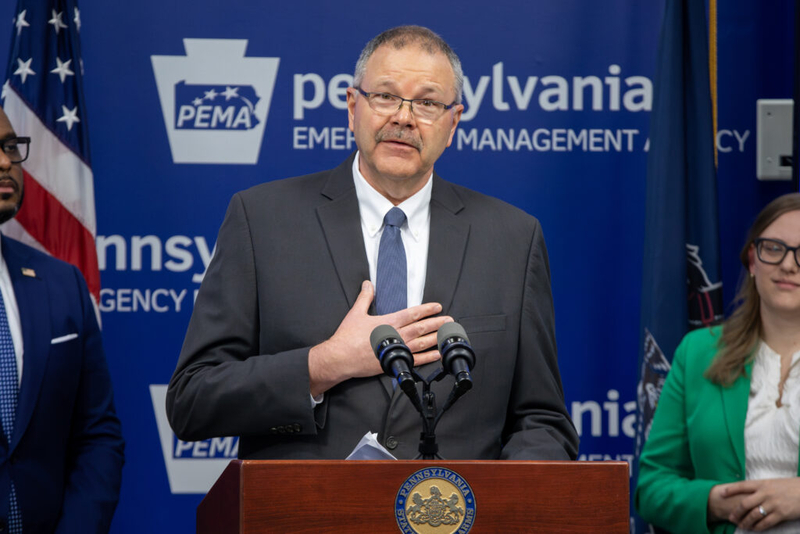
Randy Padfield, Director of the Pennsylvania Emergency Management Agency (PEMA), speaks at at March 17, 2026 press conference about PTSI coverage for first responders. (Photo from PACast)
A newly enacted state law expanded Pennsylvania’s Workers’ Compensation Act to include Post-Traumatic Stress Injury coverage for first responders, but some worry that it won’t be comprehensive enough during disasters.
Act 121 of 2024 allows firefighters, police, EMTs and paramedics with PTSI to receive compensation for cumulative, everyday stressors, ending a requirement to prove “objective abnormal working conditions.” The law took effect in October.
But a survey of insurance providers revealed that coverage wasn’t uniform for first responders deployed outside of their home jurisdictions, said Randy Padfield, the Pennsylvania Emergency Management Agency director.
“Some of them came back and said, ‘Yes.’ Some of them came back and said, ‘No.’ Some said, ‘We would cover them in these areas, but not for state deployment,’” Padfield said at a Tuesday press conference. “There were a lot of gaps that we identified and we don’t want any gaps.”
Padfield said the state had between 40-50 swift water or flood evacuation teams alongside eight urban search and rescue teams, the latter of which are trained to respond to building collapses and other disasters. When a storm hits only part of the state, the governor has the authority to reassign resources from another area.
Emergency crews can also be deployed to natural disasters in other states. For example, two crews of wildland firefighters from Pennsylvania were deployed to California in January 2025, to help combat the devastating wildfires near Los Angeles.
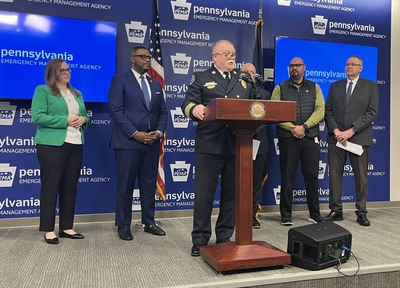
State Fire Commissioner Tom Cook said that studies estimate one in seven first responders experience PTSI, adding that “suffering silently” was once the norm and exacerbated by barriers to care.
“These first responders rush into danger to protect the lives and property of our citizens and visitors. They see tragedy, trauma and loss in ways that most people never will,” said Cook. “For too long, the physical dangers of the job were recognized, but the mental and emotional toll was not treated the same way.”
Covered events under the law include: death, serious injury, threats to life or mass casualty events. Eligible responders may qualify for medical treatment and wage loss benefits for up to 104 weeks.
“For generations, the fire service and emergency services culture emphasized toughness and pushing through trauma. Today, we understand that seeking help is a sign of strength, not weakness,” said Cook. Laws like these help legitimize and destigmatize the very real emotional damage that can occur from emergency services work.”
Padfield said coverage limits haven’t kept up with “actual” medical costs. Under current law, payments are capped at $20,000 for an injury resulting in death, up to $15,000 for medical and hospital expenses and up to $200 per week for up to six months for total disability.
The work ahead
Closing the gap to include first responders outside of their jurisdictions will require another bill — which hasn’t yet been introduced — though Gov. Josh Shapiro included the concept in his proposed budget earlier this year.
Rep. Jennifer O’Mara (D-Delaware) authored the measure alongside Sen. Camera Bartolotta (R-Washington). O’Mara’s father, a career firefighter with the Philadelphia Fire Department, died by suicide in 2003 shortly after coming home from a shift — an example of the toll PTSI can take on first responders.
“I now like to say I turned pain into policy,” said O’Mara. “Which is not an easy thing to do in Harrisburg.”
She shared that it took several years to get the effort to Shapiro’s desk for a signature, despite its bipartisan support.
“This bill was actually going on before I got elected in 2019,” said O’Mara. “I thought, ‘Of course we’ll get this done’ — because I was new and naive, and I did not realize just how many obstacles we would face.”
Opposition came from insurers, employers and municipalities, she said. Finally, in 2024, the parties reached a compromise. The Pennsylvania Municipal League detailed the additions incorporated to keep costs sustainable for local government units.
However, the Pennsylvania State Association of Township Supervisors still warned that workers’ compensation premiums are expected to increase this year.
Regardless of party, Lt. Gov. Austin Davis urged lawmakers to “take off our red jersey and our blue jerseys” in favor of a “Pennsylvania jersey” to quickly move new legislation.
“I hope that we can once again find bipartisan support where Democrats and Republicans will come together to get this done for the good people of Pennsylvania and to keep our communities safe,” said Davis.
Davis noted the increasing number of extreme weather events across the commonwealth, which scientists link to global warming and climate change. Despite the increase, the number of first responders has fallen to a “crisis” level in some areas, with younger generations opting for other careers.
Laws like this were “just a start,” he said, adding that people are “definitely not going to go into (emergency response) if they know that if they get injured or have a medical condition, it’s not going to be covered.”

Harrisburg, PA