Oregon lawmakers want to build on immigration protections. Here’s where those bills stand
Feb 17, 2026 | 4:03 pm ET
Description
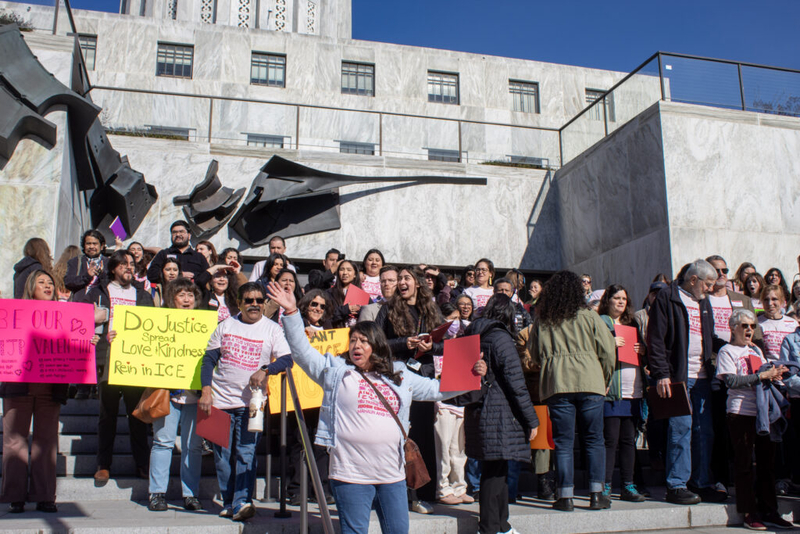
Oregonians, chanting “el pueblo unido jamás será vencido,” a Spanish phrase meaning “together united we will never be defeated,” gathered in front of the Oregon State Capitol in support of a range of bills meant to strengthen protections for immigrants on Friday, February 13, 2026. (Photo by Mia Maldonado/Oregon Capital Chronicle)
As the first state in the nation to pass a sanctuary law, Oregon has some of the most comprehensive immigration protections in the country. However, lawmakers are trying to do more in response to concerns that federal immigration officers are overstepping their authority.
Before the legislative session ends March 8, the Legislature’s Democratic majority plans to pass its “immigration justice package,” or at least 13 bills that would make it easier to sue federal agents, increase data protections for immigrants, guide schools and hospitals on how to respond when federal agents appear on campus grounds and restrict federal agents from wearing masks.

“The immigrant justice package is how our state is standing up to fight back,” Sen. Wlnsvey Campos, D-Aloha, said at an immigrants rights rally on Friday. “This is about the father who has built his life and business here for 20 years who has been torn away from his children. It is about the student whose visa was unjustly revoked. It is about the family who was detained and sent to Texas for accessing emergency medical care for their little daughter.”
Each bill must receive approval from a committee before advancing to the House or Senate floor. The process must then be repeated in the opposite chamber before it can head to the governor’s desk. Gov. Tina Kotek can sign a bill into law, let it become law without her signature or veto it.
At least one bill related to anti-discrimination laws in schools received support from Republicans.
Below are bills directly responding to the federal government’s immigration enforcement presence in the state and their status.
ICE at schools: House Bill 4079 would require school districts and colleges to develop an alert system to notify students and parents if federal agents appear on school property. The House advanced the bill along party lines, except for Rep. Tawna Sanchez, D-Portland — the only Democrat to vote against it. The Senate passed the bill along party lines. It is headed to Kotek’s desk next.
Anti-discrimination protections in schools: Senate Bill 1538 adds immigration status as a protected class under anti-discrimination laws that govern Oregon’s K-12 schools. The Senate and House passed bill mostly along party lines. In the Senate it received support from five Republicans, including Sens. Dick Anderson, R- Lincoln City; Mike McLane, R-Powell Butte, Todd Nash, R-Enterprise; Suzanne Weber, R-Tillamook; and David Brock Smith, R-Port Orford. Kotek signed the bill into law on March 5.
ICE in hospitals: Senate Bill 1570 would create guidelines hospitals must follow should federal immigration agents appear on campus grounds, including documenting agent visits, prohibiting agents from accessing nonpublic areas unless there’s a court order and preventing hospitals from retaliating against workers who provide a patient with information on legal rights and services. The Oregon Health Authority would be able to revoke a hospital’s license if it fails to comply with the guidelines. The Senate and House passed the bill. It heads to the governor’s desk next.
Immigration status protections in court: House Bill 4111 would prohibit data about a party’s or a witness’s immigration status from being used in a civil case. The bill would make it unlawful for employers to retaliate against workers attempting to update their employment authorization status. The House and Senate passed the bill along party lines. It heads to Kotek’s desk next.
Data privacy: Senate Bill 1587 prohibits data brokers from providing data to others for purposes related to enforcement of civil law, unless there’s a court order. The Senate and House passed the bill along party lines. It heads to the governor’s desk next.
Right to sue: Senate Bill 1563 would let a person whose civil rights were violated by law enforcement or other government officials sue for damages and attorney fees. The bill did not advance past the committee process.
Rules for federal, out-of-state law enforcement: House Bill 4114 would require non-Oregon law enforcement operating in the state to follow identification requirements, warrant procedures and requirements when entering buildings during an operation. It would create a civil cause of action against outside law enforcement if they don’t follow the regulations. The House and Senate passed the bill along party lines. It heads to Kotek’s desk next.
Office of Immigrant and Refugee Advancement: Senate Bill 1594 would direct the agency to create model policies relating to citizenship or immigration status that can be used in response to federal actions. The Senate and House passed the bill along party lines. It heads to Kotek’s desk next.
Universal representation: House Bill 4117 would deposit $10 million from the state general fund into the state’s universal representation fund, which subsidizes legal assistance for income-qualifying immigrants looking for help with asylum applications, work authorization forms or to challenge their detainment. It didn’t advance past the committee process.
Withholding money from the feds: House Bill 4143 would let the state withhold to the federal government if the federal government unlawfully keeps money away from the state. The House passed the bill in a party-line vote, but it did not make it to the Senate side before the last day of the legislative session.
Should Oregon water down a bill to ban officers from wearing masks? Democrats are divided
No masks via constitutional amendment: Senate Joint Resolution 203 proposes an amendment to the Oregon Constitution, which Oregonians would have the opportunity to vote on in the November general election, banning law enforcement from wearing masks and requiring them to wear uniforms with visible badge numbers unless they are working undercover. The bill died in the committee process.
No masks for law enforcement: House Bill 4138 would require all law enforcement agencies operating in Oregon adopt a policy restricting the use of facial coverings to narrow instances, such as for medical necessity, undercover operations or SWAT assignment. The House and Senate passed the bill along party lines. It is headed to Kotek’s desk next.
No state funding for deportations: House Bill 4150 would prohibit state contractors and grant recipients from helping transport people for deportation. The bill did not receive a work session by the Feb. 16 deadline and is therefore not advancing.
Correction: This story originally misstated Sen. Suzanne Weber’s residence. She is from Tillamook, not Salem.
Salem, OR