Ohio’s school AI policies need a proof-of-learning standard
Sep 16, 2026 | 3:30 am ET
Description
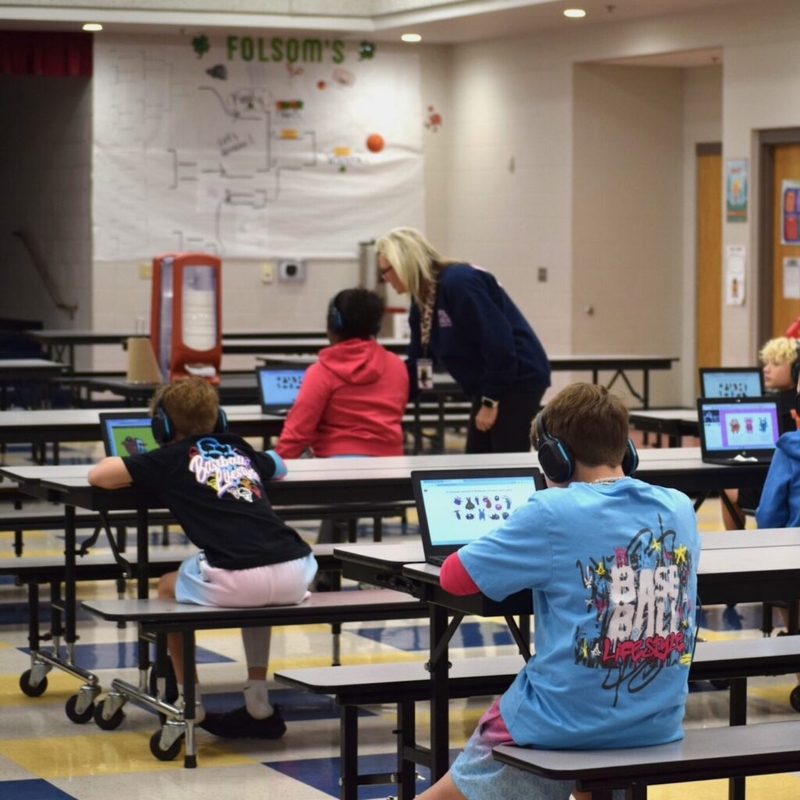
Students study on laptops inside an elementary school. (Photo by Antoinette Grajeda, States Newsroom.)
Ohio’s public schools have crossed an important line. State law required every traditional public school district, community school, and STEM school to adopt an artificial intelligence policy by July 1, 2026.
Now comes the harder part: making those policies useful as students and teachers return to classrooms.
The state’s model policy points districts in the right direction. It calls for clear rules on student and staff use, privacy, ethics, third-party tools, teacher practices, and the effect of AI on learning objectives and assessment.
Those categories matter. But a policy can satisfy every category and still leave teachers with the central classroom problem unanswered: how can they tell whether AI helped a student learn, or simply helped a student produce?
Ohio should add a proof-of-learning standard to the next phase of implementation.
When AI materially contributes to a graded assignment, students should provide a brief explanation of four things: what they asked the system to do, what they changed or rejected, what they independently verified, and what they can now explain or perform without the tool.
The standard should stay narrow. It should not turn spellcheck, autocomplete, or routine formatting into a disclosure exercise. It should apply when AI materially shapes the reasoning, research, writing, code, design, or conclusions submitted for evaluation.
This approach fits the concern Ohio has already identified. The model policy specifically asks districts to consider how AI affects student learning objectives and assessment.
A proof-of-learning note turns that broad principle into something a teacher can actually use. Instead of trying to infer understanding from polished output alone, the teacher gets a small window into the student’s judgment.
That matters because generative AI can make weak understanding look deceptively strong. A student can receive a fluent answer before learning enough to recognize a bad premise, a fabricated source, or a shallow explanation.
The risk grows when schools focus mainly on detecting whether AI was used. Detection turns the classroom into a contest over concealment. Learning requires a different question: what intellectual work did the student still do?
A four-part note can answer that question without requiring surveillance. A history student might explain that an AI system suggested three causes for an event, but the student rejected one after reading the assigned sources.
A computer science student might note that generated code failed an edge case and describe the fix. A career-technical student could show how an AI-generated procedure changed after comparison with a safety standard or equipment manual. The evidence lies in the student’s decisions, not in a screenshot of a chat log.
The Ohio Capital Journal reported in May that broader efforts to regulate artificial intelligence in Ohio had stalled amid uncertainty over what the state could enforce.
Schools present a different situation. Ohio has already acted. The legislature set the policy deadline, the Department of Education and Workforce produced a model, and districts now have implementation authority.
That makes education a practical place to establish a workable norm of human accountability while larger AI debates continue.
The standard would also help prepare students for work. Employers increasingly expect workers to use AI, but employers still need people who can catch errors, protect confidential information, recognize when a task should stay human, and take responsibility for the result.
Students who practice documenting those decisions will enter the workforce with a more valuable skill than prompt fluency. They will know how to supervise a machine.
Districts should avoid turning the standard into a paperwork burden. The Department of Education and Workforce could publish a one-page set of examples showing when a proof-of-learning note is appropriate and when it is unnecessary.
Teachers could adapt the four questions to their subjects. Districts could test the approach in a limited number of courses during the fall, then compare student work and teacher feedback before expanding it.
Schools should also protect privacy. Students should never have to submit full prompt histories or sensitive information to prove responsible use. The state model already emphasizes privacy and personally identifiable information.
A proof-of-learning note should record human decisions, not create a new archive of student conversations with AI systems.
The July deadline forced Ohio schools to write rules. The start of the school year will test whether those rules improve learning.
Ohio can make them more useful by asking students for evidence of judgment whenever AI plays a meaningful role in their work. The goal should be simple: students may learn with powerful tools, but they must still be able to show the thinking that belongs to them.
Columbus, OH