Police surveillance technology requires rules and public oversight, not just trust
Sep 15, 2026 | 7:00 am ET
Description
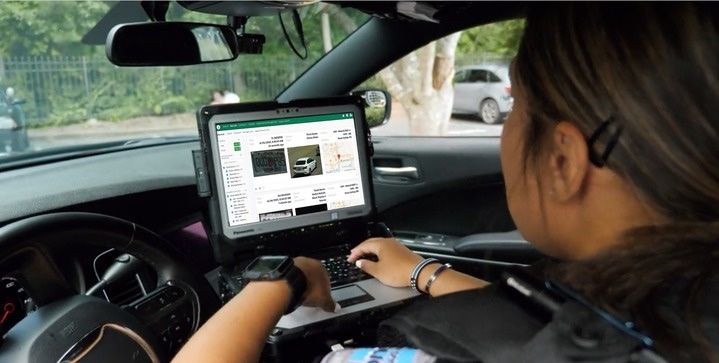
A police officer uses the Flock Safety license plate reader system. The authors argue that where Minnesota cities implement new technologies with surveillance capabilities, they need enforceable rules, internal audits and public oversight. (Photo courtesy of Flock Safety)
San Francisco police accidentally broadcast hours of live drone footage to the internet recently. The video included thermal images, GPS information, and views into private spaces. During one flight, a drone followed a vehicle across the city, zoomed in on its license plate, and tracked the driver until police made an arrest. During another flight, a drone filmed through an apartment window while responding to what records inconsistently described as a welfare check or missing person investigation.
This breach shows what “drones as first responders” — as their boosters have branded them — can become: not simply a faster way to reach emergencies, but a mobile surveillance system capable of following people, reading license plates, and recording homes from above.
The danger becomes even clearer when drones are understood as one component of an expanding surveillance dragnet in Minneapolis and across Minnesota, including automatic license plate readers, facial recognition and other technologies misleadingly presented by law enforcement agencies and private contractors as safe, neutral and protected from abuse.
What occurs with these surveillance technologies is an explosion in use without commensurate growth in oversight and transparency. Over two years in San Francisco, the drone fleet grew from six drones to 98 drones and officers flew more than 1,400 flights. In the first three weeks of use in St. Paul, officers flew nearly 500 flights.
Drones aren’t the only surveillance tools that law enforcement uses to excess. Automatic license plate readers — or ALPR — photograph passing vehicles, record their locations and create enormous troves of searchable and shareable data. Current Minnesota law requires that each search relates to a documented active criminal investigation. Current law also requires that prior to sharing ALPR data with an outside agency, Minnesota law enforcement must confirm that the search is related to an active criminal investigation. In many cases, Minnesota agencies are not doing that due diligence.
Without strong guardrails and public oversight and accountability, networks of cameras can reveal to law enforcement where nearly anyone lives, works, worships, receives medical care, attends a protest, or spends the night.
Public records obtained by the ACLU-MN indicate that some Minnesota municipalities allowed such broad access to their ALPR systems that, in January, nearly 300,000 searches were run against their cameras. Records showed that many searches related to “civil immigration” instead of any active criminal investigation.
Local law enforcement does not have the time or resources to vet 300,000 monthly searches to ensure compliance with state law. Instead, they trust outside law enforcement agencies and third-party vendors to do that work for them.
The public should be educated about the potential for misuse. But even when used in compliance with local regulations, research shows that ALPR systems do not make communities safer or prevent crime.
One study placed license-plate-reader patrols in 30 crime hot spots across two jurisdictions. Researchers found no statistically significant reduction in crime generally or in vehicle-related crime. A later study found that while ALPRs increased stolen-vehicle recoveries, they did not increase arrests, reduce calls for crime or disorder while officers were present, delay the next incident, or reduce its seriousness. The authors concluded that the study offered little clear evidence that ALPRs improve crime prevention.
Minnesotans should be concerned about expanding the surveillance dragnet using any of these technologies. But where Minnesota cities do implement new technologies with surveillance capabilities, they need enforceable rules, internal audits and public oversight.
Any drone program must restrict flights to defined emergencies; prohibit surveillance of protests and other First Amendment activity; cannot carry weapons, crowd suppressants, or additional data collection devices like stingrays, which mimic a cell tower to capture data; minimize and localize data collection and retention; mandate deletion schedules; require warrants for investigative tracking; mandate independent audits; provide public access to deployment records; and establish enforceable consequences when rules are broken.
The same principles should govern drones, ALPRs, and all other forms of technological surveillance. Minnesota lawmakers must limit data sharing with third parties and outside agencies, require judicial authorization outside narrow emergencies, and ensure that independent bodies — not police alone — review compliance.
Minnesotans should not have to surrender their anonymity, movements or associations merely because technology makes pervasive monitoring possible.

Saint Paul, MN