Ohio governor candidate suggested consolidating universities. Economists think it’s a bad idea.
Jul 27, 2026 | 3:55 am ET
Description
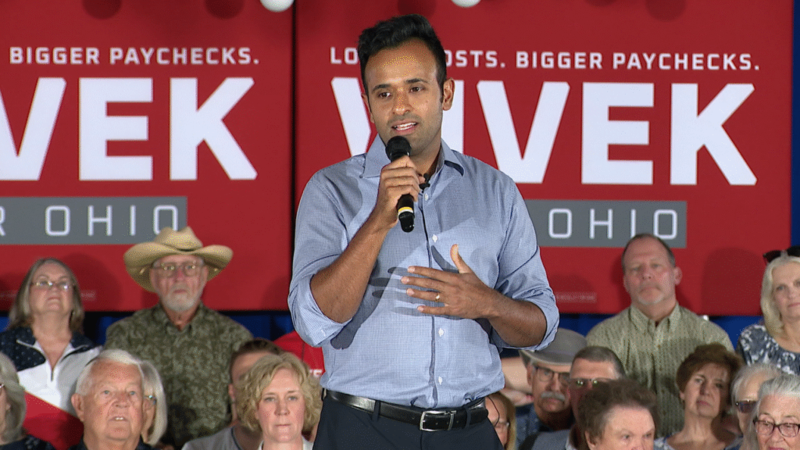
Ohio Republican candidate for governor Vivek Ramaswamy. (Photo by WEWS.)
Republican nominee for governor Vivek Ramaswamy in March said that consolidating Ohio’s public universities would make higher education better and more affordable.
The strong consensus of economists surveyed on the topic this month said such a move would reduce the number of graduates in Ohio and reduce economic output. They split on whether it would even save any money.
Amid a backlash, Ramaswamy is now backing away from his call.
“I think that we have too many duplicative programs in our universities,” Ramaswamy told a Strongsville audience earlier this month, according to Cleveland’s WEWS.
He later added, “I want every region to have the best higher education institutions available for people in (every) region. But not every university needs to offer every program.”
Vivek Ramaswamy said Ohio should shut down ‘subpar’ universities. Then came the backlash.
Ramaswamy said something quite different in a March 27 column in The Columbus Dispatch. He cited Ohio’s aging population and declining enrollment, and referred approvingly to the fact that Georgia eliminated nine public universities between 2011 and 2018.
He wrote that as governor, he would “identify where missions overlap, where enrollment collapse has made independence untenable, and where administrative functions can be unified without harming students.”
The result, he said, would “create a more competitive, increasingly affordable and rightsized higher education system for taxpayers and students.”
A panel of Ohio economists surveyed by Scioto Analysis wasn’t sold on the argument. None believed it would help the Ohio economy in the long run.
Asked whether they agreed that, “Reducing the number of universities in Ohio would reduce long-term economic output in the state of Ohio,” 11 agreed and four were uncertain.
None said they thought cutting the number of public universities would increase economic output.
Most of them work for public universities, so a little bias in their favor might be inherent. But Kevin Egan of the University of Toledo made a straightforward argument for why cutting public universities cuts economic output.
“On average college graduates earn more reflecting their extra value to the economy,” he wrote in the comment section of the survey. “Closing any local public university will reduce some local commuters from attending college and thus will reduce valuable workers to the economy in the long-term.”
On the other hand, Curtis Reynolds of Kent State University said the economic benefit of public colleges in Ohio might be blunted because Ohio’s leadership doesn’t do a better job of making the state attractive to young professionals.
“I am less confident about this for one simple reason: Ohio struggles to keep the college graduates that we create,” he wrote. “If the state cannot keep college graduates, then producing college graduates may matter less (from the perspective of the state).”
Reynolds didn’t mention the issue, but when CNBC earlier this month ranked Ohio its Top State for Business, it ranked it 18th for quality of life. And one thing it could have dinged Ohio on is an abortion ban passed by Republicans in the state’s gerrymandered legislature. It was later overturned by voters, but legislative Republicans continue to try to restrict abortion rights.
“And with surveys showing a sizable percentage of younger workers would not live in a state that bans abortion, we factor reproductive rights in this category as well,” CNBC said of its quality-of-life scoring.
The Ohio economists overwhelmingly agreed that getting rid of public universities would cut the portion of Ohioans who get college degrees. Twelve said it would and two were uncertain.
“It will reduce the number of bachelor’s degrees and eventually reduce the number of graduate degrees as well,” said Charles Kroncke of Mount St. Joseph University.
Ramaswamy was famously part of incoming President Donald Trump’s “Department of Government Efficiency” before making an early departure.
Run by Elon Musk, another billionaire with no government experience, DOGE promised to cut waste and save taxpayers $2 trillion.
The ramshackle effort caused widespread chaos and fired people who often had to be rehired. It saved vastly less than promised — and by some estimates, it even ended up costing taxpayers billions.
While Ramaswamy said his college-consolidation plan would save Ohioans money, the economists didn’t seem to believe the matter was so clear-cut.
Six said it would save money, six said it wouldn’t and two were uncertain.
Even some of the economists who said consolidation would save money questioned the wisdom of doing so.
“It would save money for the state in the short run but would be penny wise and pound foolish in the long run,” said Bob Gitter of Ohio Wesleyan University. “Education is one of the primary functions of government.”

Columbus, OH