Ohio corruption trial traces tactics to prop up nuclear and coal plants
Mar 10, 2026 | 4:50 am ET
Description
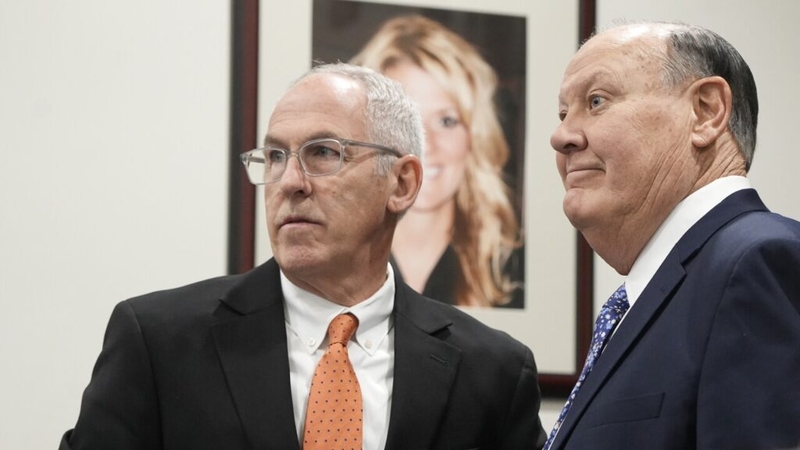
Defendants Michael Dowling and Chuck Jones wait for the start of their trial in Summit County Court of Common Pleas Judge Susan Baker Ross's courtroom.
(Photo by Mike Cardew- Pool/Akron Beacon Journal)
This story was originally published by Canary Media.
Ohio jurors will soon decide whether two former FirstEnergy executives are guilty of state criminal charges related to the Ohio House Bill 6 utility bribery scheme.
It’s a landmark moment for what is the largest corruption scandal in state history, in which utility execs allegedly bribed state officials to pass and protect a law to bail out uneconomic coal and nuclear plants and to gut the state’s clean energy standards. Its effects still reverberate today, nearly seven years after HB 6 became law, in the form of higher energy bills, dirtier air, and less solar and wind power across Ohio.
The trial in Akron of FirstEnergy’s former CEO Chuck Jones and former senior vice president for external affairs Mike Dowling is expected to take several more weeks. The state alleges that they engaged in a pattern of corrupt activities including bribing a former public utilities chair, telecommunications fraud, money laundering, and records tampering.
Jones and Dowling also face separate federal charges relating to their alleged roles in a yearslong conspiracy to pass HB 6 in 2019 and to thwart a statewide referendum effort that could have blocked the law.
FirstEnergy admitted in 2021 that it and its subsidiaries had paid approximately $60 million to dark money groups that funneled the funds to an organization controlled by former Ohio House Speaker Larry Householder, a Republican who presided over the chamber when HB 6 passed.
It also admitted paying $4.3 million to a company owned by Sam Randazzo, a lawyer and former chair of the Public Utilities Commission of Ohio, shortly before Republican Gov. Mike DeWine picked him for that position in 2019.
When a federal judge demanded to know who paid the bribes, FirstEnergy fingered two former top execs: Jones and Dowling. Both deny any criminal wrongdoing.
Householder and lobbyist Matt Borges, who once chaired the Ohio Republican Party, were convicted in 2023 on charges under the federal Racketeer Influenced Corrupt Organizations Act. Requests for review of their cases are pending at the U.S. Supreme Court. Householder also faces state criminal charges, and that trial is scheduled for June 8.
Ohio customers have paid more than $400 million in coal plant subsidies under HB 6. The law has been mostly repealed now, but the renewable-energy and energy-efficiency standards remain decimated.
The charges against Jones and Dowling matter not just in Ohio but more broadly, because corruption undermines democracy through government officials serving private people or companies instead of the public.
Cover-ups while blaming the dead guy
The state case, filed in February 2024, focuses heavily on actions by Jones and Dowling related to Randazzo, whose Sustainability Funding Alliance of Ohio received the $4.3 million payment from FirstEnergy in 2019.
Much of Jones’ and Dowling’s defense in the state case has sought to blame Randazzo for any illegal actions. Randazzo faced federal charges and was a co-defendant with Jones and Dowling in the state case when he died of an apparent suicide in 2024.
Cross-examination by defense lawyers has generally tried to cast Jones’ and Dowling’s actions as normal business for an Ohio utility, suggesting they had no reason to suspect that money paid to Randazzo’s company over the course of roughly a decade would end up in his pocket and not be put toward lawful business uses. They likewise claim they never bribed Randazzo to act on FirstEnergy’s behalf either before or after he became Public Utilities Commission chair.
One of Randazzo’s former legal clients was Industrial Energy Users–Ohio, an association of large industrial energy users in Ohio, now known as the Ohio Energy Leadership Council.
IEU–Ohio was initially opposed to an early bailout plan for FirstEnergy’s nuclear and coal plants. But in 2015, Randazzo agreed to drop IEU–Ohio’s opposition. The company denied at the time that it had struck any side deals to get parties in the case to stop fighting against the bailout plan, which cost Ohio customers more than $450 million.
FirstEnergy paid money to Randazzo’s company until early 2019, just before he became Public Utilities Commission chair and the legislature passed HB 6, cementing the coal and nuclear subsidies that FirstEnergy sought.
Throughout this time, FirstEnergy made payments for “consulting” work — culminating in that $4.3 million payment to the Sustainability Funding Alliance of Ohio in 2019. FirstEnergy did not disclose that agreement or the 2019 payment before Randazzo took office.
The defense contends that the funds were actually meant for members of IEU–Ohio — not for Randazzo as a bribe.
Testimony by Ebony Yeboah-Amankwah, an attorney and onetime chief ethics officer for FirstEnergy, confirmed that FirstEnergy handled payments for IEU–Ohio “through a black-box settlement.”
That’s unusual. Standard legal practice calls for any funds held by lawyers for clients to be placed in secure accounts for the clients’ benefit, not disbursed to companies owned by their lawyers.
Testimony by Ohio attorney George Jonson, an expert in legal ethics, further established that basic requirements for a settlement include identification of the parties, the released claims, signatures, and other terms.
The $4.3 million payment made to Randazzo in early 2019 was ultimately disclosed in a Nov. 19, 2020, securities filing. Regulators didn’t order any investigation into the 2015 deal to drop IEU–Ohio’s opposition to a coal and nuclear bailout until December 2020.
Yeboah-Amankwah suggested that the payments to Randazzo’s company weren’t unusual enough to raise a red flag.
“If you thought there was something wrong, you wouldn’t have kept silent … You didn’t see any problem. Is that right?” asked Jones’ attorney, Carole Rendon.
“That’s correct,” said Yeboah-Amankwah, who testified under a grant of immunity.
FirstEnergy dismissed her and its chief legal officer Robert Reffner in November 2020, less than two weeks after it dismissed Jones, Dowling, and Dennis Chack, another former vice president, who testified on Feb. 24.
An “Ohio hole”
Other allegations claim Randazzo used his position as utilities commission chair in 2019 to get rid of a requirement that would have forced FirstEnergy to file a new rate case in 2024. The company’s last rate case had been in 2007, and it had relied on add-ons called riders to increase charges to utility customers without a full review of all costs and expenses.
Testimony by Eileen Mikkelsen, FirstEnergy’s former head of rates and regulatory affairs, confirmed the existence of an “Ohio hole.”
“Our expenses were lower than the revenue we were collecting,” she testified. “So, absent action between 2018 and 2024, all else equal, we would be subject to a rate reduction.”
Evidence in the state case includes texts discussing Randazzo’s action to remove the requirement for a new rate in November 2019. He resigned from the utilities commission one year later, following an early-morning search of his home by federal agents. The rate case requirement was later reinstated.
Last fall, the commission ordered rate decreases for FirstEnergy’s Toledo Edison and Ohio Edison customers, and an increase for its Cleveland Electric Illuminating Co. ratepayers that was millions less than the company wanted. The company plans to file another rate case this year.
Mikkelsen’s testimony also illustrated how interactions between Randazzo and FirstEnergy led to language in HB 6 that pegged the company’s revenues from customers to the level it collected in 2018, when expenses were unusually high. Jones once said the terms would have made the company “somewhat recession proof.”
FirstEnergy referred to the since-removed provision as “decoupling” — a term that generally refers to a true-up process in which utilities are assured of being able to cover their current expenses while promoting energy-efficiency measures. But such decoupling was irrelevant in the case of HB 6: The law effectively removed any additional efficiency requirements for the company.
Instead, Mikkelsen’s testimony suggested the law’s terms were meant to replace extra revenue the company had gotten as a result of the energy-efficiency standard through shared savings and lost distribution revenue. The purpose of lost distribution revenue is to make up for shortfalls when energy efficiency leads to lower electricity sales. And shared savings are a portion of ratepayers’ reduced costs, which Mikkelsen said was to incentivize utilities to promote energy efficiency.
When asked about FirstEnergy’s position on HB 6 gutting Ohio’s clean energy standards, Mikkelsen suggested that it helped the bill’s promoters cast it as something that wouldn’t raise rates.
But that explanation didn’t account for the benefits of either the energy-efficiency standard or the renewable-energy standard — or the economic and environmental harms caused by years of subsidies and blocked competition for aging power plants that can’t compete economically with renewables.
Columbus, OH