Nurses at St. Mary’s organize for union, citing loss of local responsiveness
May 27, 2026 | 4:30 am ET
Description
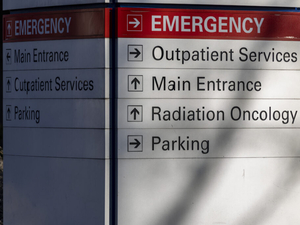
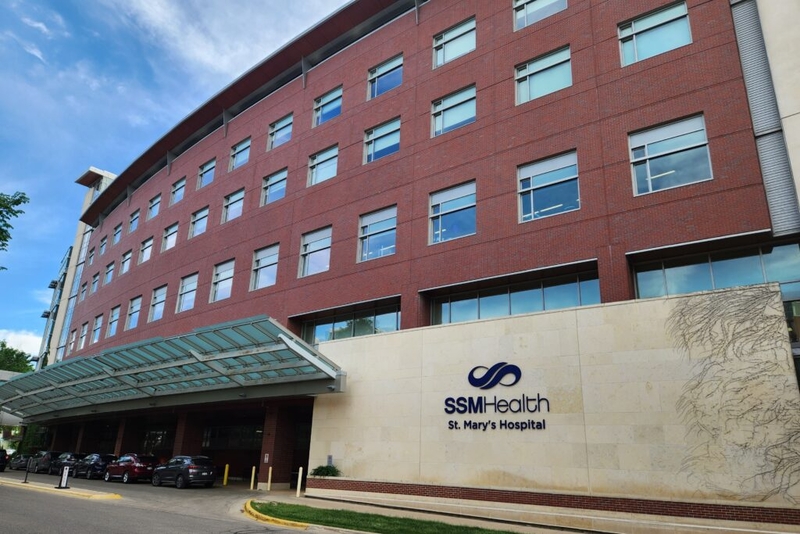
Nurses at St. Mary's Hospital in Madison have petitioned for an election to vote on joining the Service Employees International Union. (Photo by Erik Gunn/Wisconsin Examiner)
More than 800 nurses at a Madison hospital owned by a national nonprofit group will vote in the coming weeks on whether to join a union.
The organizing campaign at St. Mary’s Hospital is one of the largest in recent memory in Wisconsin.
In a statement earlier this month, a spokesperson said the hospital’s parent organization, SSM Health, “respects the right of its employees” to freely choose union representation. Nurses and the Service Employees International Union say the hospital’s management has responded with stiff opposition.
Union supporters are planning a rally Thursday afternoon in front of the hospital, with U.S. Rep. Mark Pocan (D-Black Earth) among the featured speakers.
“There’s a national crisis facing both our healthcare system and the nursing workforce,” Pocan said in a statement issued Tuesday announcing the event. “St. Mary’s nurses are trying to address this crisis right here in our community by having a strong voice for better staffing and retention. SSM should respect their freedom to vote in a fair union election without any pressure campaign.”
The union election, supervised by the National Labor Relations Board, will be the largest such vote in recent memory in Wisconsin. A date for the election hasn’t yet been set, but it could be announced as early as this week.
It comes amid a rising interest in unions among healthcare workers — one that coincides with the growth of increasingly concentrated multistate healthcare networks, including nonprofit organizations.
“We’re seeing more union elections, we’re seeing more petitions for recognition of unions as well,” said Dr. Ahmed Ahmed, a research fellow at Brigham and Women’s Hospital in Boston and Harvard Medical School, in a panel discussion earlier this month conducted by Wisconsin Health News.
With mergers and consolidations, hospitals and health systems have grown larger and larger. Labor costs are their biggest expense, and in trying to trim those costs, they’re increasing caseloads and reducing the time patients have with their providers, Ahmed said. Healthcare workers are turning to unions in search of “one collective voice that is able to govern and be able to bargain for those things.”
Centralized decision-making
Supporters of the St. Mary’s union campaign say that concentration is one of the reasons they’re organizing. Centralized decision-making at the Missouri headquarters of the parent organization have felt to some like a corporate takeover.
“There have been a lot more directives from corporate headquarters in St. Louis,” said Josh Taylor, a nurse in the hospital’s inpatient behavioral health unit.
St. Mary’s was one of several hospitals and healthcare facilities established by nuns from Europe and sponsored by Roman Catholic congregations in the 19th century. The facilities were only loosely connected until 1986 when the corporate structure changed with the creation of SSM Health, according to the SSM Health website.
SSM Health had been sponsored by the Franciscan Sisters of Mary until 2013, when sponsorship shifted to a new corporate entity, SSM Health Ministries, while remaining part of the Roman Catholic church.
SSM Health is headquartered in St. Louis and operates in four states — Wisconsin, Illinois, Missouri and Oklahoma — where it runs 24 hospitals and more than 540 other facilities, including doctor’s offices, outpatient services, home care and hospice programs.
According to SSM’s annual financial statements, SSM Health had $12.7 billion in revenues in 2025 and ended the year with a balance of $484 million in net revenue over expenses.
In 2014 SSM Health began applying its name to all of the healthcare facilities in its network. It also consolidated its business operations including human resources, finance, strategy and planning and marketing and communications.
With those changes, nurses who are supporting unionizing say that decision-making on day-to-day policies and practices has moved farther away.
“We watched our personalized policies for our hospital disappear,” said Lynette Willsey-Schmidt, a labor and delivery nurse who has worked at St. Mary’s for more than 11 years.
Employee councils called ineffective
Willsey-Schmidt said labor and delivery nurses along with the doctors in the department had developed a series of practices to reduce intervention during births where risks and complications were lower. Those practices were welcomed by patients, she said.
But as SSM Health took charge of policymaking, “we were told we can’t do that anymore,” Willsey-Schmidt said, because those policies didn’t exist elsewhere in the SSM Health system.
Taylor said that while employee councils are supposed to relay feedback from the floor to upper management, they haven’t been effective.
“I’ve been on the unit councils,” he said. “We have tried the normal routes to bring our concerns to the table. We are heard, but nothing is acted on.”
When employees have raised concerns, “We’re told, ‘This is how it is. This is how all the hospitals have to do it,’” Taylor said.
Morgan Espich, an inpatient medical and surgical nurse, said the hospital recently purchased and began requiring nurses to use a new brand of intravenous pumps, different from what they had been using. She and her coworkers had been happy with the previous models, Espich said, and no one explained the reason for the change. “We just had to get new ones that no one asked for,” she recalled.
In addition, the hospital staff has to keep some of the older IV pumps on hand, said Carrie Schrank, an intermediate care trauma nurse, to substitute for the new pumps when they malfunction.
Nurses contend staffing levels have left employees straining to cover all their responsibilities, while nurses have been told to improve productivity.
“Productivity should be about patients’ outcomes,” Willsey-Schmidt said.
Consultants who visited earlier this year recommended ways to reduce staffing, but Schrank said their recommendations didn’t address how acutely ill some patients are.
“The days we’re busy, we go home and wonder, did I do enough?” Espich said.
Hospital stance — respect or intimidation?
SSM Health released a statement earlier this month in response to the Wisconsin Examiner’s submission of specific questions about the union campaign as well as a request for an interview.
“At SSM Health, we work hard to cultivate a supportive and collaborative work environment where every employee is treated with respect and compassion,” said the statement, delivered by Kim Sveum, SSM Health regional director of communications.
“We value our high-quality patient-centered care and place of healing. We strive to ensure that our team thrives so that they can do their best work in realizing our Mission to provide exceptional patient care.”
The statement concluded, “SSM Health respects the right of its employees to make a free and informed choice as to whether or not they wish to be represented by a union.”
Union organizers say that there have been extensive messages posted on employee bulletin boards disparaging unions and the SEIU and emphasizing employees’ right to decline to sign a union authorization card.
“They have been constantly intimidating staff,” Schrank said.
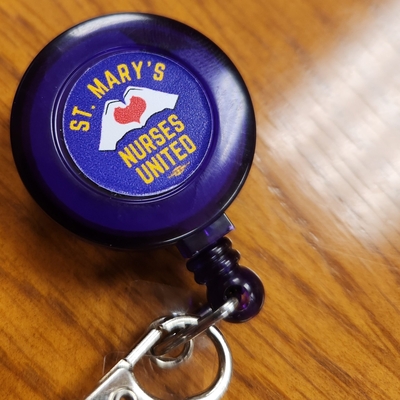
Employees typically attach their work badges to a retractable line coiled up in a holder called a badge reel that can be clipped to a lapel or pocket. When they made their campaign public, pro-union nurses began using a customized badge reel with an emblem, “St. Mary’s Nurses United.”
Supervisors have ordered employees to remove those badge reels. Espich and other nurses said they have been told that “this is soliciting” against hospital policy, and that nurses who don’t remove the badge reel would be sent home without pay for the day.
“With this union-busting, though, we’re all fired up even more,” Espich said.

Madison, WI