More megachurches want to be your alma mater
May 27, 2026 | 5:00 am ET
Description
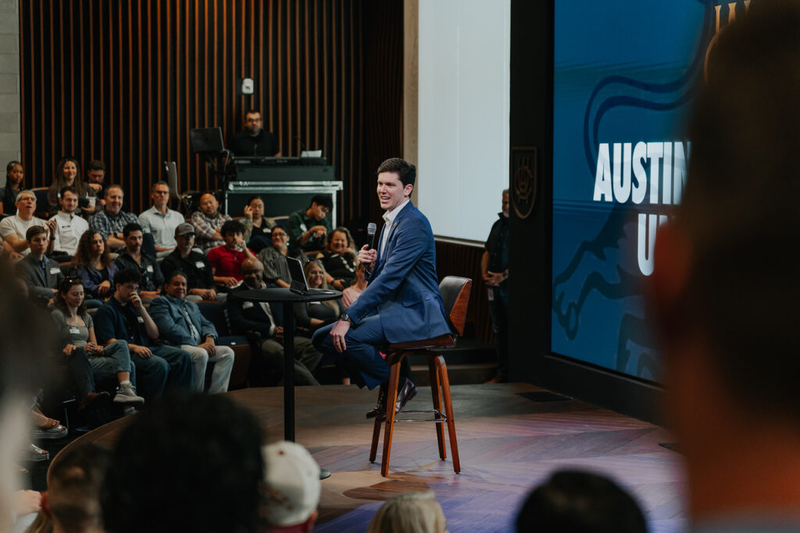
Connor Champion, president of Austin Christian University in Texas, addresses students at the school. Some of the nation’s biggest megachurches are getting into the college business, prioritizing hands-on job training and church culture over a more traditional liberal arts focus. (Courtesy of Austin Christian University)
In the heart of the Bible Belt, a small Methodist college graduated its final class in May 2024, shutting its doors after 168 years.
Birmingham-Southern College in Birmingham, Alabama, was a Christian private liberal arts school that counted among its graduates members of Congress, famous musicians, Pulitzer Prize winners and the former executive editor of The New York Times. Yet it had been unable to endure years of financial losses.
About 15 minutes southeast, toward the Birmingham suburbs, the inaugural freshman class at Highlands College was finishing its first year that same spring. The private Christian school, which has just gotten permission from the state to award bachelor’s degrees, was born out of the nondenominational Church of the Highlands, the biggest religious congregation in the state and one of the largest in the nation. It claims a weekly attendance of 60,000 across more than two dozen campuses in Alabama and Georgia.
Long-established, religiously affiliated small colleges such as Birmingham-Southern are battling the same existential pressures weighing on non-religious liberal arts colleges nationwide: declining enrollment, rising operational costs and a deepening skepticism of higher education among families who fear ideological influence on their children or question whether steep tuition and fees are worth it.
But a different model of Christian education is on the upswing: Some of the nation’s biggest megachurches are getting into the college business, prioritizing job training and church culture over traditional liberal arts. A franchise-style model from a Christian university in Florida has made it easier than ever for them to launch.
The new schools are attracting big donors and growing their enrollment through a built-in base of believers — and some are pushing to access public funding.
States including Florida, Georgia and Minnesota have opened their state financial assistance programs to religious colleges in recent years. The change mirrors a broader push already underway in K-12 education, where states have funneled billions to religious schools.
Many of these new colleges eschew the regional accrediting that’s standard for more established universities. Some pursue alternative accreditation from religious nonprofits that may or may not be recognized by the U.S. Department of Education.
That means students’ college credits may not transfer to other schools or to graduate programs. And the costs of non-accredited coursework aren’t eligible for federal financial assistance offered through the Free Application for Federal Student Aid, or FAFSA.
Supporters of the megachurch-affiliated schools say they’re a good option for students who want practical training for specific jobs, generally in ministry or business. They say students benefit from being closely connected to their local faith community.
But some experts question whether the schools’ lack of traditional accreditation could limit students’ options after graduation, or whether their close ties to one church could have an outsized impact on the school’s accountability and transparency.
“Public funding is something that everybody should be concerned about, no matter your politics, no matter your religion,” said Adam Laats, a professor of education and history at Binghamton University in upstate New York who has written books on the history of Christian education in America.
“And I think it’s everyone’s business if there are schools that are restricting the chances of students in a way that students aren’t aware of what they’re getting into.”
Financial aid
Schools such as Highlands College are growing their physical footprints with big donations from heavy hitters. A $20 million donation from the Green family, whose patriarch David Green founded the Hobby Lobby craft store chain, funded Highlands’ first two residence halls.
In March, 3-year-old Austin Christian University — born out of Texas-based Celebration Church, which has more than 23,000 members — broke ground on a $50 million complex thanks to a donation of the same size from Roger Bringmann, a vice president at California-based tech giant Nvidia.
The schools’ focus more closely aligns with many conservatives’ educational goals. Republicans in statehouses across the country have pushed to increase Christianity’s influence and presence in education, while President Donald Trump’s administration has proposed relaxing accreditation rules.
In Florida last month, Republican state Attorney General James Uthmeier declared the state won’t enforce its constitutional ban on funding religious institutions, opening the door for state-funded scholarships for Christian colleges.
The newer Christian schools also may benefit from battles fought by their older counterparts.
Last year, Georgia agreed to allow religious colleges to participate in state-funded financial aid programs after a 64-year-old Christian college sued the state over its law that barred theological schools from public tuition assistance.
And after two century-old colleges filed suit in Minnesota last year, a federal judge struck down a 2023 state law that barred religious colleges from a state-funded dual enrollment program that lets high school students enroll in college credit courses tuition-free.
“We’ve done lobbying at the state level, working with the state legislators to get access to things like in-state, need-based grants,” said Patrick Fitzgerald, a spokesperson for Southeastern University, in Lakeland, Florida, which has partnered with more than 200 churches across the country to help them launch colleges. “Depending on the need in each state and the availability of state funding, we try to access every scholarship dollar that we can for students.”
Accreditation of colleges, once low key, has gotten political
Many megachurch schools offer financial aid. But tuition and fees at more established church-affiliated schools can run into the mid-five figures — on par with their private college counterparts, but far above in-state tuition at big public universities.
At Highlands College, tuition, housing and fees total about $42,000 per year. The school, which focuses on training for the ministry, says 100% of its students receive scholarships. In-state tuition, housing and fees at the University of Alabama cost $28,196 per year. At Birmingham-Southern, the year it closed, those same costs totaled about $36,500.
But costs vary. At Elevation College, which plans to welcome its first class this fall and was launched by North Carolina megachurch Elevation Church, the tuition, housing and fees are about $19,936 per year. VOUS College of Ministry in Miami, based at one of the fastest-growing megachurches in Florida, charges $12,136 per year in tuition and fees, though that doesn’t include housing.
Single-church affiliations
Unlike more traditional schools that are affiliated with an entire denomination, these newer schools are often deeply entwined with the leadership at just one megachurch.
At Austin Christian, for example, the college president is Connor Champion, the son of Celebration Church’s founding pastors, Joe and Lori Champion.
Public funding is something that everybody should be concerned about, no matter your politics, no matter your religion.
Last year, Church of the Highlands founding pastor Chris Hodges stepped down from his role there to focus on being chancellor at Highlands College, and tapped the college’s president to become the church’s new head pastor.
Some critics say that when schools are closely tied to one church, rather than to an entire denomination, the church’s leadership and finances have an outsized impact on the school.
“You can end up with this insular, sometimes authoritarian power structure, which I don’t mean to say is unique to religious schools, but it is one of the hazards of this kind of institutional structure,” said Laats.
But having a college tied to a local church also can boost its credibility and accountability within that faith community, said Rick Ostrander, a longtime Christian college administrator who is currently the executive director for the Michigan Christian Study Center at the University of Michigan.
“There’s always the danger with new markets and new models that develop some bad actors or just some unhealthy situations,” Ostrander said, “but I think that’s less likely in this area than some other quote-unquote professional areas.”
Church franchise models
The Highlands model — practical, church-based job training paired with academic courses offered through an accredited partner university — is spreading, in part, thanks to a franchise-style approach from a Florida university that has made launching a church-based college easier than ever.
Southeastern University in central Florida is a private school affiliated with Assemblies of God, one of the world’s largest Pentecostal Christian denominations. Southeastern is accredited by a federally recognized regional accreditation body, and it’s one of the fastest-growing private nonprofit colleges in the country, according to the Chronicle of Higher Education.
One reason for that growth is it has partnered with more than 200 churches, including some of the nation’s largest, to offer accredited Southeastern degrees through local startup colleges. Some of these church colleges, such as Highlands, have hundreds of students; some just a handful. Southeastern provides the academics while the church provides the practicum classes.
About a third of the 13,600 students at Southeastern are at schools affiliated with their network partner churches, said Fitzgerald, who is chief of staff for Kent Ingle, the president of Southeastern.
The university helps the church colleges line up curriculum and instructors, he said, and helps secure the necessary state approvals.
“We make sure that their courses are up to accreditation standards,” Fitzgerald said. “We make sure that the faculty they have are well-qualified, and we’re able to provide a stamp of approval on pretty much what they’re already doing, and so it’s a match made in heaven, if you will.”
By offering educational degrees, a church can create a pipeline of future staffers who are steeped in its culture, a priority for megachurches intent on preserving their brand.
And it gives churches additional workers who run conferences, staff events or manage social media, all for college credit rather than wages. That can be a boon for high-revenue megachurches that rely on an army of volunteers.
Fitzgerald said he’s not aware that Southeastern has ever said no to a church that approached it about becoming a partner site. Revenue from student tuition and fees is split between Southeastern and the church college.
Coming changes
One of Southeastern University’s biggest success stories has been Highlands College in Birmingham. The school began offering unaccredited ministry courses in 2011 before joining the Southeastern network in 2017.
In 2023, Highlands was awarded its own accreditation by the Association for Higher Education, a network of Christian schools that has been recognized by the U.S. Department of Education and the Council for Higher Education Accreditation. It now offers more than half a dozen bachelor’s degree programs.
This fall, the college will launch a new business school and a bachelor’s degree in business leadership. The Dunn School of Business is named in honor of the former CEO of a faith-based investment group that has invested millions in a church-planting network co-founded by Chris Hodges, the chancellor of Highlands College.
In Texas, Austin Christian University is focused entirely on business education, offering a bachelor’s of business administration degree through its partnership with Southeastern. Tuition, fees and housing are $35,000 per year. In addition to academic classes, students attend weekly sessions with Christian business executives and can work with Christian entrepreneurs on business projects in a “startup accelerator” program.
The business focus could help protect the school from coming changes at the federal level.
The Trump administration has been working to overhaul higher education, including proposing a new rule that would require undergraduate programs to show their graduates earn more than the median earnings of similarly aged adults with only a high school diploma, or risk losing access to federal student loans and grants.
Some Christian higher ed organizations, such as the Association for Biblical Higher Education and the Council for Christian Colleges and Universities, worry these provisions would have a disproportionately negative effect on Christian institutions, particularly those that train for traditionally lower-paying ministry or church roles.
Fitzgerald of Southeastern said he isn’t concerned that the federal overhaul will harm the newest crop of church colleges.
“We believe that as students begin to really reevaluate the return on investment of higher education, we think that unique models for education like this one are the ones that are going to thrive and succeed,” Fitzgerald said.
Stateline reporter Robbie Sequiera contributed to this story. Stateline reporter Anna Claire Vollers can be reached at [email protected].