‘Not at the same level…yet’: ICE actions near schools in MN put Nevadans on alert
Jan 28, 2026 | 10:24 am ET
Description
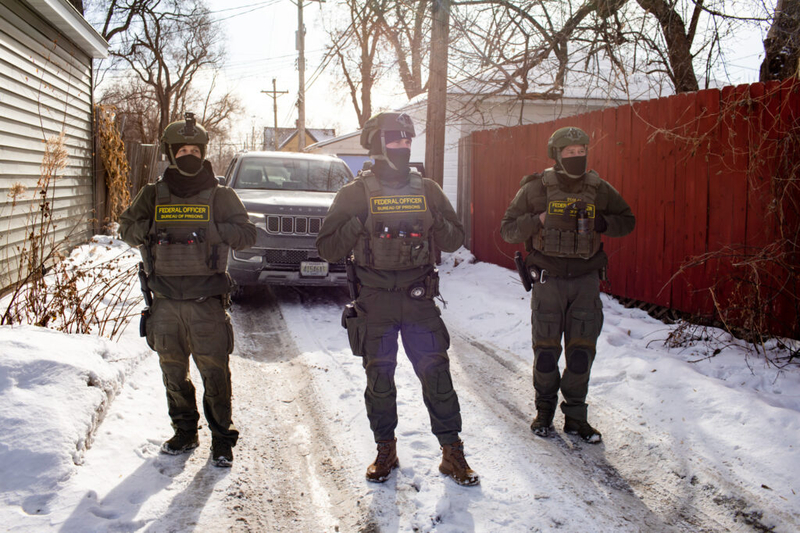
Federal agents block an alley in Minneapolis while they detain a man and his young daughter Thursday, Jan. 22, 2026. (Photo by Nicole Neri/Minnesota Reformer)
A 5-year-old boy, wearing a Spiderman backpack and a bright blue winter hat, detained by immigration enforcement agents after returning home with his dad after preschool. A chaotic scene outside a high school around dismissal time; immigration enforcement agents spraying chemical irritants and tackling people.
The Trump administration’s siege against Minneapolis has played out not just in public streets but in schools — places once considered “sensitive locations” off limits to immigration enforcement activities — and with children. It has many Nevadans wondering whether Clark County School District, the fifth largest school district in the country, is doing — or can do — anything to protect its students and their families if similar surges happen here.
The Nevada Department of Education says it “is not aware of any instances during the current or preceding school year in which federal immigration authorities have attempted to access Nevada school grounds without a lawful order, warrant, or applicable exception.” The department clarified to the Nevada Current that it is also unaware of any enforcement actions on school grounds that were deemed allowable.
The Nevada Immigration Coalition and the ACLU of Nevada say they are similarly unaware of any such activity on school grounds.
“What we have been hearing from the community is people have been picked up while they’re taking children to school or picking them up from school,” said Noé Orosco, coordinator of the Nevada Immigration Coalition, which is led by Progressive Leadership Alliance of Nevada (PLAN), Culinary Union and Make the Road Nevada and includes 20 statewide partners.
CCSD, in a statement to the Current, said it “cannot verify off-campus law enforcement activity.” The Nevada DOE said it could not speak to whether or how individual schools were tracking or reporting off-campus activities.
Orosco believes the district’s responsibility “does not begin and end at the school gates.”
“CCSD operates beyond the physical boundaries of a campus,” he says. “They have programs in community settings, they have a police department that monitors adjacent streets to campus. I don’t think the district should be narrowing its scope and saying it can only do something within the boundaries of any school.”
ACLU of Nevada executive director Athar Hassebullah said what happens outside of official school grounds is a “free for all.” Federal immigration agents are able to engage in those spaces, and because of a recent precedent set by the U.S. Supreme Court, they are increasingly profiling people based on perceived race or accent.
The prospect of immigration agents camping out near a school — either looking for specific individuals, or even just using their presence to incite fear — is a real threat, said Hassebullah. Making matters worse are growing reports of AI-generated images and videos of ICE agents outside of schools.
“This could cause additional panic,” he added.
Reports, whether intended to protect or to panic, are now common on local social media groups.
Data privacy concerns are also a growing concern, adds Hassebullah, though they are not as widely discussed because they don’t involve dark tinted SUVs driven by masked men with tactical gear. The ACLU of Nevada has sued the Nevada Department of Motor Vehicles, alleging the agency improperly and illegally turned over driver information to ICE.
All of this contributes to “a very real fear” among students and their families, advocates agree. Nevada has one of the highest shares of school-aged children in immigrant families, behind only California, Texas and New Jersey, according to American Community Survey data analyzed by KFF.
Mixed-status families, of which Nevada has many, may be rethinking their schedules to ensure that someone less likely to be targeted by immigration officials is picking up the children.
“These conversations are being had,” says Orosco, though he emphasized that such conversations aren’t limited to school bell schedules because immigration enforcement is currently happening in a variety of spaces, often without an audience of observers.
On the whole, Orosco feels the conversation is shifting, from “immigration enforcement in Nevada is not at the same level as Minneapolis” to “Nevada is not seeing the same level of enforcement yet.”
“Yet.” he emphasized. “The key thing is it is not happening yet.”
He continued, “The federal government has essentially shown it has no limitations. How can we prepare? Nevada could be a targeted location.”
During a special session in November, state lawmakers passed legislation to prohibit federal immigration officers from accessing school grounds without a warrant. Those provisions were amended into Gov. Joe Lombardo’s sweeping crime bill after separate, stronger protections being pushed by the Latino caucus were rejected by majority party leaders.
Lawmakers also passed a data privacy bill designed to better protect student data beyond FERPA.
But they should have done much more, says Hassebullah. The ACLU pushed for legislation to bar the expansion of ICE detention centers in the states. That “would have helped all people, including students and their families,” he added.
They also could have considered legislation to ensure that local police officers are on the side of Nevadans and not, as Hassebullah sees them, the “untrained thugs” on immigration enforcement teams who routinely harass and threaten citizens and immigrants alike.
Law enforcement should be required under state law “to immediately treat every single incident that comes through, in every single jurisdiction in Nevada, as an emergency,” says Hassebullah. “They should respond immediately and protect the individual that’s being accosted in that fashion.”
Adds Hassebullah, “There’s a whole lot more that could be done. We could also have a governor that steps up and says something about the issue as a whole.”
Lombardo did not respond to requests for comment about events in Minneapolis earlier this week. Early Wednesday morning, he issued a statement reiterating his support for “the President’s efforts to secure the border,” but also disapproving of Trump administration officials who decided “to draw conclusions related to law enforcement action without having all the facts.”
A hotline and ‘engaging’
In the absence of action from political leaders, community groups are stepping up.
Last year, during one of what they said were two immigration enforcement surges in the state, the coalition launched a hotline where people could report suspected ICE activity, which people would then try to verify and spread awareness about. The hotline also provides people with resources.
According to Orosco, the coalition around two weeks ago verified a parent had been picked up by immigration enforcement agents after dropping a student off at an eastside high school. But the incident did not occur on the campus itself.
Orosco said the coalition is “engaging” with CCSD Superintendent Jhone Ebert’s office and hopes it can sit down soon to collaborate. Members are hoping to discuss how and what resources the district is making available to students and their families.
Those efforts began before scores of students participated in anti-ICE walkouts. But Orosco thinks the walkouts have made it all the more important for which discussions to happen.
The students “are asking for leadership from the district that does not disappear when it becomes uncomfortable or politically difficult,” he said.
Orosco believes many of the students who participated in the walkout did so because the issue is highly personal.
“Many of them go to school carrying a question that they should not have to carry,” he said. “‘Will my family still be together when I get home?’ That fear doesn’t disappear when the bell rings. It will shape how they learn, whether they’re able to learn.”
Las Vegas, NV