Higher education in Louisiana, short $800M, appears headed for a funding overhaul
Aug 25, 2026 | 5:45 pm ET
Description
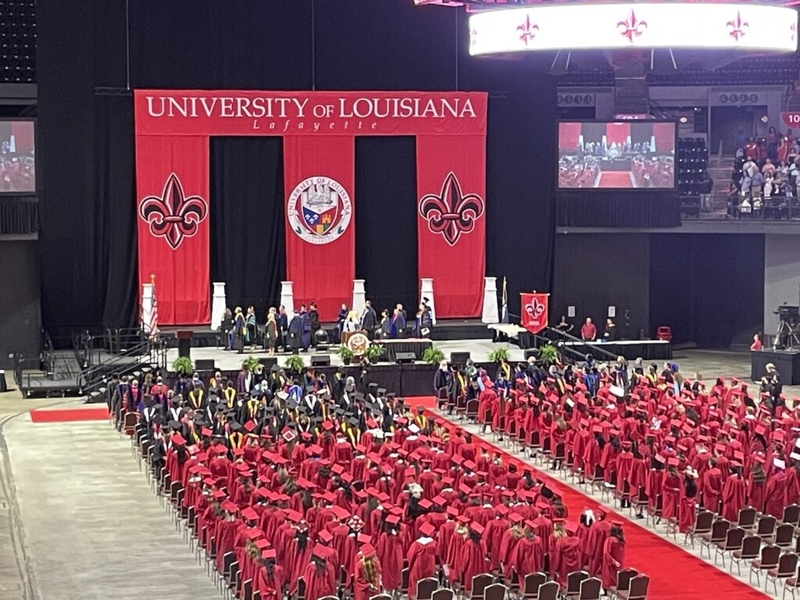
Graduates stand at the end of University of Louisiana at Lafayette commencement exercises May 16, 2025, at the Cajun Dome. (Greg LaRose/Louisiana Illuminator)
A legislative task force is staring at a growing problem with higher education in Louisiana: How to fund a system with more demands than ever before while state and federal dollars are on the decline.
Louisiana uses a outcomes-based formula to fund its colleges and universities. The bulk of the money provided, 70%, is considered base funding to cover their operational expenses. The remaining 30% rewards schools for reaching benchmarks, such as student retention, and meeting state priorities like workforce needs.
Questions about the formula were first raised earlier this year when some conservative lawmakers became aware of an old metric that incentivized universities to graduate already-enrolled minority students. Though it had already been removed from the formula, this metric became the topic of a U.S. Department of Education investigation.
The task force, which held its first meeting Tuesday, comes together at a time when higher education financing in Louisiana faces myriad challenges. They include schools being asked to do more to promote workforce development as Louisiana launches a series of major industrial projects.
Louisiana’s higher education funding problems are not new ones, although they have become more acute. During Gov. Bobby Jindal’s tenure from 2008-16, the state was in a self-inflicted fiscal crisis, with the governor choosing to use single-year budget surpluses to fund ongoing state government expenses. Higher education was on the chopping block annually to balance the budget, leading colleges and universities to switch from being primarily state-funded to student tuition-supported.
Since the start of the COVID-19 pandemic, inflation has created additional constraints across state government. Gov. Jeff Landry has kept higher education spending at a standstill since he took office in 2024.
Elizabeth Bentley-Smith, the deputy commissioner of higher education for finance and administration, told the task force that Louisiana’s public colleges and universities are underfunded by more than $800 million.
Increased costs for college athletics have been amplified over the past few years with the advent of revenue sharing and name, image and likeness payments. Schools are now diverting money from other items previously covered through philanthropy, such as facility upkeep, to keep their team rosters intact, university officials said.
Louisiana’s college sports programs are losing money. Can sales taxes save them?
As a result, nearly every athletic department at Louisiana’s Division I schools operates at a deficit, adding additional budget pressure to their universities.
These factors, plus declining enrollment at several institutions, have created budget crises at schools, including the University of New Orleans (now LSU New Orleans) and the University of Louisiana at Lafayette.
UNO faced a $30 million budget shortfall and implemented a spending freeze, layoffs and staff furloughs in an attempt to make ends meet. Due to the budget crunch, the school was transferred from the University of Louisiana System to the LSU System, with legislators approving more than $20 million to pay for the move.
UL Lafayette faced an approximately $50 million shortfall and implemented similar austerity measures.
The problem is likely to compound moving forward, with college enrollment anticipated to fall and the federal policy landscape uncertain.
Louisiana’s population is shrinking and its birth rate is declining. The state is projected to see a 7.5% to 15% decrease in students who attend college by 2029, the Public Affairs Research Council detailed three years ago in a report on falling enrollment in Louisiana.
That’s a problem because Louisiana’s colleges and universities have become increasingly dependent on student tuition dollars.
“This is a potential harbinger of things to come,” PAR President Steven Procopio told the task force.
On top of the state-level problems, federal policy could also lead to challenges for higher education, two analysts from the State Higher Education Executive Officers Association told the panel.
The Pell Grant program, which provides funding for low-income students to attend college, is already operating at a shortfall, which is projected to continually increase. Tom Harnisch, SHEEO’s vice president for government relations, said Congress either needs to provide more Pell funds, restrict who’s eligible or reduce award amounts.
The latter two options would be a problem for Louisiana, where 42% of college students get the award compared with 32% nationwide.
In addition, changes in the One Big Beautiful Bill Act reduced federal loan opportunities for graduate school students and could eliminate financial aid opportunities entirely for some programs if they fail the “do no harm” standard. It means graduates from those programs earn no more compared with those without that level of education.
Higher Education Commissioner Kim Hunter Reed said the Board of Regents is examining these changes to estimate their impact to Louisiana’s college and university budgets.
The One Big Beautiful Bill Act will also reduce Medicaid funding over the next 10 years, which will cut hard in Louisiana, one of four states facing the largest decreases. Historically, higher education has absorbed the brunt of major budget cuts in Louisiana.
As these costs pile up, Kristine Strickland, chancellor of Fletcher Technical Community College in Terrebonne Parish, said so do the expectations.
The governor has announced a series of major economic development projects throughout the state, each with their own specialized workforce needs. Many of these companies have made donations to the community colleges and universities that will train the students they intend to hire, but the brunt of funding these new programs falls on the schools themselves.
“We’re being called upon more and more to be responsive in an immediate time frame,” Strickland said at the task force meeting. “We do know that standing up new programs is a more expensive venture than maintaining current programs, and then taking those to scale is even more expensive.”
Sen. Mike Reese, R-Leesville, who chairs the task force, said it will meet at least three more times and hear budget presentations from campus leaders as well as state economic development and labor officials.
Reese, who became McNeese State University president on July 1, said he wasn’t sure if the committee’s report, which must be submitted to the Legislature by February, would overhaul the state’s higher education formula or just recommend tweaks.
Baton Rouge, LA