North Dakota rural health plan approved, ‘now we’ve got to implement it’
Jan 23, 2026 | 3:36 pm ET
Description
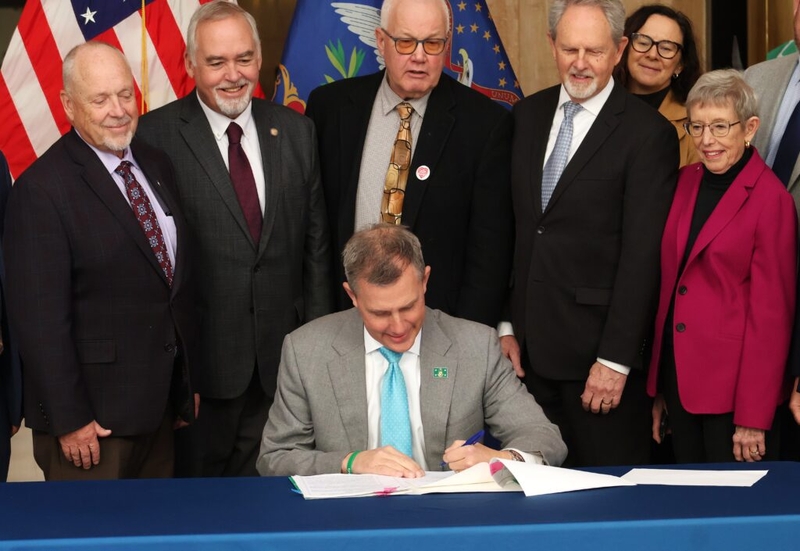
Gov. Kelly Armstrong signs a series of bills at the conclusion of a special session of the Legislature on Jan. 23, 2026. (Photo by Michael Achterling/North Dakota Monitor)
Gov. Kelly Armstrong on Friday signed a budget and four bills into law to lock in North Dakota’s first two years of funding from a massive federal rural health grant.
“This isn’t the end,” he said at a noon press conference after the Legislature brought its special session to a close. “This is the beginning — now we’ve got to implement it.”
The North Dakota Department of Health and Human Services will start accepting grant applications from organizations interested in program money in February, according to Interim Commissioner Pat Traynor.
The $50 billion program was created by Congress last summer as part of its budget reconciliation bill. It was advertised as a way to partially make up for funding rural states will lose from Medicaid cuts included elsewhere in the legislation.
The Legislature convened for three days this week to authorize the North Dakota Department of Health and Human Services to spend its share of the money. Legislative Council Director John Bjornson said the cost of the special session is expected to be roughly $225,000.
The flagship legislation of the session, the state’s Rural Health Transformation Program budget, passed in the Senate unanimously Friday morning.
House Bill 1623 appropriates $397.9 million for the program for the 2025-2027 budget cycle, the amount the state expects to receive for the first two years of the program.
North Dakota in December learned its award for 2026 would be $199 million. The state plans to dedicate $33.4 million of that on technology, $116 million to expand health care access in rural areas, $32.2 million to address workforce issues and $17.1 million to promote healthy lifestyles.
Armstrong said he’s particularly excited about the prospect of the grant being used to expand mobile health clinics and telehealth infrastructure in the state.
“If you have access to it and you don’t have to drive 100 miles in a blizzard for an appointment that you could do in that space, I think that’s really, really exciting,” he said.
The budget also includes a provision to enable the state-owned Bank of North Dakota to provide up to $40 million in stop-gap loans to grant applicants awaiting reimbursement from the federal government.
He said the Department of Health and Human Services will now submit the budget to the federal government for final approval.
The agency has launched a webpage for the Rural Health Transformation Program where people can sign up for email updates.
Organizations will have a short timeline to apply for grants. The Department of Health of Human Services has to commit the money by the end of October and spend it within the following year.
The agency will soon organize listening sessions to field questions from grant applicants, Traynor said.
The department will have personnel available to assist with applications. That includes hiring a liaison to help Tribal communities navigate the grant process, given their unique legal status as sovereign nations.
Rep. Collette Brown, a Warwick Democrat and a citizen of the Spirit Lake Nation, highlighted workforce shortages on the reservation as a major area where funding is needed.
“We need doctors, we need dentists, we need mental health, we need chiropractors,” Brown said.
Rep. Jayme Davis, a Turtle Mountain Band of Chippewa citizen, in the fall pushed for 5% of North Dakota’s award to be set aside for tribes in the state’s budget, but the Rural Health Transformation Committee rejected her proposal.
Davis said she’s concerned about rural communities in the state getting their fair share of the funding.
“I want to make sure that the frontier, the real rural, is at the top of everybody’s list,” the Rolette Democrat said.
Armstrong on Friday afternoon also approved four policies that the Trump administration incentivized states to adopt by promising extra Rural Health Transformation Program money.
One of those policies, Senate Bill 2402, allows pharmacists to prescribe some medications to patients and order some lab tests.
House Bill 1621 requires North Dakota students to participate in the presidential physical fitness test.
Armstrong also signed Senate Bill 2401, which mandates doctors receive one hour of education on nutrition and metabolic health as part of their continuing education.
The fourth policy, House Bill 1622, allows North Dakota to join a licensure compact for physician assistants.
The Legislature this week also passed a handful of unrelated bills, including an amendment to clarify how the residential property tax credit is applied.
House Bill 1626, brought by Rep. Craig Headland, R-Montpelier, would change how counties apply a 5% discount to homeowners who pay property taxes early. Currently, the 5% discount is applied after the primary residence credit, which Headland said prevents some homeowners from receiving the full $1,600 property tax credit promised to them during the 2025 Legislative session.
Lawmakers also approved legislation to set aside $325,000 for litigation funding for the Public Service Commission. If more money is needed, the bill authorizes the commission to take out a loan from the Bank of North Dakota as well. The legislation also earmarks $1.5 million for North Dakota Information Technology to bring state websites and other digital content into compliance with American Disability Act requirements.
Other legislation passed by the Legislature would allow the University of North Dakota to use proceeds from a land sale for renovations to the Ray Richards golf course or to support the school’s varsity golf teams. The university is selling 6.5 acres of land to the Department of Transportation to accommodate a railroad underpass project.
Additionally, the Legislature approved a resolution brought by Rep. Glenn Bosch, R-Bismarck, celebrating the 175th anniversary of the YMCA.
Armstrong signed the additional bills Friday afternoon.
North Dakota Monitor reporter Jacob Orledge contributed to this report.
This story was updated.
Bismarck, ND