Looking back on 60 years of Medicare and Medicaid
Aug 07, 2026 | 5:55 am ET
Description
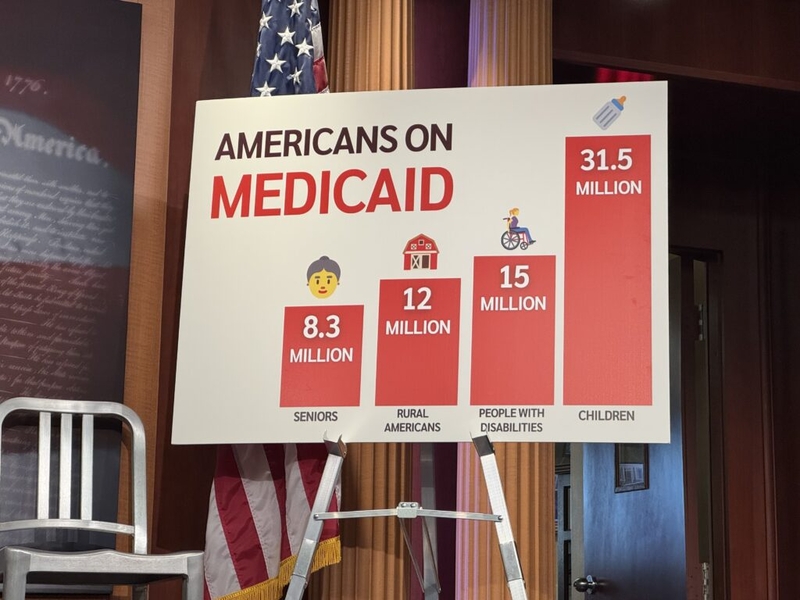
Medicaid sign at U.S. Senate Democrats’ press conference on Feb. 19, 2025. (Photo by Shauneen Miranda/States Newsroom)
Last week marked the 61st anniversary of Medicare and Medicaid, and with so many dire threats to both health care programs, we would do well to reflect on their history and the promises delivered to millions of Americans since they were signed into law six decades ago in Independence, Missouri.
On July 30, 1965, President Lyndon B. Johnson signed the Medicare and Medicaid Act, marking the beginning of Medicare, a health insurance program for people over 65, and Medicaid, a health insurance program for people with limited income.
At the bill-signing ceremony, former President Harry Truman and his wife Bess were enrolled as Medicare’s first two beneficiaries and received the first Medicare cards. President Johnson then recognized Truman for his 20-year effort in pushing for a national health insurance program. As far back as 1948, Truman, while campaigning for reelection, had said, “I put it to you, is it un-American to visit the sick, aid the afflicted or comfort the dying? I thought that was simple Christianity.” Truman won reelection, however he faced impossible opposition from Congress, and would have to wait 20 years to see his dream of a national health care program fully realized. Truman then remarked at the ceremony, “Mr. President, I am glad to have lived this long and to witness today the signing of the Medicare bill which puts this Nation right where it needs to be, to be right.”
Today’s Medicare program provides healthcare for 70 million senior Americans. Prior to President Donald Trump’s so-called “Big Beautiful Bill” passed in July of last year, nearly 81 million Americans received health care through Medicaid. But in passing that bill, the GOP controlled Congress, including our entire delegation, made the single largest cut to healthcare in U.S. history, with a $1 trillion cut to Medicaid alone. In only one year since that fateful vote, a staggering 8 million Americans have already lost healthcare coverage. And for what? To pay for tax breaks for billionaires and big corporations.
And the hits from the Trump administration keep coming: last week the Centers for Medicare & Medicaid Services announced that it will end Medicare Part D, a subsidy program that stabilizes premiums of prescription drug plans, impacting nearly 25 million seniors and people with disabilities who afford prescriptions through that program.
The elimination of Affordable Care Act tax credits coupled with onerous eligibility restrictions have also led to skyrocketing premiums and a precipitous drop in the number of people with health care coverage. We can expect that healthcare enrollment will continue to deteriorate as people on Medicaid struggle to reckon with the mountains of paperwork now required around work reporting requirements and redeterminations — scheduled to go into effect in January 2027.
According to Steve Davis, a professor in the department of health policy management at West Virginia University, “You will see less utilization of healthcare services because people no longer have insurance. So less utilization, less access to health care and more sickness, morbidity and potentially even mortality. And that is more costly for us all.”
The president and our members of Congress have turned their backs on the needs of West Virginians. This may come at a great political cost as the damage is felt by more and more people in terms of higher costs, loss of coverage, bankruptcies, hospital closures, preventable deaths and job loss.
President Johnson, in his praise of President Truman for his unwavering commitment to a national health care program, said, “And just think, Mr. President, because of [Medicare and Medicaid] — and the long years of struggle which so many have put into creating it — there are men and women in pain who will now find ease. There are those, alone in suffering who will now hear the sound of some approaching footsteps coming to help. There are those fearing the terrible darkness of despairing poverty — despite their long years of labor and expectation — who will now look up to see the light of hope and realization.”
Instead of hope or help, today’s approaching footsteps are bringing misery to millions of Americans. But at some point, hopefully soon, they will wake up a sleeping giant.
Charleston, WV