No immediate decision from judge on releasing probe of controversial UNC program
Aug 04, 2026 | 9:01 pm ET
Description
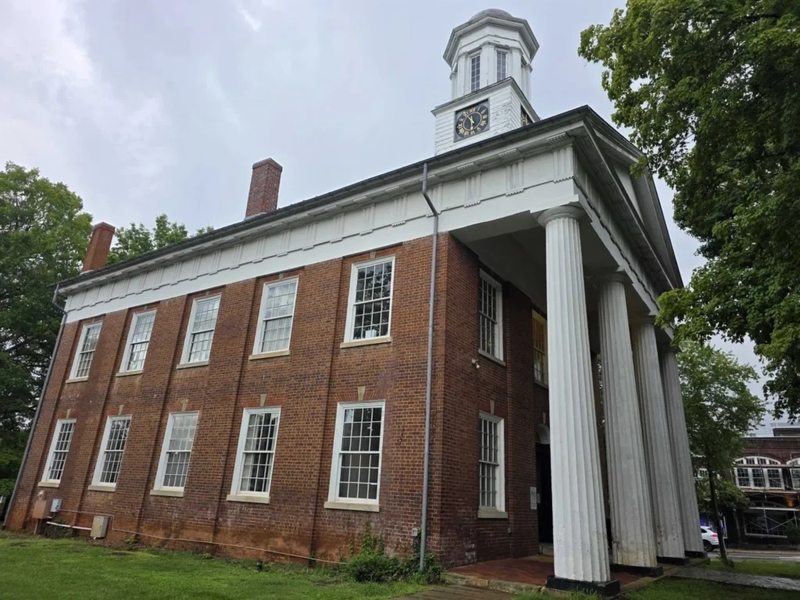
The historic old Orange County courthouse in downtown Hillsborough, built in the 1800s, has been replaced mostly by a newer courthouse across the street, but still hosts hearings in civil cases, Aug. 4, 2026. (Photo: Frank Taylor/ Carolina Public Press)
A coalition of news media organizations and the University of North Carolina at Chapel Hill will have to wait a bit longer to learn whether a lawsuit seeking the release of records from the school will go forward.
An Orange County judge who conducted a hearing in the case Tuesday did not immediately issue a ruling.
The lawsuit from the news media organizations, including Carolina Public Press and NC Newsline, claims the state public records law requires the university to release a $1.2 million, 400-plus page report on its internal investigation into its controversial School of Civic Life and Leadership, or SCiLL.
UNC disagrees and has asked for summary judgment, which would effectively end the case.
Before issuing a ruling, Superior Court Judge John Morris said he will personally review the internal investigation report to help him decide whether to end the lawsuit or let the case proceed to trial.
Controversial UNC program
Since its inception in 2023, SCiLL has drawn criticism for its faculty turnover rate, connections to conservative scholars and hasty confirmation by the UNC Board of Trustees and the legislature.
On account of turnover, the university said it would bring in outside firm K&L Gates to conduct an “independent and impartial” review of SCiLL in September 2025.
UNC announced K&L Gates had completed its review of the school March 6 but swiftly denied public records requests seeking the full report, or even a summary, and issued a public statement that the report would not be released.
News media case
The news media coalition sued the university in April, arguing that it is a public record because it was paid for with taxpayer funds.
The parties failed to reach a consensus during a mandatory mediation session last month. Tuesday’s hearing was the result of UNC’s attorneys filing a motion for summary judgment, a request to end a lawsuit before it goes to trial on the grounds there’s no legal argument to continue.
UNC’s primary argument for keeping the report from public view is that its contents are trial preparation materials, and there is a prospect of litigation. It’s not clear what trial the university is preparing for in relation to the report, though UNC’s attorney Wes Camden said there have been allegations related to employment and hiring decisions and anti-discrimination laws like Title VII and Title IX.
“Every single page of this report was stamped by K&L Gates as being attorney work product, and that was done at the time,” Camden said. “That was done well before any of this was raised.
“So, respectfully, your honor, our position is the entire report is governed by trial preparation materials. It’s obviously why the report was commissioned. It’s why the report was prepared, and it’s frankly what the report does.”
The news media outlets’ attorney Mike Tadych referred to a statute in the public records law, G.S. 132-1.9, which says if a public records request is denied on an assertion that the public record is trial preparation material prepared for a legal proceeding that has not happened, the owner of the record should provide a written justification. There is no pending litigation, and a justification hasn’t been produced, Tadych said.
The university has also said the report is covered by attorney work product privilege and the state’s Human Resources Act. While such exceptions are not directly included in the public records law, the defense argued they still apply.
“Although the Public Records Act provides broad access to public records, that access is not absolute because ‘the Public Records Act contains various exemptions,’” the motion for summary judgment read.
“Some exemptions — like the exemptions for trial preparation materials and attorney-client communications are embedded within the Public Records Act itself. Others are scattered throughout the General Statutes but apply to the university as a public agency and state employer. Regardless of their location, exceptions and exemptions to the Public Records Act are construed narrowly.”
But Tadych said those “common law exceptions” not explicitly found in the public records law, have been found in previous case law to be insufficient, such as in McCormick v. Hanson.
Three of the news media outlets suing the university, Carolina Public Press, NC Newsline and the Daily Tar Heel, either did not make a request for the report or did not request it until after the lawsuit had been filed.
Camden said the news media organizations could not be denied the report if they had not requested it, which Tadych called a diversion, given the university had made it clear through denials to other news media outlets, which are visible on the university’s public records portal, and its statement that the report would not be released.
“What Mr. Camden did not tell you was that, had they received the report, I wouldn’t be standing in front of you,” Tadych said.
“So they too have been denied, and I think that’s a bit of a procedural red herring. Nobody in this room, other than counsel for the defendants and now you, your honor, has been allowed access to this report, in our understanding.”
The judge could opt not to recognize those specific news media companies in the case if he agrees with the defense’s argument about them, but there are other players whose claims would still have to be addressed, Tadych said.
A version of the 400-plus page report had already been provided to Morris by UNC’s attorneys ahead of the hearing. After arguments, Morris said he would have to review it himself, which he would be unlikely to complete within this court session, which is usually a week long.
“It will be an intensive legal inquiry and review,” Morris said.
Tadych told reporters the judge may come to a number of conclusions, such as the entire report should remain confidential or just parts of it should be redacted.
So far, not so much as a title page or an index has been released. Tadych speculates that’s in part because it would be a bad look for the university to release 400 pages blacked out with redactions. But that might be what the public records law obligates it to do, Tadych said.
There’s been a widespread push from faculty and students for the university to release the report. The UNC Faculty Council approved two resolutions April 17 calling for transparency related to SCiLL and the report, including a suggestion the university release it with redactions, if necessary. Students also protested shortly after the news media coalition filed the lawsuit, calling for the university to “release the SCiLL files.”
“If you look at their briefing, their position on it has been a lot about that the school’s taken on a lot of criticism, both internally and externally — this investigation using public funds was to address that,” Tadych said.
“Under the Human Resources Act, the university can say, ‘Well, this is important enough for the integrity of the program, or the services that the program delivers, that we can release the information.’?They’ve not availed themselves of that, and instead have said, ‘A thumbs up to everything, and that’s all we’re gonna say.’
“Having spent a million dollars plus on a report and having this new school created, it engenders some controversy. And if this report addresses that, then why shouldn’t the public be able to see that?”
This article first appeared on Carolina Public Press and is republished here under a Creative Commons Attribution-NoDerivatives 4.0 International License.

Raleigh, NC