NJ Supreme Court sides with Seaside Park in eminent domain case
Aug 10, 2026 | 1:24 pm ET
Description
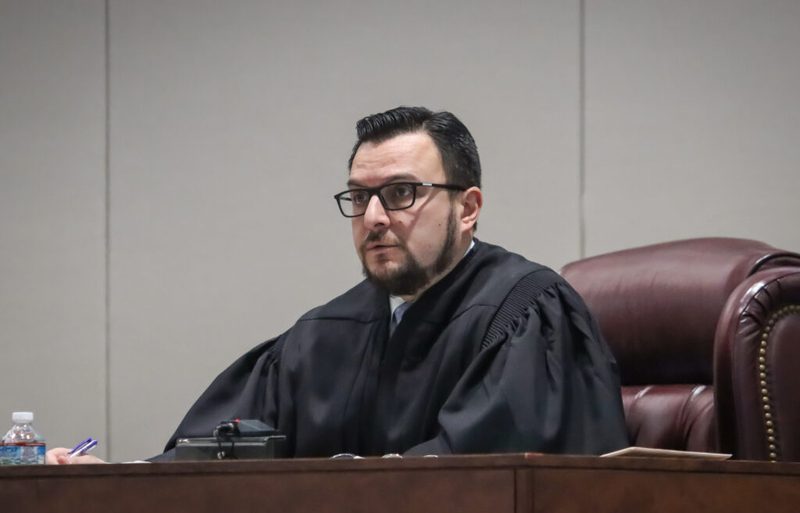
New Jersey Supreme Court Justice Michael Noriega wrote Monday’s majority opinion backing Seaside Park in its attempt to seize a motel via eminent domain. (Photo by Mary Iuvone/New Jersey Monitor)
New Jersey law does not require municipalities to say why they need land they seek to claim through eminent domain, the state’s Supreme Court said in a divided ruling Monday.
In a 6 to 1 decision, the justices ruled that towns are not required to state the public use that prompts them to claim property through eminent domain, resolving Seaside Park’s yearslong quest to claim the Desert Palm Inn, a motel it moved to condemn in April 2022.
“No law requires a municipality to articulate the intended public use in the ordinance itself,” Justice Michael Noriega wrote for the majority.
Shree Jyoti, the firm that owned the motel, had argued it could not be seized by eminent domain because Seaside Park did not specify why it needed the property when it passed an ordinance to take it. The borough said only that it would be put toward a public use.
Though town officials in legal filings later said they would turn the property into a parking lot — and yet later, a well — neither New Jersey’s Eminent Domain Act nor its Local Lands and Buildings Law require it to state the taking’s purpose in ordinance. They only require the municipality to pass an ordinance, the court ruled.
“The statute does not set forth any requirements for the ordinance beyond the need for its adoption — it is silent as to the contents of the ordinance,” Noriega wrote.
In his dissent, Justice John Hoffman said he would have blocked the acquisition because Seaside Park had violated the square corners doctrine, a judicial construction that effectively says government agencies must be forthright when dealing with the public.
In this case, forthrightness would have meant disclosing the proposed public use for the property as early as possible, wrote Hoffman, who agreed that state law does not require towns to state a public use in an ordinance approving an eminent domain seizure.
Seaside Park knew its plans for the property at least at least a month before it moved to claim it, according to court records, but declined to disclose that purpose to the motel’s owner upon request.
It only revealed the purpose the second time it sued to claim the property, some five months after the borough approved the ordinance to seize it. The borough’s first suit was dismissed because it did not state a public use, and this appeal flowed from the second.
“I cannot join an opinion that overlooks the Borough’s intentional lack of candid engagement,” Hoffman wrote. “By excusing such conduct, the majority degrades the ‘square corners’ doctrine that asks our public leaders to operate with a baseline level of honesty and integrity.”
The majority’s opinion did chide Seaside Park for its lack of candor, acknowledging “the borough has spent the last four years involved in a matter that likely could have been resolved by simply disclosing the intended public use at the earliest reasonable point.”
The court’s decision here is incongruous with a recent ruling that blocked Jackson’s use of eminent domain to claim land it attempted to swap with a developer for a different parcel, Hoffman noted. There, the court found Jackson failed to be forthright because its statements that the seized lands would be used for open space were false.
“If a municipality can be found to have failed to ‘turn square corners’ by offering a pretextual public purpose, it is unclear how, exactly, it can satisfy its obligation to act ‘forthrightly’ by refusing to disclose its known public purpose for the property in question when asked,” Hoffman wrote.

Trenton, NJ