‘Not too reassured’: WV lawmakers unimpressed by Flock rep’s answers to privacy concerns, more
Aug 10, 2026 | 6:00 am ET
Description
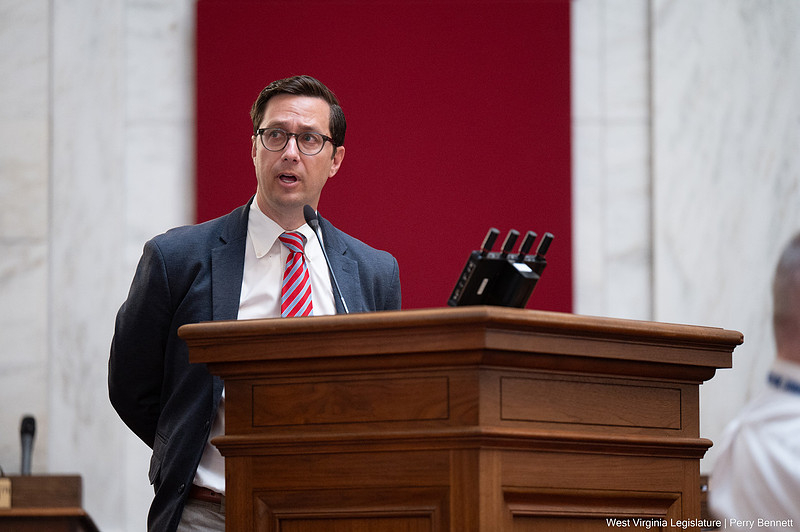
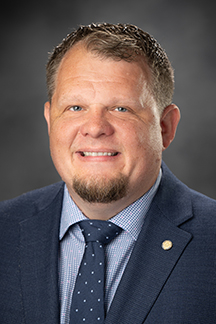
Kevin Kane, the director of Government Affairs for Flock Safety, presents to the Joint Standing Committee on Government Organization in House chambers on Sunday, Aug. 9, 2026 in Charleston, West Virginia. Lawmakers on the committee spent over an hour seeking clear information on how Flock — which is entering into contracts with localities and businesses across the state — functions. (Photo by Perry Bennett/West Virginia Legislative Photography)
As localities across West Virginia move forward with purchasing controversial surveillance equipment meant to assist law enforcement agencies, a representative for Flock Safety — the major contractor behind several of these agreements — presented to state lawmakers on Sunday in an attempt to answer questions about the company and its products.
Overall, some lawmakers on the Joint Standing Committee on Government Organization were unimpressed with the few answers they received from Kevin Kane, the director of Government Affairs for Flock Safety. For over an hour, legislators asked Kane about how Flock functions — they wanted more insight into how the data collected by Flock technology is stored, who owns and has access to it, what security measures exist to protect it and how bad actors who misuse it are found, among numerous other things.

“To me, where the rubber meets the road on this is getting answers to specific questions about what the safeguards are,” said Del. Tristan Leavitt, R-Kanawha. “Based on the reporting that’s out there, there are a lot of questions and I was not too reassured about the answers we got today.”
Leavitt — along with more than 10 other legislators from the joint committee — grilled Kane on recent controversies circulating around Flock. They referred to investigations revealing that police across the country have misused the technology to stalk people unrelated to criminal investigations and a December incident where 60 Flock cameras in California were compromised, leaving public livestreams available for anyone to access and download from a 30 day period. They attempted to get clear answers on who actually owns the information collected by Flock’s system and what data exists to support the company’s assertions over the software’s accuracy.
Several of the questions were met with contradicting information and promises from Kane that he would follow up with their offices in private.

“I’m glad they were willing to answer any and all questions, but I’m not totally certain that the answers were direct. There was definitely some talking around the direct answers,” said Sen. Patricia Rucker, R-Jefferson. “There was a little bit of skating around the questions instead of actually wanting to address directly what our concerns were.”
Kane asserted that Flock has “never been hacked” and the incident in Bakersfield, California, was due to “a bug” with the internet service provider.
He said that Flock has implemented more protections, like an internal audit program, to flag questionable queries into collected data.
Kane said that automatic license plate readers, or ALPRs, from the company only capture license plate numbers, and that the system operated with “about 99.99%” accuracy for flagging plates that are already on law enforcement’s radar due to information collected in investigations, like AMBER alerts or stolen vehicles.
But that data — and several other assertions made by Kane — are only provable through internal surveys performed by Flock, not an independent source. In 2024, a police department in Roseville, California performed its own audit of Flock’s ALPR accuracy. They found that the Flock technology misread license plates in 71% of the alerts it sent to police.
Kane also said — numerous times — that “all of the data” collected by Flock’s systems are “100% owned” by the customers they serve, like law enforcement agencies, private businesses and home owners associations. But that data, he also said, is accessible to Flock corporate and pulled to help train the company’s AI models, as well as for any other use the company may have.
“Under your agreements, it grants Flock non‑exclusive, worldwide, perpetual, royalty‑free right and license during and after the term thereof to disclose the agency’s data, inclusive of any footage, to enable law enforcement monitoring against law enforcement,” said Del. Ryan Browning, R-Wayne. “I don’t think that sounds like it’s the citizens’ data when you have a perpetual right to access this data at any time.”
Kane, in response, said he understood this to be “quite standard language” for services like those provided by Flock.
That language, Browning said, is included in the contract that Huntington City Council recently entered into to install a $2.1 million Flock surveillance system, which will include ALPRs along with audio detection, live video cameras and drone services.
The five-year contract for the devices will cost Huntington $394,785 the first year and $438,220 per year thereafter, according to a resolution. The city will pay another $77,560 for two years for professional services with Flock.
After Huntington faced backlash, leaders of some cities in the area have spoken out against the cameras, or reconsidered their agreements with the company. The Putnam County Commission reportedly purchased eight of the Flock cameras last year, but officials there said they wouldn’t be turned on.
Community organizers in Huntington are collecting signatures in an effort to pass a city ordinance prohibiting mass surveillance systems that would require the city to void the contracts with Flock.
West Virginia arm of the American Civil Liberties Union is suing Huntington in Cabell County Circuit Court, alleging the city neglected key procedural matters in awarding the Flock contract.
And while Sunday’s meeting — which also included a presentation from Alasdair Whitney, legislative counsel for the Institute for Justice, a libertarian legal group that has sued Flock and other surveillance companies over alleged civil liberty violations — was focused on ALPRs specifically, lawmakers said there is much more at stake.
“We know there are more than license plate readers being purchased — we’re seeing it (in West Virginia) already. There are cameras, drones, voice recorders, more. These things are all connected, and they’re all being marketed here,” Rucker said. “We can’t pretend that (ALPRs) are the only technology in front of us, and we need to be aware of the potential risks that all of these tools can bring when used together.”
Leavitt said limiting the conversation was a disservice to both lawmakers and the public.
“Giving only information about their license plate readers when people are asking about facial recognition — that’s not very helpful to policymakers who are trying to craft a policy that applies in every way,” Leavitt said.
Rucker said she had concerns about how the technology sold and operated by Flock could violate residents’ rights under the Fourth Amendment. If a police officer needs a warrant to survey someone suspected of committing a crime, she posed, how is it constitutional for a camera or other technology — including automatic license plate readers, or ALPRs — to survey without that barrier?
Kane said that Flock “strongly encourages” governing bodies to implement “robust guardrails” to mitigate adverse outcomes of using the technology, including against people who may abuse access to it. He urged lawmakers to “not just rely on the practices” set forth by vendors like Flock.
And while Kane framed the services offered by Flock as a tool to improve “precision policing,” Whitney urged lawmakers to exercise caution regarding the use of the technology. Several courts are considering cases that could define how extensive evidence collected from Flock and other surveillance companies can be used.
Whitney said that lawmakers in West Virginia and beyond, however, should not wait on the courts to implement their own “technology-neutral” safeguards to ensure that whatever surveillance technology is used, runs both ethically and legally.
He said that the Institute for Justice has created model legislation to help put these protections in place. That legislation would include language clarifying that a warrant is required, with limited exceptions, before law enforcement use ALPR data to track citizens. The legislation would also lock down data‑sharing across jurisdictions, letting West Virginia agencies refuse out‑of‑state or federal requests unless there’s a warrant or a clearly defined exception, and layer in basic auditing and transparency rules so lawmakers and the public can see how often and why the system is searched.
Whitney stressed that his proposal doesn’t ban Flock’s cameras or other surveillance tools; it’s designed to set a floor of protections around “location information” before the technology spreads to “every street corner.”
Rucker, speaking after Sunday’s meeting, said that the Legislature’s discussions over Flock and other surveillance technology is just beginning. She said she understands that the technology offered by Flock can help law enforcement agencies — some of which are severely understaffed and overburdened — but there is a necessary balance that must be struck to ensure that residents don’t have their privacy violated.
“We can only use these things in good conscience if all the safeguards are in place and with the understanding that a search warrant is still necessary to track a citizen,” Rucker said
Leavitt said he looked forward to hearing more from Flock regarding the numerous questions he posed that Kane was unable to answer, but he also understands that Flock is a private company attempting to sell a product to governments of all sizes across the country.
“These are questions that have also been asked before other legislatures, and some other legislatures have been very unhappy with the candor they received … So now I think it’s very important to follow up, but at the end of the day, large companies pay government relations people a lot of money to do the job that they do, to provide information in a smooth way,” Leavitt said. “We could craft the best policy on earth, but without knowing the specifics of how their technology works, it would be irrelevant.”
Lori Kersey contributed to this report.
Charleston, WV