Anti-uranium advocates wrest control of public hearing on proposed mine near Navajo Nation
Aug 10, 2026 | 5:07 pm ET
Description
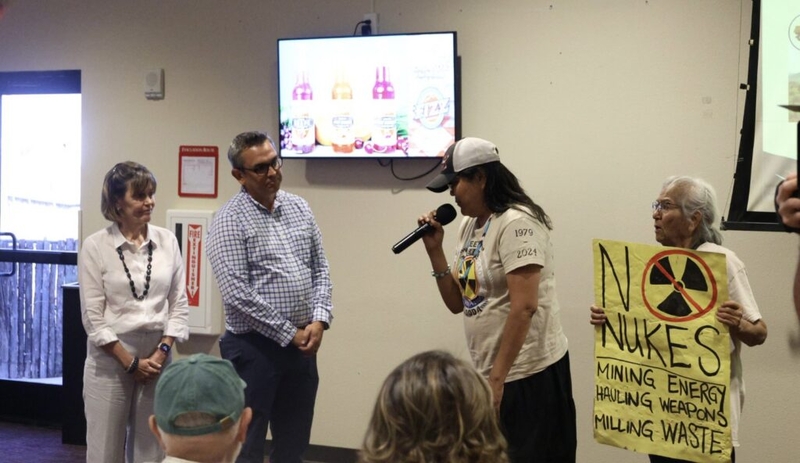
Anti-uranium advocate Jenn Nez, holding microphone, addresses NuFuels, Inc. vice president Josh Leftwich on Aug. 6, 2026, after he agreed to hand her the microphone midway during his presentation regarding the company’s efforts to extract uranium near Church Rock, N.M. (Patrick Lohmann/Source NM)
GALLUP — A recent hearing meant to inform the public about a new uranium mine proposal near Church Rock instead exposed wounds around the legacy of mining’s impacts on Navajo communities, as well as fresh concerns about whether technology that promises to safely extract the mineral is as clean as the industry claims.
Laramide Resources, a Canadian mining company, and its subsidiary NuFuels, Inc., held a public hearing Thursday at a casino near Gallup as it seeks a permit from the New Mexico Environment Department to discharge.
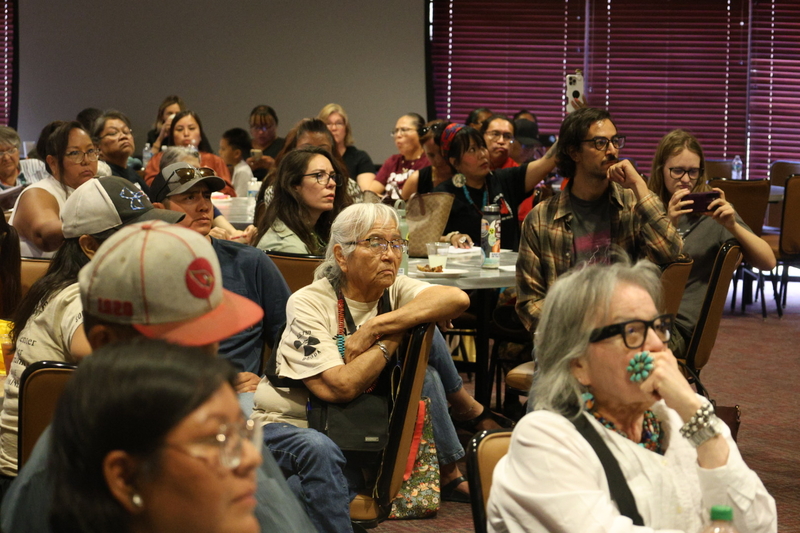
But Navajo anti-mining advocates, as well as those who still remember the cascading consequences from the 1979 Church Rock mine spill, shouted out repeatedly during the company’s presentation. They expressed frustration that NuFuels would pursue a uranium mine in an area still contending with the biggest uranium spill in the nation’s history, as well as numerous other public health and environmental harms from decades of uranium mining.
About half way through company Vice President Josh Leftwich’s presentation, advocate Jenn Nez slowly got to her feet and walked toward Leftwich, ultimately convincing him to hand her his microphone.
Through tears, Nez described cancer and other health issues she said uranium contamination caused in her family. Leftwich did not get the microphone back for most of the rest of the 90-minute meeting, as a line of fellow opponents gathered alongside Nez and waited for their chance to speak.
“Thank you for giving us this opportunity, because we took it from you,” Teracita Keyanna, vice president of the Red Water Pond Road Community Association Executive Committee, told Leftwich. “This is my community. This is my family. That’s my home you’re talking about.”
Leftwich’s presentation centered on a proposed uranium project called Church Rock Section 8, which the company hopes to build on a 175-acre site of private land surrounded by the Navajo Nation, which bans uranium mining. Before Leftwich was interrupted, he detailed how the company sought to use a mining method known as in situ recovery to access roughly 10 million pounds of uranium contained in sandstone formations in the underground aquifer.
In situ recovery entails the injection of lixiviant — a chemical solution composed of water, oxygen and either carbon dioxide or sodium bicarbonate — to dissolve the uranium underground. From there, pumps extract the uranium liquid into recovery wells, where the uranium is separated. The leftover water is then discharged back into the aquifer.
“It’s a closed-loop system,” Leftwich said. “There won’t be any other discharges. The water just circulates through the formation to extract the uranium.”
The company’s permit application notes that, when fully operational, it will seek to discharge roughly 4,000 gallons of leftover water a minute back into the aquifer, which provides drinking water to the Crownpoint community. That would be the equivalent of about nine Olympic-size swimming pools’ worth of water a day.
The company cannot begin mining until the NMED rules on the permit application, which officials said will take at least a year.
Still, Leftwich’s presentation extolled the virtues of in situ recovery as a low-emissions means of extracting uranium without risking the lives of workers underground.
By the #s: More mining claims filed in New Mexico in last 4 years than previous century
The company would also employ monitoring wells to ensure the water quality meets federal and state standards, and the company is in preliminary stages of a research project with Los Alamos National Laboratories that aims to restore the groundwater supply with “approaches tailored to the geology of the Churchrock deposit.”
However, state officials are dubious about the company’s promises to restore the groundwater to its pre-mining condition. Earlier Thursday, the New Mexico Department of Justice weighed in on the company’s pending license renewal application to the federal Nuclear Regulatory Commission with a 39-page rebuttal of numerous claims the company has made regarding its operation and in situ recovery more broadly.
The NMDOJ’s “petition to intervene” argues that in situ recovery has never been proven to restore groundwater supplies to their pre-mining states and that no technology yet exists to do so. It cites NuFuels’ own statements in an unrelated filing before the NRC in 2023, in which the company states that, “to date, no ISR site has restored all groundwater constituents of concern to pre-operational concentrations” and that uranium levels “tend to gradually rebound” in aquifers after the treatment.
Therefore, the NMDOJ wrote, the company has acknowledged “that the technology needed to ensure compliance with the governing restoration standard does not yet exist and that developing it is the object of ongoing research.”
Advocates who wrested the microphone from Leftwich on Thursday also raised concerns about what they said is untested technology, with one woman shouting that the NuFuels was making “Guinea pigs” out of the communities downstream of the mine site.
Leftwich told Source NM after the hearing that he was surprised the New Mexico Department of Justice would weigh in on what he sees as a “pretty small issue” regarding a single mine in the Church Rock area, “compared to big issues, like across the state.”
As for the hearing itself, he said he was content to let people “speak their minds” about the issue, but also that legacy uranium issues and “misinformation” are preventing a productive community debate. The hearing also marked the beginning of a 60-day public comment period.
“This is the first of hopefully multiple meetings that we can get more in-depth,” he said. “I really wish we could have good meetings.”
Santa Fe, NM