New Mexico Election 2026: Commissioner of public lands
Sep 24, 2026 | 6:19 pm ET
Description
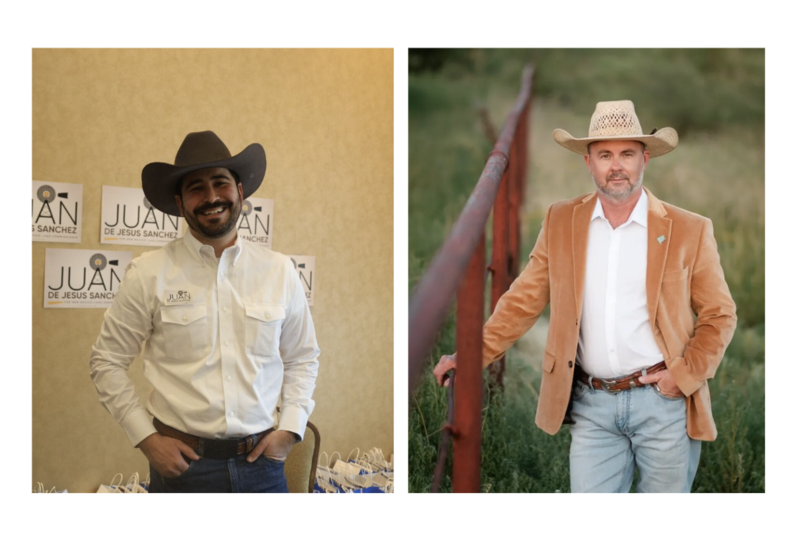
Democrat Juan de Jesus Sanchez III, left, and Republican Michael Perry are facing off in the Nov. 3 election to become New Mexico commissioner of public lands overseeing the State Land Office. (Source NM file and courtesy photos)
This November, New Mexicans will elect a new leader to the office that manages millions of acres of state lands at a time of record-high oil and gas prices, increased corporate interest in data centers and uranium extraction, and ongoing environmental threats posed by wildfire and drought.
Republican Michael Perry, a longtime official in the state Department of Wildlife and New Mexico State Land Office, is running against Democrat Juan de Jesus Sanchez III, a former political director for U.S. Sen. Martin Heinrich (D-N.M.) and natural resources specialist with the U.S. Army Corps of Engineers.
Current Land Commissioner Stephanie Garcia Richard, a Democrat, is running for lieutenant governor.
Her successor will be tasked with balancing the state’s need for revenue with environmental considerations, as well as diversifying the office’s revenue streams to reduce reliance on the volatile oil and gas industry.
In recent years, an oil and gas boom has meant the Land Office has received more than $2 billion a year in revenues, largely from oil and gas royalties, offsetting costs of public services that would otherwise fall on taxpayers.
Looming over the race is President Donald Trump’s administration, which has sought to roll back a number of policies aimed at protecting federal public lands from timber harvesting and oil production in a state with 27 million acres of federal land.
Garcia Richard has spent much of her second and final term in office seeking to push back against Trump’s policies.
She has blocked a 0.6-mile gas pipeline on state trust lands for a controversial data center in Doña Ana County; imposed a moratorium on oil-and-gas leasing on state lands near Chaco Culture National Historical Park; and earlier this month announced an executive order banning new uranium mines on lands her office oversees.
Source NM spoke to both candidates about their visions for the office, including where they would differ from Garcia Richard and support or oppose Trump’s public lands agenda. The state land commissioner receives a $149,714 annual salary each year during a four-year term.
The candidates’ answers below have been edited for clarity and concision.
Michael Perry
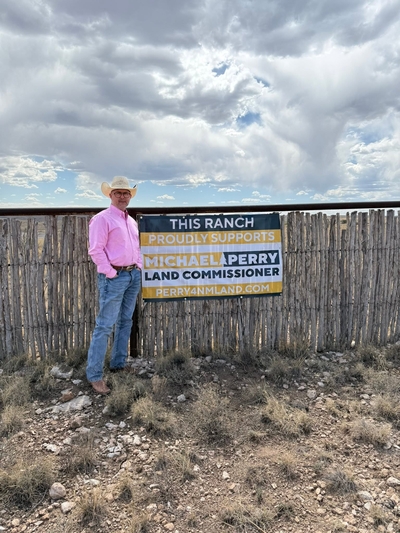
Republican Michael Perry said his decades of public lands experience and bachelor’s degree in wildlife science from New Mexico State University make him the practical choice to succeed Garcia Richard at the State Land Office.
Perry spent more than 20 years with the New Mexico Wildlife Department, previously known as the Department of Game and Fish, ultimately overseeing all of the department’s law enforcement operations in southern New Mexico. That commitment to conservation and wildlife still guides him today, he said.
“I absolutely believe in, and I was willing to give my life for, wildlife and conservation efforts,” he said.
He served as assistant lands commissioner at the State Land Office between 2016 and 2019 under former Commissioner Aubrey Dunn, overseeing watershed health, forest remediation and habitat restoration. He is also currently a Chaves County commissioner.
What makes you the most qualified to be land commissioner?
I have 33 years of specific experience that can help the State Land Office, and I was also the assistant commissioner over restoration or remediation, forest health and watershed management. I have a specific degree that is attributed to this job. Chaves County placed me on the Public Lands Advisory Committee where we go to Washington, D.C. for natural resource management issues and to secure funding.
What is one aspect of the State Land Office that the public should understand better?
The public should understand that the state land is entrusted to raise money off of the land to pay for public education and public hospitals. I don’t think the general public knows the importance of that. If you took the state land office and the functions and the money that they make, which is about $2.5 to $2.6 billion a year, out of the mix, you’re going to have to make up that funding somewhere else. The other thing the state land commissioner is supposed to do, which I don’t think we do enough, is take care of the land for the next generation, so they can take care of the land for them, so they can make money off it.
And I actually think that needs to be No. 1. I think we need to take better care of the land first, and then make money off of it second. Right now, it’s vice versa.
What new initiatives would you implement at the State Land Office upon taking office?
The absolute No. 1 initiative for me is to bring back habitat management and forest restoration, so we can have a resiliency built up in our forest that counters catastrophic wildfires and counters catastrophic flooding after the wildfires. I want to bring our watersheds back into shape, so we can get our rivers and tributaries flowing, and we can get water down the way to Elephant Butte, so our farmers can make crops. Our watersheds are in bad shape because we have too many trees or too many stems per acre on the landscape.
If elected, will you uphold incumbent Land Commissioner Stephanie Garcia Richard’s ban on new uranium mining on state trust lands? Why or why not?
If it’s really an important topic, why did she wait until the two-minute drill of the fourth quarter of her eight years in office to implement it? So I think it’s just a political move, honestly, to get to grab some ink off of the news.
I would want to look at uranium exploration pragmatically. Anybody who’s against environmental protections or the land in New Mexico, whether it’s Republican, Democrat, I’m against them. I want to make sure we take care of the land first, but I also want to say I think it would be short-sighted to say that we’re not going to have uranium exploration. I’m not saying I’m for it, but I’m saying let’s look at the area, let’s look at the geographic location, let’s look at the social parameters that (exist) where they’re talking about having it.
How will you use your office to support or oppose President Donald Trump’s push to remove Chaco Canyon buffer zone protections from oil and gas extraction?
I can’t do anything against it. I mean, I’m not in charge of federal lands and the federal government. I think we need to communicate with the people on the ground that live off the land in those areas and have a seat at the table for them, and say, ‘What would you like?’ Now, the lion’s share of the property belongs to the federal government, so they’re the ones that are driving the bus, so to speak, on oil and gas expiration. But I do support protections on state land.
If elected, will you continue to prohibit the use of state Trust land for the Project Jupiter gas pipeline or other data-center-related infrastructure?
I am not for data centers on state land. I think we can have better uses. When you build a big footprint of property on state land, you’re covering up a potential grazing allotment, a grazing lease, a right of way. Once you put that huge footprint of buildings on there it’s going to only be used for one thing. So you better make a lot of damn money off that one thing because you’re taking that land out of other uses forever.
(Regarding the Project Jupiter pipeline), she is going against her fiduciary responsibility, which is to make money for the schools, by not allowing that right-of-way. She is not doing what she’s supposed to do: Make money for the land. If she’s going to be an advocate and say I’m not going to allow this right-of-way, all they’re going to do is go around it. So now you’re causing a larger footprint and a larger land disruption, because now they’re going to drill this right away around it on BLM land, which is going to cause more hate and contempt on the landscape.
Would you continue to implement a proposed State Land Office rule that would increase the minimum bonding requirements for oil and gas operators from a minimum of $10,000 to $150,000?
I think the bonding needs to be increased. I haven’t researched it enough to see if the numerics are correct.
What is the ideal mix, in your view, of state trust land leased for oil and gas production versus wind, solar or alternative energies?
I think we’re doing pretty good on both right now. I think we need to be objective and say, ‘Are we going about this the right way?’ Because the end goal is to make money off the land for the schoolchildren, not to drive people and productions off the land because of overregulation and an increase in prices. So I absolutely support green energy. I want more green energy. I want it to be viable and vibrant, but I want it to stay in our state to help New Mexicans. And currently, I think the state land has been an advocate for green energy that is of no beneficial use to New Mexicans.
Juan de Jesus Sanchez III
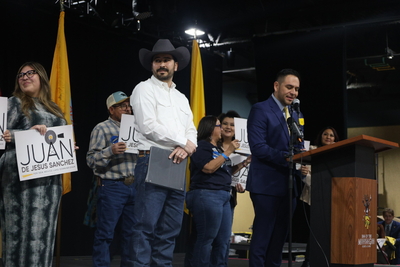
Juan de Jesus Sanchez III describes himself as a 13th generation New Mexican whose family ranch near Belen relied on a state Trust land grazing lease. He worked as a natural resources specialist for the U.S. Army Corps of Engineers and at the New Mexico Acequia Commission before becoming the political director for U.S. Sen. Martin Heinrich (D-New Mexico.)
He defeated two other Democratic opponents in the primary, including state Rep. Matthew McQueen (D-Galisteo) and Jonas Moya, the former New Mexico director of the U.S. Farm Service Agency under President Joe Biden.
“I think I’m bringing the lived experience, the professional experience, but also the values and principles to make sure our land is taken care of, not for a short-term economic benefit, but for long term sustainability,” Sanchez said.
What makes you the most qualified to be land commissioner?
I’ve got a lot of both professional and lived experience tied to the land, and the other part of it is also being able to come into the office really ready to make sure that we advocate for the land, not only in a short-term situation, which I think the the Trump administration is trying to do with things like uranium mining, drilling around Chaco Canyon, mining in the Pecos River. They’re trying to get money in the short-term instead of thinking about what the long-term consequences of these things are.
What is one aspect of the State Land Office that the public should understand better?
The main goal is to be able to generate funds for public schools. What that means is that rather than us getting taxed at a higher rate to be able to go pay for our education, our lands help foot that bill to make sure that we have less of a tax burden, and we also have the opportunity to go out and enjoy these lands in the outdoors as well.
Public lands serve so many different purposes, and I think they’re one of the most important and unique things that make New Mexico special.
What new initiatives would you implement at the State Land Office upon taking office?
One of the things I really want to do is open up a new office of outdoor rec and stewardship. Create a new position for an assistant commissioner for the head of the new office of outdoor rec and stewardship, and start building up an office from there. Essentially, what this office is going to do is look for opportunities to create more outdoor rec opportunities and work on the stewardship and restoration of our trust lands. They’re going to be focused solely on making sure we get people out in our outdoors.
If elected, will you uphold incumbent Land Commissioner Stephanie Garcia Richard’s ban on new uranium mining on state trust lands? Why or why not?
Our state has a very, very bad history with uranium mining. On state trust lands alone, there are dozens and dozens of uranium mines that need to be cleaned up. Our focus needs to be focused on cleanup of uranium mining, not continuing to mine and consider more development that could be harmful to our communities.
How will you use your office to support or oppose President Donald Trump’s push to remove Chaco Canyon buffer zone protections from oil and gas extraction?
This is not an issue that you can kind of tiptoe around and be half in, half out of. I need to be all in. I will absolutely be ensuring that the land in that 10-mile radius around Chaco Canyon remains protected and remains so that we don’t use it for extraction. And the step beyond that, if the Trump administration does remove the boundary, move it from 10 miles to 5 miles, or remove it as a whole, as they’re doing the infrastructure to build roads out there, needing easements, needing infrastructure like pipelines or transmission line, or whatever it may be, is that the land office will not cooperate in any way.
If elected, will you continue to prohibit the use of state Trust land for the Project Jupiter gas pipeline or other data-center-related infrastructure?
If the alternative is that they will be going around state Trust land, which I’ve heard is a strong possibility, then I think it’s worth sitting back at the table and negotiating more strongly with Project Jupiter and trying to figure out what kind of leverage the land office has there.
I’m going to be advocating in this first legislative session for very strict guardrails around data centers. After that, each data center is different. I have six different levels of things that are important to me for me to even consider a data center on state trust land:public input before decisions are made; community benefit programs to make sure that the communities are taken care of in some way or another; making sure that water we use for drinking or agriculture is not used for data centers; project labor agreements and ensuring that labor is being taken care of; these need to be off grid and at least 50% renewable energy from the offset; and the sixth is bonding around these infrastructures.
Would you continue to implement a proposed State Land Office rule that would increase the minimum bonding requirements for oil and gas operators from a minimum of $10,000 to $150,000?
I wholeheartedly support the current bonding rule proposed. I’ve told (the) oil and gas industry that I will be implementing that. I have told advocates I will be implementing that.
What is the ideal mix, in your view, of state trust land leased for oil and gas production versus wind, solar or alternative energies?
I don’t think we need to be thinking in a mixed percentile. We need to be thinking about responsible revenue generation. So oil and gas right now generate about 97% of the funds that are brought in from the land office. I would like to bring that down, but really, it’s going to be dependent. Oil and gas is a boom and bust industry, and it’s booming right now. If it ends up busting, then the percentage that we get from renewables will ultimately go up.
We need to continue to increase our renewable energy opportunities: wind, solar, transmission, and now geothermal and continue to make sure that we are getting our the revenue from oil and gas, as long as we’re holding all those who use our land accountable and making sure they’re cleaning up.
Have you learned anything about who might have been behind the PACS that supported you during the primary election?
The super PAC is still something that I have no idea who put in the money behind it, and I could say that they did not help me. They did a disservice to my campaign. If we need to be taking care of some of the loopholes that they were able to take advantage of, I’m happy to advocate with legislators to make sure we take care of that, because I still don’t know what the background was there.
As for the (Chevron-backed) independent expenditure, that was all public. There was nothing that was behind the curtains. I haven’t had any conversations with some of the contributors about why they did support me.
Santa Fe, NM