New Louisiana security council puts foreign researchers under microscope
Sep 17, 2026 | 5:08 pm ET
Description
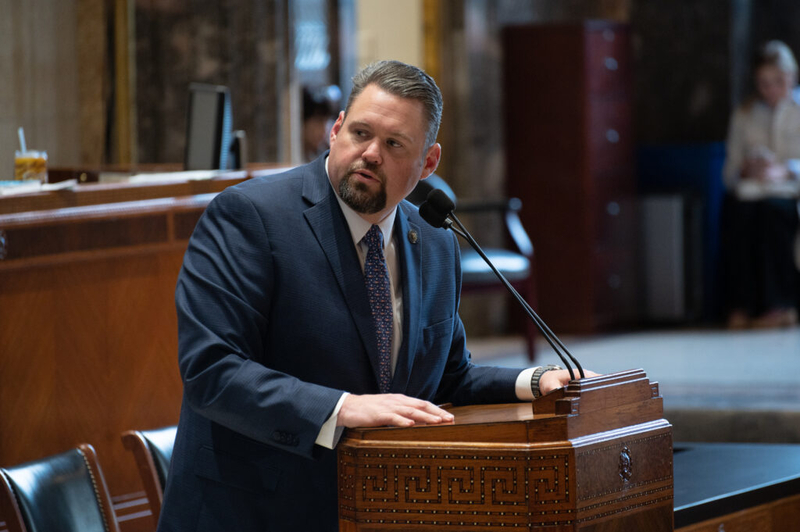
Sen. Adam Bass stands at the podium in the Senate Chamber. (Photo by Allison Allsop / Louisiana Illuminator)
Faculty at Louisiana universities from certain countries will soon have to seek state permission to do their research under a new, far-reaching law that dramatically increases surveillance of researchers.
Act 505 by Sen. Adam Bass, R-Shreveport, created the Higher Education Research Security Council, which met for the first time this week.
Bass sold the legislation as an extra layer of security to prevent Chinese spies from stealing research conducted at Louisiana universities. But the law goes much further, creating a new framework that subjects research faculty from China, Cuba, Iran and Russia to an unprecedented level of scrutiny. American faculty will also be subject to review when they want to work with researchers from those countries.
Bass’ legislation was crafted with the help of the nonprofit policy group State Armor, which founder Michael Lucci said works with state and local governments “to defend and develop resilience against the Chinese Communist Party” when he appeared before a state Senate committee in March.
Texas and Louisiana so far are the only states that have set up research security councils, though the proposal has been made in other states.
Critics of State Armor have said its tactics amount to modern-day McCarthyism.
The increased scrutiny has raised concerns from faculty, who consider foreign collaborators vital to the research conducted at Louisiana universities, particularly in the sciences.
“As you can expect, it is not difficult to think of a scenario where this bill will add delays or directly limit the collaborations we can do with foreign scientists,” said Rodrigo Diaz, who leads LSU’s Center for Research Excellence for the Study of Invasive Species.
“We have collaborated with Chinese colleagues working on invasive species and biological control,” Diaz added. “This work is important because those natural enemies will help with management of invasive species in the USA.”
The new security council must meet quarterly, though it might meet more frequently, said Commissioner of Higher Education Kim Hunter, who chairs the council. Its members include appointees of the lieutenant governor, attorney general and chairs of the legislature’s two homeland security committees — all offices that Republicans currently hold.
The Louisiana State Police superintendent and the lead agent for the FBI’s New Orleans office also have representatives on the security council, as does the state’s chief information officer. Three university researchers, four research security officers and five representatives from the state’s private universities are also included.
The law allows the attorney general to investigate any violations of the research security law and offers a monetary reward to any whistleblower who identifies related violations.
The security council has the power to approve or reject, for any reason, any research partnership between a Louisiana university and a university from one of the foreign adversary nations, which are designated under federal law. The council must also sanction any partnerships involving Louisiana researchers who are citizens of those nations.
The legislation also requires university employees to report any interaction, communication or meeting they have with someone from the listed nations within 30 days, even if the security council gives its approval to a collaboration. It means the Louisiana faculty member has to submit every email and text message and log all phone calls with their foreign collaborator for review by the state.
The definition of a research partnership is extensive, encompassing any work that involves more than one institution. Who counts as a researcher is also broad, including everyone from full-time faculty to graduate and undergraduate students.
That means the council will have to give their approval to numerous projects. They range from an agricultural research collaboration between the LSU AgCenter and a Chinese university to an archival research project a student from China at the University of Louisiana at Lafayette is doing with the help of a Louisiana Tech librarian.
Given the hundreds of faculty and students at Louisiana universities from the listed countries — and the hundreds of co-authors from those countries who work with Louisiana researchers — the security council is likely to review a long list of projects at each meeting.
This new reporting system is on top of existing research security protocol that universities follow to monitor for undue foreign influence as well as state and federal laws with a similar purpose.
“To protect our institution and our researchers LSU not only has a formal policy addressing research security, we also conduct rigorous annual trainings to ensure compliance with the most up to date federal guidance,” LSU spokeswoman Meg Sunstrom said.
“The best practice for research institutions like ours is to embrace collaborative science while providing appropriate guardrails to protect our intellectual property and our people,” Sunstrom added.
The new law also gives the governor, the Louisiana Senate president, House speaker and legislative auditor authority to request an audit of any research partnership, contract or grant involving foreign adversary nations or researchers from those countries.
It prohibits partnerships with institutions or researchers from those nations if the project is funded partially or totally by the federal defense, health or energy departments.
Jason Li, a graduate research associate with LSU’s Department of Physics and Astronomy, told state lawmakers at a March hearing on the Bass bill that these collaborations with federal grant backing constitute a considerable portion of higher education research.
“They are the vast majority of research projects,” Li said. “…This bill in its current form will impact virtually all the research projects, especially those at Tulane, LSU Health Sciences Center and Pennington (Biomedical Research Center) that rely heavily on (U.S. Health Department) funds.”
Additionally, the law requires the Louisiana Board of Regents, which oversees higher education in the state, to maintain a public online database disclosing proposed gifts, contracts and partnerships submitted to the council for approval, along with the council’s decision. Reed said it has not yet been determined if the database will post faculty member names publicly.
Other provisions of the law include:
- requiring the Board of Regents to develop policy that prioritizes research and partnerships with Israel and Taiwan. Any cultural exchange programs involving foreign adversaries must also receive security council approval.
- a research security review of the state done by the council and submitted to the governor, attorney general and legislature every even-numbered year.
- research security policy for Louisiana’s colleges and universities and development of an annual training program for research security officers at each school.
The law in place now is a narrower version of Bass’ original proposal, which required students and employees from China to sign a pledge certifying they were not members of the Chinese Communist Party, the People’s Liberation Army or any Chinese intelligence agency, affiliate or subsidiary. The provision was removed over constitutional concerns.
The security council will next meet in November and start reviewing research projects in January.
Baton Rouge, LA