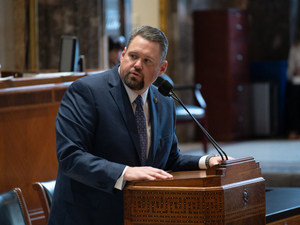
Kosta Diamantis flees to Greece, attorney says
Sep 17, 2026 | 4:58 pm ET

Description
Photo courtesy of CT Mirror
This story has been updated.
Facing a potential sentence Thursday of more than a decade in prison for bribery and extortion committed as a high-ranking state official, a defiant Konstantinos “Kosta” Diamantis informed his lawyer Wednesday evening he has fled to Greece, beyond the easy reach of U.S. law enforcement.
Diamantis, 70, is a dual citizen of Greece, which generally protects its citizens against extradition. On Wednesday, he sent his lawyer, Norman A. Pattis, a rambling 10-page email accusing Gov. Ned Lamont and former President Joe Biden of “weaponizing” the Department of Justice to unfairly prosecute him.
The email uses rhetoric similar to an application Diamantis made for a presidential pardon, and Pattis acknowledged that the intended audience most likely was President Donald Trump.
Diamantis was to be sentenced in U.S. District Court in Bridgeport for using his influence as a state official overseeing school construction grants to extort bribes from two companies he helped land contracts worth $8.5 million for projects in Hartford, New Britain and Tolland.
[The Kosta Diamantis timeline]
In the same courtroom where a jury returned guilty verdicts on 21 counts a year ago, U.S. District Judge Stefan R. Underhill was expected to impose a penalty reflecting the scope of a conspiracy that Diamantis led from 2018 until the Lamont administration moved to fire him in October 2021, three years before his arrest.
Diamantis had asked Underhill to set aside sentencing guidelines that produced a recommended sentence between 121 and 151 months in prison, a penalty that Pattis had argued in a filing “would consume much of Mr. Diamantis’ remaining life.”
Underhill rescheduled the sentencing to Sept. 30, indicating it would go forward with or without Diamantis. Pattis checked his schedule and confirmed his own availability.
On Thursday, Pattis said Diamantis emailed him first on Wednesday then made clear in a phone call around 6:30 p.m. that was he was in Greece and not intending to return. Pattis declined to give Diamantis’ precise whereabouts in Greece, but he had a duty as an officer of the court to inform the judge and prosecutors Wednesday night his client had become a fugitive.
In the 16 hours following that notice from Pattis, federal authorities were able to determine that Diamantis, who is on an alert list banning him from flights out of the U.S., had taken a boat from Florida to the Bahamas, then flew from the island’s airport in Nassau to London, Assistant U.S. Attorney Jonathan N. Francis said.
The U.S. Attorney’s office would explore extradition with Greece or through the European Union, of which Greece is a member, to extradite Diamantis, Francis said. Pattis said Greece generally does not extradite its citizens outside specific conditions outlined in treaties, but Greece has had a bilateral treaty with the U.S. since 1931.
According to a United Nations summary of extradition laws, Greece’s Code of Penal Procedure prohibits extradition if the person “for which extradition is requested was Greek when the act was committed.” It also provides another possible motive for Diamantis to assert he is the victim of a criminal conspiracy: The code prohibits extradition if the crime is characterized as “political, military, tax-related or related to the press.”
Reaction outside the court was swift.
“Kosta Diamantis betrayed the public’s trust and needs to be held accountable for his actions. His repeated efforts to skirt justice are shameful. I hope he is apprehended and made to face the music as soon as possible,” Lamont said in a statement.
Comptroller Sean Scanlon immediately said he had suspended the direct deposit of Diamantis’ state pension, and Attorney General William Tong said he would go to court to permanently revoke state retirement benefits that paid Diamantis $75,000 last year.
The conspiracy charged by federal prosecutors did not implicate anyone else in state government, but Republican gubernatorial nominee Ryan Fazio asserted that the episode reflected on the governor, echoing a claim made by Republican Bob Stefanowski in the 2022 campaign.
“When Gov. Lamont promoted Kosta Diamantis and put him in a position of enormous authority over taxpayer dollars, he was putting his trust in him to safeguard the public’s money,” Fazio said in a statement. “That decision ended with Diamantis convicted on federal corruption charges, and now he has fled the country rather than face sentencing. The taxpayers deserve accountability for the judgment and failures that allowed this to happen.”
Pattis said he believed that Fazio was involved in outreach to the White House on behalf of Diamantis — an assertion that provoked an angry denial. Pattis, who is not directly involved with the pardon request, did not say why he believed Fazio was involved.
“This is categorically untrue,” Fazio said in a text. “Kosta Diamantis was employed and promoted by Ned Lamont. Kosta Diamantis should go to prison, not be pardoned.”
Diamantis repeatedly asked to travel to Greece while he was awaiting trial last year, and prosecutors said Thursday it now appears he had booked a flight then without being detected. Prosecutors also warned the judge after he was convicted that Diamantis had sought Greek citizenship and had obtained a Greek passport. The judge allowed Diamantis to remain out on bond as he awaited sentencing.

That sentencing was supposed to occur earlier this year, but it was repeatedly delayed as Diamantis prepared for a second corruption trial, in which he is accused of cancelling a state audit investigating potential Medicaid fraud for a Bristol eye doctor, who was a friend and close acquaintance.
In the email sent to his attorney, Diamantis cast the prosecution as “politically motivated.” He also said that the Department of Justice was “weaponized” against him, copying language frequently used by Trump.
Diamantis blames Lamont for the federal charges leveled against him. And he claims the criminal case against him was meant to distract the public from the governor and his wife’s business dealings, particularly a previously vetted investment in a company that provided COVID-19 testing in the early weeks of the pandemic.
“The entire investigation was a politically insulated script written by Lamont, Connecticut DOJ and Connecticut tight knit legal aristocracy hired by Lamont to protect himself and his family from scrutiny and ensure I would be discredited,” Diamantis wrote.
He mentioned that Underhill once worked at Day Pitney, the firm that the Lamont administration had hired to review Diamantis’ actions, and suggested the President Bill Clinton’s nomination of Underhill to the court somehow made his conduct at the trial suspect. He also noted that a Day Pitney partner was the father-in-law of David Novick, another prosecutor in the case.
Before Underhill opened court Thursday, Pattis and Novick leaned towards each in a quiet conversation.
Pattis distanced himself from the contents of Diamantis’ email, which faulted the judge over how he presided and implied a far-reaching conspiracy involving the prosecution and others. Underhill’s only reaction was mild.
“He has a right to his perceptions,” Underhill said.
Outside the court, Pattis said he did not condone his client’s actions but understood them “as a fellow human being.”
“The sentencing is remarkably difficult day for people. We have the colloquialism of ‘Judgment Day.’ All sorts of options people discuss. So I can’t say that I was stunned by what I heard,” Pattis said.
He hedged on the question of whether the conduct of the trial was unfair, as alleged by Diamantis.
“I think that the email raises questions. Whether those questions are sufficient to call into question the fairness of the trial is an open question at this point,” Pattis said.
Pattis acknowledged that his client most likely was aware the more conventional avenue was to appeal his conviction.
Diamantis was a Democratic lawmaker representing Bristol in the state House of Representatives for 14 years until losing a primary in 2006. A former House colleague hired him in 2015 during the administration of Gov. Dannel P. Malloy to oversee the Office of School Construction Grants and Review.
He was permitted to keep that post after Melissa McCaw, the first secretary of policy and management under Lamont, named him as her deputy in the office at the heart of state government. Its wide-ranging responsibilities included the preparation and management of the budget.
The only indicted conspirators were three executives at the two construction companies Diamantis extorted, but the scandal had broader ramifications. McCaw, whose relationship with the governor’s top staff had become fraught, resigned in February 2021.
Chief State’s Attorney Richard Colangelo Jr., who had hired Diamantis’ daughter while lobbying her father for help obtaining raises for himself and other prosecutors, announced his intention to retire the same month after an independent investigation that questioned his credibility and raised ethical concerns.
And, for the second time in four years, Diamantis is an issue in a campaign for governor.

Hartford, CT