What happened at Geisinger? Arrests near Danville hospital show difficulty tracking ICE activity.
Sep 17, 2026 | 5:19 pm ET
Description
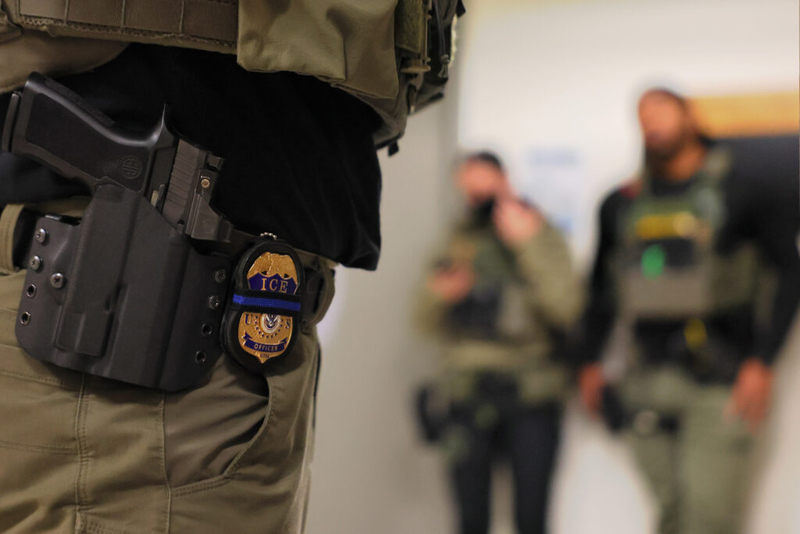
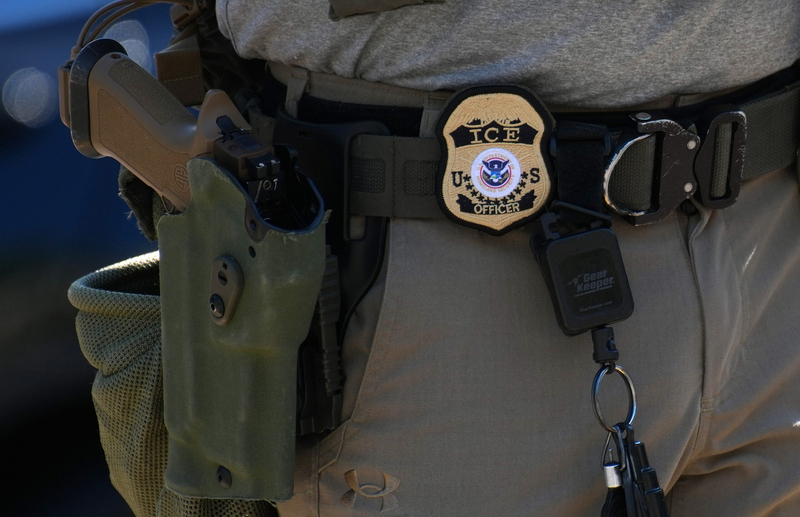
An Immigration and Customs Enforcement officer's badge is seen as federal agents patrol the halls of immigration court in New York City on June 10, 2025. (Photo by Michael M. Santiago/Getty Images)
Earlier this month, immigrants’ rights advocacy groups, the Pennsylvania Immigration Coalition and the Centre County Rapid Response Network, brought attention to what they were calling the “largest ICE workplace raid in Pennsylvania to date.”
They said more than 40 construction workers — nationals from Nicaragua, El Salvador, Honduras and other countries — were detained in a major Immigration and Customs Enforcement (ICE) operation while leaving work building an addition on the Geisinger Medical Center campus in Danville, Montour County, on Sept. 2. Several more, they said, were arrested under similar circumstances the following week on Sept. 8.
The group added that eyewitnesses who spoke to them, but who were not identified to the Capital-Star, said aggressive policing tactics were employed, making them feel like they were part of a “manhunt.”
“I cannot stop replaying the events in my mind,” they quoted one worker as having told them. “ICE monitored us with drones, watched our vehicles, and intercepted us on the roads. Alongside local police, they waited for us. … Since then, my fellow co-workers are terrified, and no one wants to work. I am afraid and filled with uncertainty.”
The Capital-Star has not been able to independently verify many of the details, and has received conflicting information from police departments in the county that assisted ICE, advocates and witnesses, including a Geisinger employee and a construction worker who was there the day of the raid.
Altogether, the incident paints a picture of how difficult it can be to get timely and accurate information on ICE activity at this phase of the Trump administration’s mass deportation campaign, which has gained steam since it began last year.
While the administration has repeatedly promised to target criminals, who they often refer to as “the worst of the worst,” a spokesperson for ICE said many of the people arrested in Danville “face charges of illegal reentry after being removed from the U.S. by order of a DOJ immigration judge, which is a felony.” They did not say anyone detained or targeted had a record of violent or non-immigration related crime.
After three days and numerous news reports about the raid citing advocacy groups, an ICE spokesperson said they arrested “10 illegal aliens in Danville, Pennsylvania, on September 2 after they were encountered by local law enforcement during vehicle stops.” But few additional details were provided and they did not respond to specific questions, including whether their operation was explicitly targeting construction workers on the Geisinger site, whether immigrants with legal status or outside of Danville were also arrested in the same operation, and what sort of guidelines they have for operating around a medical facility.
Police chiefs say their officers were involved in a small number of arrests and were aware of a larger ICE operation happening on Sept. 2, but provided conflicting statements on whether they were targeting people suspected of immigration crimes at all.
In the early months of the Trump administration’s mass deportation campaign, DHS often telegraphed — and even advertised — major raids. Now, organizers are struggling to track their activity in real time as ICE tries to implement a “softer touch,” even with arrests reaching new records.
Mirna Miranda, the Pennsylvania organizing director with We Are CASA, a national group dedicated to organizing and protecting the civil rights of immigrants, said the incident at Geisinger fits a troubling pattern.
“All the information is so closed,” she said. “We’re unable to kind of understand their tactics, the way they are acting in communities, leaving no trace behind.”
“It’s confusing,” she added. “We feel really powerless when we are not able to get the way they are working. It’s like they’re in such a low profile. It’s just like that. No information, no nothing.”
The witnesses
For weeks, he had seen the suspicious vehicles: plain SUVs with tinted windows and sometimes antennas circling the construction site on the Geisinger Medical Center campus in Danville. He said they seemed to drive slowly around the work site, then speed up and circle back. The $880 million expansion of the medical center meant dozens of workers were on the campus each day, many of them Latino.
The worker, who requested anonymity for fear of retaliation by his employer and U.S. Immigrations and Customs Enforcement (ICE), had noticed vehicles like them before. Last summer, a restaurant he worked at near his hometown an hour outside Danville was raided by immigration agents, and those were the kinds of cars they drove.
As a U.S. citizen who had moved from Central America as a teenager, he was not swept up in that raid.
But on Sept. 2, when he spotted police around the exits to the hospital campus, he started telling others to be careful. That’s how it had gone before. The marked cars showed up first, and federal immigration agents followed.
He saw the cars from the shuttle bus that took him and his coworkers to a nearby parking lot when they got off work around 4 p.m. Still unsure what it meant, he talked with a group of his colleagues when they arrived at their cars. That’s when the drone showed up.
“We noticed that there were some electrician guys working, and we thought it was them maybe, but it just looked very suspicious that it immediately came and hovered over us,” he said. “That threw me off. So I told my coworkers, ‘Guys, be really careful. I think something’s gonna happen.’”
Four of his colleagues, all non-citizens, got in one car together. He went to his own vehicle and decided to follow. Since ICE ramped up operations in the last year, he’d made a habit of carrying his passport and Social Security card so he wasn’t as afraid of getting detained or deported.
Just three or four blocks from the hospital campus, police pulled over the car carrying his four, non-citizen colleagues. He had to decide whether to intervene and try to translate, which could put him at risk of arrest, or take advantage of his freedom to try to warn the rest of his colleagues. He chose the latter.
All the information is so closed. We’re unable to kind of understand their tactics, the way they are acting in communities, leaving no trace behind. It’s like they’re in such a low profile. It’s just like that. No information, no nothing.”
He began reaching out to people by phone. As the ICE operation unfolded, he returned to the parking lot to tell whoever was left that ICE was coming, and drove around the area for about an hour.
He was pulled over by police himself and approached by a masked federal agent, but was allowed to go after showing proof of citizenship.
When he returned to work Friday — virtually none of the Latino workers went in Thursday, the day after the raid — he said those left began trying to put together the pieces. Dozens were missing, but it wasn’t clear who’d been detained, fled, or simply no longer wanted anything to do with the job.
There were also rumors that ICE had detained more people at hotels and temporary worker housing after the initial raid.
“To be honest, I have no idea,” the worker told the Capital-Star about how many people were detained in total. “I can just tell you from my company – the company I work for – nine, 10, 11 people. But hearing from the guys at the other companies, the number is big.”
The Geisinger construction site, like many big projects, is a collaboration of numerous companies and subcontractors, each overseeing their own part of the project. Some workers stay for weeks, some for months. That makes putting together an accurate picture of how many people were affected by the raid difficult.
Amber Neidig, a Geisinger employee in the social work department, also told the Capital-Star that prior to Sept. 2, she and others witnessed what they believed to be law enforcement officers monitoring the campus, and not just the construction site. The description of the cars matches those described by the construction worker.
She is deeply involved in immigrants’ rights advocacy and county Democratic politics. Neidig volunteers with multiple community rapid response teams and is the elected chair of the Montour County Democratic Committee. She’s also a candidate in the 108th state House District, and spoke to the Capital-Star about the events in that capacity.
Neidig said, along with witnessing what she believed to be law enforcement activity on the campus, she heard radio chatter from bus drivers discussing what they believed to be law enforcement agents appearing to film people in the parking lot. She shared messages with the Capital-Star showing she discussed this contemporaneously with colleagues, though it was not reported to Geisinger.
She added that she could not verify the number of people who were ultimately detained, but believes the 40-plus figure cited by local advocacy groups comes from the number of people who did not report to work after.
“We have not been able to determine how many were detained vs. fled,” Neidig said.
“We would never divulge investigative practices or procedures,” a spokesperson for ICE said when asked about the surveillance claims.
Mahoning Township Police Chief Frederick Dyroff III, when asked whether his department assisted with any surveillance of the site or workers, said, “I’m not going to answer that.”
Police stories change
The Capital-Star reached out to the Danville Borough and Mahoning Township police departments.
Initially, Dyroff said that, along with Danville Borough officers and members of other departments, “we assisted ICE with a detail on September 2nd.”
But his account contained a contradiction. He said that his agents were assisting ICE with an operation, and conversely that all they did was conduct traffic stops as usual, calling ICE if there were records of an immigration-related crime.
Following an initial conversation on Sept. 8, Dyroff referred all calls to an ICE field office, which did not respond to multiple messages. He also offered few new details at a Mahoning Township supervisors meeting where he spoke on Sept. 14. But reached again Wednesday, he said five people in total were turned over to federal agents by his officers.
“Listen, there’s no secret we know where there’s a concentration of people working who are here illegally,” he said. “So it does not take a rocket scientist to find out where they’re working at.”
“So we were in the area,” he said about the vicinity of the Geisinger Medical Center Campus. “We knew ICE was in the area. We made legal traffic stops on people who were violating the law, and if they were deemed illegal, they were turned over to ICE.”
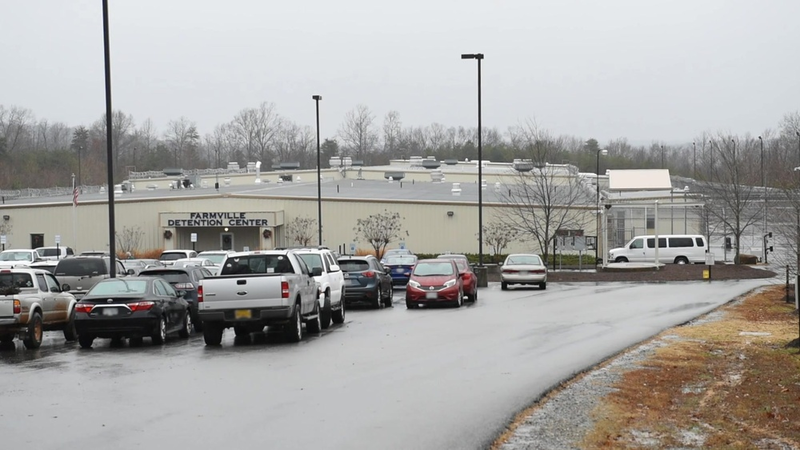
His officers, he said, were parked about a quarter to a half mile up the road from Geisinger property, just past the Danville Borough limits in Mahoning Township.
Danville Borough Police Chief Greg Watson told the Capital-Star that he was aware of an ICE operation the week of the 2nd, but couldn’t remember the exact date. He added that he’d never heard about any effort to target construction workers employed on the Geisinger campus, and that nothing happened on the medical center property.
Like Dyroff, he was surprised by claims it resulted in dozens of detentions, noting he was only aware of one or two of his officers assisting in one or two arrests that day.
“I’m not going to say it was larger than usual,” he said of the operation.” We’ve done that type of stuff throughout the summer.”
Both the Mahoning and Danville Borough police departments are part of ICE’s 287(g) program, in which law enforcement agencies partner with ICE to assist in federal immigration enforcement. That can result in police departments receiving free training and funds for equipment.
“We have guys riding with them at times,” Watson told the Capital-Star about the program. “We’ll team up.”
Like the police chiefs and ICE itself, a spokesperson for Geisinger Medical Center stressed that no law enforcement activity took place on the hospital campus itself the day of the arrests.
Listen, there’s no secret we know where there’s a concentration of people working who are here illegally. So it does not take a rocket scientist to find out where they’re working at.
“Geisinger is aware of law enforcement activity on Wednesday, Sept. 2,” Chris Murphy, a spokesperson for Geisinger said in a statement. “The location of the activity was not on Geisinger property and appears to have involved workers from the Geisinger Medical Center tower construction project. As with any large construction project, we hire a construction manager to oversee the project. It is their responsibility to make sure all workers on the project meet all federal and state work eligibility requirements.”
A spokesperson for the construction company Ewing Cole, which was the designer of the addition on Geisinger’s Danville campus, declined to comment. General contracting company Whiting-Turner and project management company PURE Project Management did not respond to requests for comment.
287(g) program presents problems getting public records
Kim Piermattei, a general practice lawyer in central Pennsylvania, was contacted by an acquaintance who knew someone stopped by police and ICE that day. She was asked if she could provide legal help in connection to their experience.
Though she’s not an immigration lawyer, and had never even talked to the person who was stopped, Piermattei agreed to submit a Right to Know request to the Mahoning Police Department, which conducted the initial traffic stop.
Pennsylvania’s Right to Know law allows journalists, lawyers and members of the public the right to request records kept by public bodies.
Generally speaking, police departments keep detailed records of every traffic stop they make. But that wasn’t the case for the stop Piermattei asked about.
“I give him credit. He did get back to me over the holiday weekend,” she said of the Mahoning officer who helped handle her request. “But he sent a response basically saying they have no documents.”
The officer who spoke to her told her that a Mahoning officer did appear to instigate the stop, but since they turned the person over to ICE, it was no longer their issue to document.
“That should be public knowledge,” Piermattei said.
Dyroff, the Mahoning police chief, said he didn’t believe any documents had been given to ICE. He added that if her request was denied, it may have been because not every traffic stop leads to documentation. When someone is let go without a warning or citation, he said, there’s no paper trail. And dispatch records are kept with the county.
Melissa Melewsky, a lawyer with the Pennsylvania NewsMedia Association who assists journalists with public records requests, told the Capital-Star that experiences like Piermattei’s are increasingly common when it comes to records related to immigration enforcement.
“What I’ve seen is agreements with local police that say if you help us — if you help ICE — all documents belong to us,” she said, referring to language in 287(g) agreements she’s reviewed.
Melewsky has not specifically seen the agreements between ICE and the Mahoning Township and Danville Borough police departments.
A generic agreement on ICE’s website includes a passage that reads, “information obtained or developed as a result of this [agreement], including any documents created by the [law enforcement agency] that contain information developed or obtained as a result of this [agreement], is under the control of ICE.”
Before any such documents can be disclosed, it says, police must consult with ICE’s office of public affairs.
Melewsky said she believes that such an arrangement is likely illegal, and that an attempt to deny the release of public records citing one would likely fall apart under legal scrutiny. Still, they present a road block. Appealing a denial under Pennsylvania’s Right to Know law can be a time consuming process.
Moreover, the law allows local law enforcement agencies fairly broad latitude to deny the release of records, regardless of ICE involvement.
Melewsky said police can deny the release of records on a number of grounds, including that they may threaten public safety, or that they are related to criminal investigations.
“Pennsylvania’s law is so abysmal with regard to law enforcement records,” she said. “It is not helpful for Pennsylvanians seeking accountability for law enforcement agencies in their communities.”
The Capital-Star has also submitted records requests to the Mahoning Township and Danville Borough police departments, as well as the Montour County Public Safety Office, but responses can take weeks. The Mahoning police department and Montour County have both requested additional time to process the requests.
The lack of quality records around ICE activity is a problem some Democratic members of the Pennsylvania Congressional delegation have picked up on as well, though they’re tackling the issue on a federal level.
Last week, Reps. Chris Deluzio, Madeleine Dean, Mary Gay Scanlon and Summer Lee sent a letter to ICE’s acting director, David Venturella, warning that the agency’s lack of data transparency was making it increasingly difficult to know what their agents were doing and how.
Specifically, they warned that data related to arrests made with law enforcement partners through the 287(g) program was proving nearly impossible for the public to get.
“The public has a right to clear and complete information about the nature of the enforcement activities taking place in our neighborhoods and the departments or agencies responsible for carrying them out,” the letter said. “Programs between federal and local law enforcement agencies must meet the highest standards of transparency.”
In the last several months, law enforcement agencies are increasingly partnering with ICE to aid their mass deportation efforts, and are playing a major role in the new surge in arrests, especially in rural areas.
For the construction worker who witnessed the raid and spoke to the Capital-Star, there’s another problem as well.
“They’re always lying,” he said about ICE and the way they communicate to the public. “They’ll tell you a kind-of-a-truth and a kind-of-a-lie … They’ll say they took 10 ‘illegals’ and they had no paperwork. Okay. But what about the other people that were here with work visas? Parole? People in process of asylum? What about them?”
The worker said he’s aware that some of his colleagues who were taken were in the country seeking asylum or on immigration parole granted under the Biden administration, with upcoming court dates. Some had recently expired work visas.
“They don’t want to disclose that amount because they know it’s a big number,” he said.
On Wednesday, a spokesperson for ICE added to the agency’s initial statement, saying, “All illegal aliens were arrested away from the Geisinger campus. None had active TPS or valid parole.”
They did not respond to specific questions about whether their initial count of 10 people arrested in Danville included the five arrested just over the Mahoning Township border, or anyone arrested at worker housing.

Harrisburg, PA