New garden symbolizes work that remains to build relationship between tribes, Roosevelt library
Jul 04, 2026 | 4:06 pm ET
Description
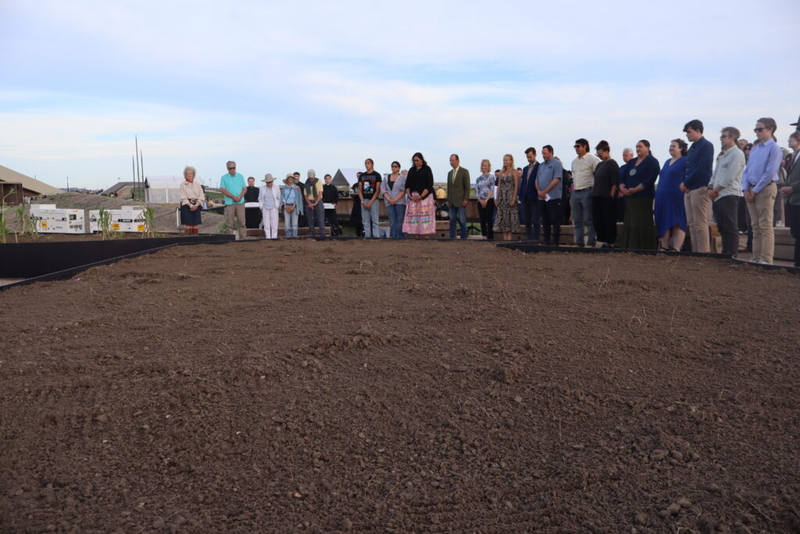
Theodore Roosevelt Presidential Library staff unveiled a medicinal garden July 3, 2026, during a private ceremony with the Roosevelt family and Native American leaders. The small crowd pauses in a moment of silence for the dedication. (Photo by Jacob Orledge/North Dakota Monitor)
MEDORA – The Theodore Roosevelt Presidential Library unveiled a medicinal garden, developed by a Native American artist, during a private ceremony Friday evening to mark a renewed commitment to a partnership with tribal communities in the years ahead.
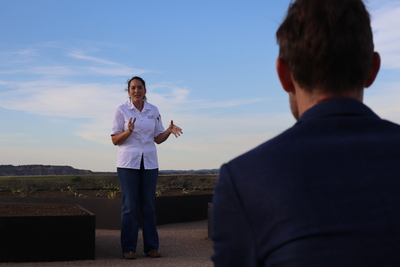
The garden’s form was designed by Cannupa Hanska Luger, a member of the Three Affiliated Tribes who lives in New Mexico, to symbolize the hard work ahead to maintain that partnership.
“The core of anything that I’ve ever tried to express is one of belonging, what it means to belong to place,” the artist said at the ceremony Friday evening. “It’s different to belong to a place than to have a place belong to you.”
Theodore Roosevelt library opening recalls past, calls for civic engagement
Traditional seeds from tribes in the region will be planted in three garden beds, shaped to resemble a tipi skin laid open on the ground in order to symbolize the collective intent to gather as a community before a tipi is raised up. It was designed to reinforce the idea that relationships between the library and the tribes will require constant renewal and participation.
“It’s hard to get something started,” Hanska Luger said. “That’s true for this place and I think it’s represented in the garden. And it will take watering. It’ll take maintenance. It’ll take care.”
Twyla Baker, head of the advisory council of Native Americans consulting on the library and the president of the Nueta Hidatsa Sahnish College in New Town, said Native Americans have long known the act of putting your hands in the dirt and growing crops helps not only feed one’s people, but feed their spirit as well.
“We are so happy, we are so proud to be able to share that knowledge,” Baker said. “What we have needs to go on, and this is a fantastic opportunity for that to happen for us to continue to share that legacy.”
Theodore Roosevelt V, the great-great-grandson of the former president known for conservation, said that this was the start of a process, not the end of it. The garden is a symbolic gesture representing the incorporation of Native Americans into the future of the library, and they have to follow through on that, he said.
“That’s something that’s going to happen for years to come,” Roosevelt V said. “Keeping that garden, replanting that garden, that’s the symbolic nature of what needs to happen. The bigger thing is making sure that we continue to incorporate their views and their understandings and them into the project, and that’s a bigger project that we need to do.”
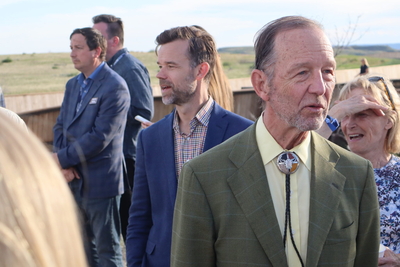
The process began in 2021 and 2022 when Ed O’Keefe, CEO of the library’s foundation, said he put 2,700 miles on his father’s Subaru while traveling North Dakota to hear from Native Americans on the library. That led to a day of honest conversations between tribal leaders, library executives and the Roosevelt family in the autumn of 2022, which concluded in a blessing of the land on the spot the medicinal garden is now located.
O’Keefe said the input could be summarized with two things. First, don’t lionize Theodore Roosevelt, whose racist rhetoric and policies harmed Native Americans. Second, ensure tribal communities feel heard and remind visitors not just of a hard past but also the vibrant present and future for Indigenous peoples.
“We have told the truth where truth needs telling, and we have, as diligently as we can, focused not just on the past, but the present and the future,” O’Keefe said.
Prairie Rose Seminole, an archivist with the Northern Plains National Heritage Area, participated as a member of the advisory council that has been consulting with the library. She said it is important the library continues to engage tribal communities, emphasizing they are welcome to make their voices heard.
“One of the things that folks don’t learn is that when conservation efforts started in this country, they removed the tribes. We weren’t a part of those conversations, and then we weren’t allowed to be on the land anymore,” Seminole said. “Those of us who hunted and gathered and had treaty rights to be in these places were no longer allowed, and so this is just really coming back.”
Candace Stock, a Native American executive chef hired by the library, said she viewed the ceremony as an invitation to connect and build a strong partnership between the tribes and library, despite the “apprehension when it comes to tribal nations being involved in the Theodore Roosevelt Presidential Library because of his view on Native Americans.”
“Where it goes will really bring us closer together in this project,” Stock said. “I’m really excited to share the fruition from these gardens with everyone.”
That continues a long tradition among the Mandan, Hidatsa and Arikara Nation, Baker said. They served as a significant trade hub for thousands of years.
“For thousands of years, actually, this whole place was a place of trade. It was a place of coming together and bringing together peoples from across the country, across the nation,” Baker said. “There were no lines that divided us.”
The seeds will be planted in community with each other, rather than in rows. The MHA’s garden bed will include Hidatsa red beans, Arikara yellow beans, Mandan bride corn, black sunflowers, and green striped squash. Stock said there will also be tobacco planted that was originally grown by her youth group.
“One of the things about our tribal foodstuffs is that it is restorative to the ground and the land that we planted in it is intended that way,” Baker said. “It is meant to replenish the land, and we plant them not in rows, but in community with each other.”
Theodore Roosevelt IV said he is hoping this partnership will lead to an exchange of information on conservation practices. He said many Indigenous people have developed best practices over thousands of years of history that the United States could learn from in managing public lands, such as taking soil from lakes for use in farming and using prescribed burns to keep a forest healthy.
“There’s a lot of very interesting technologies that the Indigenous peoples here have that is clearly useful as we are going through this existential problem of how do we take care of our public lands in an era when we probably use them more than we should, and in the threat of global warming,” he said.
Seminole hopes the library will continue to take concrete steps to incorporating Native Americans, as well as Indigenous history.
She suggested hiring more Native Americans, in addition to the executive chef, to help curate the exhibits.
Theodore Roosevelt’s racist rhetoric complicates his legacy in North Dakota
Seminole said there are ways to weave Indigenous history into many of the major narratives Medora and the library explore about life on the frontier during the era Roosevelt visited.
“You go to Medora and the history is very much the frontier in the West and the cowboys. Very little on the relationship with the tribal populations here, and there’s some really great stories of the tribal population here working with the cowboys,” Seminole said. “There’s this whole culture there, and I want to see more of that. So there’s so many layers to what that can look like.”
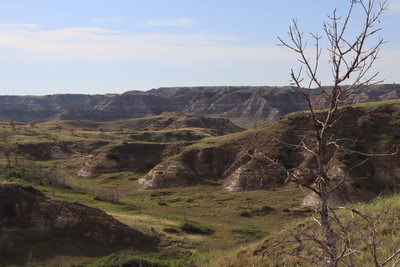
The Badlands region where the library is located is sacred to the MHA Nation. Baker said it is where her ancestors would come to pray because of the energies and spirits present in the area.
Outsiders traveling through the Badlands, like Theodore Roosevelt in the 1880s, will often recognize the area is special. But they lack the knowledge of thousands of years of Indigenous history, customs and traditions that help contextualize the region’s past.
“People just drive through here without understanding or seeing or knowing the significance of what they drive by. The ceremonial spots. The places where battles happen. The places where we came together as people,” Baker said. “This place was the center of all things, was the center of everything that we were as a people.”
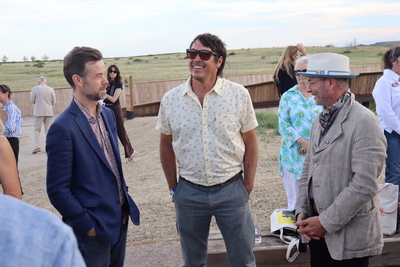
Rep. Bernie Satrom, a Republican from Jamestown, was in Medora for the library festivities and was present for the commemoration ceremony. He said relations between the state and tribal nations have not always been handled as well as they should have been, but former Gov. Doug Burgum placed the state on the right path toward fixing that.
Satrom said “we each have to do our part,” and the ceremony was the latest step.
“I think it’s really symbolic of a healing process that has been occurring and is occurring in North Dakota,” Satrom said. “The Native people are the biggest part of the history of our state, and I’m encouraged that there’s going to be some studies and some sharing of their history here as well.”
The Roosevelt family knows there is more work to be done to put this partnership into practice now that the library is open.
“We, and I, personally recommit to the work that is still to be done to ensure the tribal communities in this region and in this state feel the healing care and honored place here that they deserve,” said Serena Roosevelt, wife of Roosevelt V.
North Dakota Monitor reporter Jacob Orledge can be reached at [email protected].
Bismarck, ND