Maine commemorating United States’ 250th anniversary through a diversity of perspectives
Jul 03, 2026 | 5:01 am ET
Description
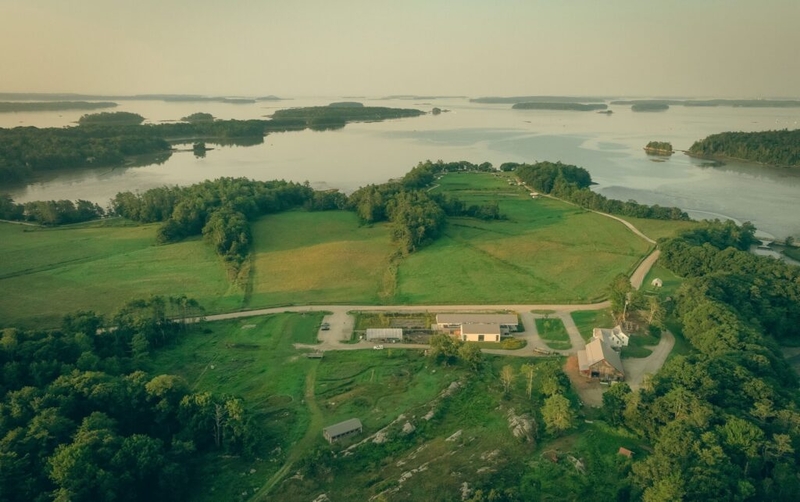
The main campus of the Wolfe's Neck Center for Agriculture and the Environment in Freeport, Maine.
(Photo courtesy of Wolfe's Neck Center for Agriculture and the Environment)
Planting Wabanaki-cultivated corn, beans and squash on the campus of the Wolfe’s Neck Center for Agriculture and Environment in Freeport, historian Tilly Laskey remarked to Jennifer Neptune, director of the Penobscot Nation Museum, that it was likely the first time in 270 years that anyone from the Penobscot Nation had planted those varieties in this soil.
“Longer than the United States has been a country, Penobscot people have been dislocated from their homelands,” Laskey told Maine Morning Star.
That is the understanding that a research project funded by the Maine Semiquincentennial Commission intends to unearth more fully by comparing Wabanaki and colonial perspectives in the region and restoring Wabanaki access to their ancestral territories.
It is one of 14 projects, many of which are year-long endeavors, made possible through the commission, which was established by state law in 2023 to commemorate 250 years since the signing of the Declaration of Independence.
The state is also celebrating the anniversary by displaying one of the first printings of that founding document at the Maine Historical Society in Portland through the July 4 holiday, after which it will tour each of the state’s 16 counties.
Maine was one of several states that did not participate in the “Great American State Fair” organized by Freedom 250, a nonprofit aligned with President Donald Trump behind several semiquincentennial events, including a series of Ultimate Fighting Championship fights at the White House earlier this month.
The administration’s celebration is separate from the America250 commission, created by Congress a decade ago, and which has its own nationwide programming. Maine did send items to be included in the time capsule put together by that organization, which is intended to be opened on the country’s 500th anniversary.
In addition to firework shows and parades on July 4, many Mainers are, and have already been, commemorating the anniversary with deeper dives into the nation’s history.
Among the 14 grants awarded by the commission are projects to honor residents who served in the Revolutionary War and examine how natural resources have shaped life in Maine. Many specifically amplify experiences that have not customarily been centered when commemorating the country’s past, such as the Wabanaki Nations, women and Black Mainers.
The Wolfe Neck Center’s work, which is in collaboration with the Penobscot Nation Cultural and Historic Preservation Department, is the first project of the center’s newly created Casco History Lab, aimed at developing and sharing place-based knowledge by providing physical connections to historic and cultural landscapes.
The group is studying almost 900 acres of land, in addition to nearby waterways. That involves comparing findings in British manuscripts and maps from voyages around the 1630s with Wabanaki knowledge of the region, which Laskey will make available to the public through an index.
But that work also involves spending time on the land to physically connect archival findings to the present-day area. So far, citizens of the Penobscot Nation have done one such visit and are planning more throughout the year, including to islands in Casco Bay.
“The most important thing is really being able to combat the complete erasure of Abenaki and Penobscot people from that region,” said Laskey.
The goal of the project is less on producing a final product and more on relationship building to continue this type of work well beyond the current year, Laskey said.
Lesser-known parts of the country’s past have also been a focus of some of the 50 events, so far, in Presque Isle, also funded by one of the commission’s grants. These events, the brainchild of the town’s public information officer, Kimberly Smith, range from lectures on the history of the Pledge of Allegiance and land grants, to pioneer skills workshops complete with butter churning and quill pen making.
“From my perspective,” Smith said, “you can’t celebrate a quarter of a millennium in a day.”
A primary theme throughout the more educational components of the year-long celebration has been women of the American Revolution.
“If you were asked to name 10 people who made a difference in the American Revolution, you would probably come up with Paul Revere, John Hancock, John Adams, Samuel Adams, George Washington,” Smith said, “but I doubt very much you’d come up with very many, if any, female names.”
Smith, who is also a local historian, spent months researching who to feature in lectures and exhibits. She said she found so many little-known women who played consequential roles in this part of the nation’s history that it was difficult for her to choose.
For the first event back in January, Smith held a lecture on Margaret Corbin, who fought as a soldier and was the first American woman to earn a military pension.
Corbin is also featured in a traveling kiosk that’s been brought to several events, as well as another female soldier, Deborah Sampson, a spy named Lydia Darragh, and Sybil Ludington, a 16-year-old who rode twice as far as Paul Revere to warn people of a British invasion.
“It’s fun to hear these stories and to know that there were patriots that we really didn’t know about that really had a significant impact on the war,” Smith said.
Smith planned so many different events in the hope that they would attract more than history buffs.
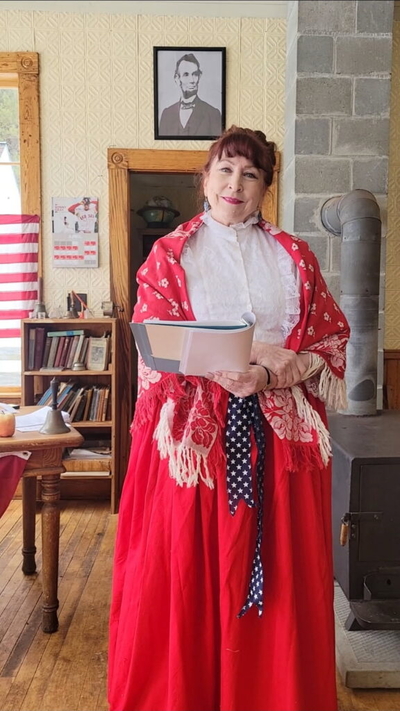
For instance, she brought her research on Revolutionary-era teachers to life. Dressed up in period attire in April, Smith taught for an hour in a historical one-room school house, one of two still preserved in the town today.
“They had to teach all eight grades in the course of a day,” Smith said. “Some of the teachers were literally only 16 years old.”
Another reenactment will be done on July 4, but Smith plans to continue these reenactments and other programming well beyond 2026. She said she’s built a resource library of nearly 100 topics so far, which she hopes will serve as a resource for civics groups and students of all ages.
As events continue in Presque Isle, some grant-funded projects will present the bulk of their work starting in the fall.
That’s the case for The Third Place Inc., a cross-sector network that connects Maine’s Black professionals, students, and entrepreneurs, which received funding for a series exploring the contributions, experiences and legacies of Black Mainers.
Executive Director Adilah Muhammad said the series will kick off in September with a double feature — The Malaga Ship: A Story of Maine and the Middle Passage, and Once Upon a Hill in Maine: The Pedro Tovookan Parris Story — both by storyteller Antonio Rocha, which explore Maine’s ties to the trans-Atlantic slave trade and the resilience of those who survived it.
The location of that showing and subsequent events are to be announced.

Augusta, ME