Nevada charges inmates to make phone calls. Maybe it shouldn’t.
Jun 29, 2026 | 8:00 am ET
Description
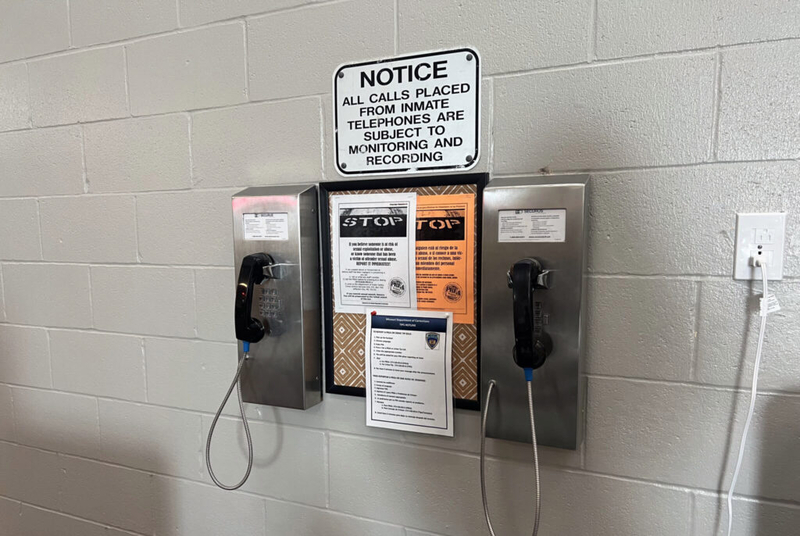
Telephones inside a Missouri state women’s prison where, like in Nevada, incarcerated people pay per-minute rates to call loved ones. (Photo by Amanda Watford/Stateline)
After three months of being apart, Alisha Anderson, a 45-year-old Nevadan, loves talking to her husband, Numa, on the phone. What Anderson didn’t expect was the whopping $600 bill that accompanied the phone calls and video visits.
For family members and loved ones of incarcerated individuals, a phone call can put financial strain on top of an already stressful circumstance. Under the Viapath contract with the Nevada Department of Corrections (NDOC) and other local facilities, phone calls cost $0.10 per minute. Though with taxes and long-distance calls, that price increases.
Anderson says she was unaware of the taxes charged to her account before making phone calls to Numa.
“We are getting taxed 5 cents (per minute) per phone call,” Anderson said. “I didn’t realize that until I pulled my transaction history. It makes me wonder if others know that as well. I was charged almost $20 in taxes for phone calls, and I had no idea.”
To receive calls from inmates, loved ones must fund either a prepaid collect account or a traditional collect account. Prepaid collect accounts require recipients to deposit funds in advance to make calls, while traditional collect accounts bill recipients directly to their phone bill after the call.
Families and friends typically stick with prepaid collect accounts because they are cheaper at $0.10 per minute compared to traditional collect accounts, which charge recipients $0.14 per minute.
These costs add up, especially when underlying fees are included. Since Numa’s incarceration, Anderson has been feeling the weight of these hefty fees, expressing her frustration at these “hidden charges.”
“I looked at the Terms of Service Agreement, it doesn’t say anything about taxes, nor does it mention anything about taxes when I go through the process of putting money on the phone,” Anderson said. “It costs $1.50 for him and I to have a 15-minute phone call, and about 40% of the time the calls are either buffering, cutting out, or they just drop completely.”
Nick Shepack, the Nevada state director of the Fines and Fees Justice Center, broke down how phone costs can vary for recipients.
“There is some discrepancy from families right now, that when they’re buying minutes in bulk, the service charges they’re adding are making them higher, closer to $0.11 or $0.12,” Shepack said.
Video visits and emails cost money as well.
Shepack explained that while video visits are $0.25 a minute and emails are $0.20 a piece, fees are added when loved ones make deposits to pay for them. For example, if someone deposits $10 on their account, they get charged a $5 fee, a 50% charge on a small deposit.
Anderson says video visits between her and Numa aren’t properly set up for communication.
“The video visits aren’t really even worth paying anymore, all you see is a face inside of an egg,” Anderson said. “If you make any sudden movements, it immediately blurs out. What’s the point of paying for a video visit when you can’t even see each other?”
Once the phone calls, emails, and video visits add up, families and loved ones are left with a costly bill. And that’s on top of other expenses charged to incarcerated people.
“Today’s costs pile up quickly,” Shepack said. “The department also adds a 35% markup to all commissary items. So, the average price of something like a cup of ramen, or tuna, or anything that somebody might need to supplement the subpar food, is usually significantly higher than it is for people on the outside.”
‘They need that love and support’
Communication is a non-negotiable necessity; it’s an outlet for incarcerated people to stay connected with their loved ones on the outside. Anderson is all Numa has, contact with her means having a moment of peace.
“I don’t think people realize just how important it is for these guys to have people they can talk to or vent to when they need to,” Anderson said. “It helps keep them out of trouble. If Numa has a bad day, we talk it out, and it calms him down. It’s important to talk about their accomplishments too, they need that love and support.”
In recent years, advocates across the country have fought back against the cost of phone calls.
Worth Rises, a nonprofit watchdog of prison industry practices, last month released a report looking at the more than 330,000 people incarcerated nationally in systems providing free communication.
Since Connecticut became the first state to offer free communication in 2021, incarcerated people and their families saved $622.5 million, and nearly 600 million phone calls were made, according to the report.
California, Colorado, Massachusetts, Minnesota, and New York, along with more than a dozen counties nationwide, and the federal prison system have also made communications free.
Worth Rises Executive Director Bianca Tylek described how free communication impacts not only incarcerated individuals but the public as a whole.
“At the end of the day, when you make communication free for people who are incarcerated, you improve their participation in programs, their success in rehabilitation, you help them plan for reentry, you improve their chances of success when they are released,” Tylek said. That drives down recidivism and crime, which in turn has positive social and economic impacts. ”It’s silly for us not to do it,” she said.
Research cited in the Worth Rises report notes formerly incarcerated people are 10 times more likely to be homeless than the general population, and have unemployment rates of over 27%, leading to a higher risk of reoffending upon release.
Here in Nevada, Shepack says solutions for free communication boil down to decision makers prioritizing incarceration over rehabilitation.
“We have failed to prioritize rehabilitation, which communication is a giant part of,” Shepack said.
The cost of providing free phone calls for 20 minutes a day would be “very minimal,” Shepack said. ”Ideally it would be free phone calls across the board. The return on that investment would be huge because people who communicate with their families are less likely to recidivate, they’re more likely to have jobs lined up when they come out and become productive members of society.”
The Worth Rises report found implementation of free communication policies varied from state to state.
“The large majority of states and counties that have gone to free, have gone so because advocates pushed for legislation that required it,” Tylek said. “But, that’s not the only way,” she said, noting some counties and one state have done it administratively.
She added, “It’s just a matter of renegotiating, either procuring a new contract or renegotiating the existing contract such that the payer becomes the agency as opposed to families. The payer becomes the agency… in fact, in all cases, the government ends up paying less, and so, the rates are then negotiated down.”
While the implementation of free phone calls typically happens at the legislative level, community involvement played a critical role in passing the policies.
“In all counties that have moved towards these policies, it is pressure and encouragement by impacted people like allies and advocates that end up… pressuring agencies and lawmakers to do that,” Tylek said.
Shepack says if Nevadans want free communication, they must demand it from the government.
“What Nevadans need to do, if they believe in this, is demand that they want the government to invest in this, because it makes our community safer and healthier, and it lowers crime rates,” Shepack said.
“We can continue to raise penalties … and hope that deterrence works,” but “that’s never been proven to work anywhere in this country. What we do know that works is if you allow people to talk to their loved ones, and to have constant communication, that we have better outcomes. And if the people of Nevada want to have a prison system that keeps them safe, they need to demand this type of investment.”
Las Vegas, NV