Gov. Laura Kelly surveys landscape as she exits government service, points to unfinished business
Jun 29, 2026 | 1:24 pm ET
Description
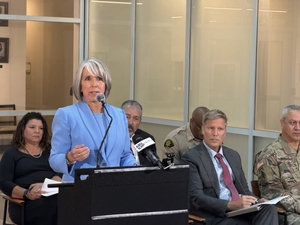
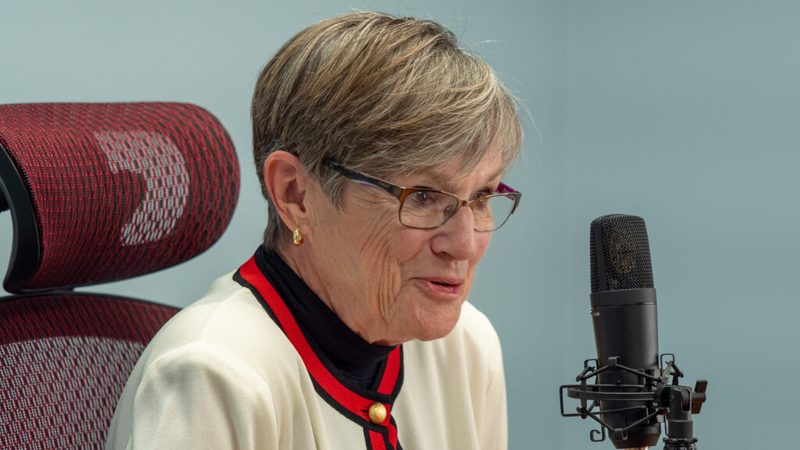
Gov. Laura Kelly, a term-limited Democrat, discusses on the Kansas Reflector podcast achievements during her time as governor and considers challenges for Kansans in the future. (Photo by Anna Kaminski/Kansas Reflector)
TOPEKA — Gov. Laura Kelly said she appreciates that when Kansans think of economic development, their minds turn to deals for the Kansas City Chiefs’ $3 billion domed stadium in Wyandotte County and Panasonic’s $4 billion battery plant in De Soto.
“Obviously, those are sort of the crown jewels,” Kelly said during a Kansas Reflector podcast interview. “Those are the things that people will remember. But what I think about, in addition to thinking about those two things, is all of the other kinds of things that we’ve been able to do.”
Kelly, who leaves office in January at the conclusion of two terms as governor, said a pivot point in her administration’s quest for capital investment and job growth in Kansas occurred in 2020 with the announcement that Urban Outfitters would build a massive distribution center in Kansas City, Kansas. Her administration offered millions of dollars in tax credits and Wyandotte County delivered a 10-year, 75% property tax abatement.
“For a company like Urban Outfitters to even consider coming to Kansas was just amazing,” Kelly said. “That was a major coup.”
The Democratic governor said the move by Urban Outfitters, a retailer targeting young adults with trend-driven clothing and goods, contributed to a domino effect that led to $35 billion in new capital investment and created or preserved 88,000 jobs in Kansas since she took office in 2019.
She said the surge in public-private investments changed perceptions of Kansas.
“I really wanted that to happen,” Kelly said. “When Urban Outfitters said yes, that gave us a pretty cool brand that said ‘yes’ to Kansas, and that, I think, attracted other businesses.”
In the beginning
Kelly, who represented a Topeka district in the Kansas Senate, said she had no interest in running for Kansas governor in 2017. She held a front row seat to the state’s financial hardships during administrations of Republican Gov. Sam Brownback and his replacement, Gov. Jeff Colyer. Colyer was seeking a full term as governor in a race against then-Secretary of State Kris Kobach.
“I really had to be talked into it,” Kelly said, “and the reason I finally agreed was because, as many people know, I’m Irish Catholic, so I’ve got a double dose of guilt, and you know, I’m also not a native Kansan. I moved here 40 years ago, and Kansas has just been so good to me and so good to my kids. In 2017, when it became apparent that the Democrats really did not have anybody in the race who could win a primary and then turn around and have any chance at winning in a general election … it really was a sense of obligation I had.”
Kelly won the 2018 Democratic primary and earned 48% of the 2018 general election vote against Kobach, who ended up with 43%. In her bid for reelection in 2022, she attracted 49.5% of the vote compared to 47.3% for Attorney General Derek Schmidt, who now serves in the U.S. House.
When sworn into office in 2019, Kelly sought to reduce turmoil caused by Brownback’s slashing of state income taxes. The subsequent revenue crash led to significant state borrowing, a sales tax hike and spending cuts to education, highways and other core services. A bipartisan coalition in the Legislature repealed much of the Brownback tax agenda in 2017.
“I came into an administration and the executive branch that had been decimated absolutely, totally, completely,” Kelly said. “There was not a nickel in any fund anywhere. We were truly bankrupt.”
Kelly said leaders of the Legislature, many of whom worked with her while in the Senate, underestimated her ability to govern.
“No doubt. Yeah, of course they did,” Kelly said. “I’m sort of surprised that that they did underestimate me, and by doing that, we were actually able to get some things done.”
On the second floor
Kelly said her initial priorities as governor included maintaining revenue streams, allowing state government to operate effectively. The state ended the practice of stripping cash from the Kansas Department of Transportation, which was known as the “Bank of KDOT.”
She focused on limiting borrowing and reducing debt. She said she stopped depriving the Kansas Public Employees Retirement System of essential state contributions. An influx of federal dollars during the COVID-19 pandemic covered large, one-time expenditures, including state building construction, the governor said.
Kansas’ rainy day fund has grown to $2 billion, Kelly said. She urged the Legislature and the next governor to make wise use of that money.
“I don’t think we should stockpile taxpayer money, but I think we need to have that. Should we ever go into another recession, and we will at some point, we have that backfill money,” Kelly said.
Kelly also committed to improving the state’s role in early childhood education. She said neglect of kids 5 years old and younger contributed to record growth in the number of children in foster care during the Brownback years. Her advocacy led to a law establishing the Office of Early Childhood, which opens July 1.
“Many, many long years ago, I worked at a state psychiatric facility for children in New York, and before that, I had worked at a prison for boys in Illinois,” she said. “In both of those settings, it became really apparent to me most of those kids were adolescents by the time I saw them, and it was just too late. There was a very limited amount that we could really do to really change the trajectory of their lives. I became a huge advocate for early childhood intervention.”
Despite grumbling from GOP legislators, Kansas sustained a court-approved agreement to annually improve funding for K-12 public education. In the past eight years, the Legislature adopted a series of tax bills that included the governor’s request for repeal of the state’s 6.5% sales tax on groceries.
During eight legislative sessions as governor, Kelly vetoed more than 100 bills and issued at least 150 line-item vetoes in budget bills.
“I‘m not surprised that I had to use it,” Kelly said. “The people elected me to be middle-of-the-road thoughtful, you know, neither liberal nor conservative. Just good policy. And that’s what I did.”
Unfinished business
Kelly said the state in the future had to focus on issues of water quantity and quality. The governor said she pushed hard for reform after the 2022 election because so many rural voters urged her to address water policy.
“It’s not that there haven’t been water plans before, but there’s never been another governor who has been in the situation that I am during my second term, where I absolutely have no further political aspirations,” she said. “I’m not surprised that we don’t have it all cemented in place right now, but what we have been able to do is to bring all of those disparate interests and stakeholders together. Slowly but surely, I think we’re getting to a point where, you know, people who have been pretty much naysayers in the past are beginning to realize that things have got to change.“
In the immediate future, Kelly said she opposed the proposed amendment to the Kansas Constitution on the Aug. 4 ballot proposing the direct election of justices to the Kansas Supreme Court.
“I’m adamantly opposed to it,” she said.
Kelly endorsed state Sen. Ethan Corson, a Johnson County Democrat, in the campaign for governor. She said Corson had the best opportunity among Democrats to win the primary and general election. This race reminded Kelly of her own race in 2018.
“In order for a Democrat to win … you’ve got to be able to attract votes from independents and moderate Republicans. That’s how the math works,” Kelly said. “If you really want to do what’s in the best interest of the state, generally a bipartisan approach is the best.”
Topeka, KS