Appeals court reverses some orders in lawsuit against Alabama Department of Corrections
Jun 29, 2026 | 6:00 am ET
Description
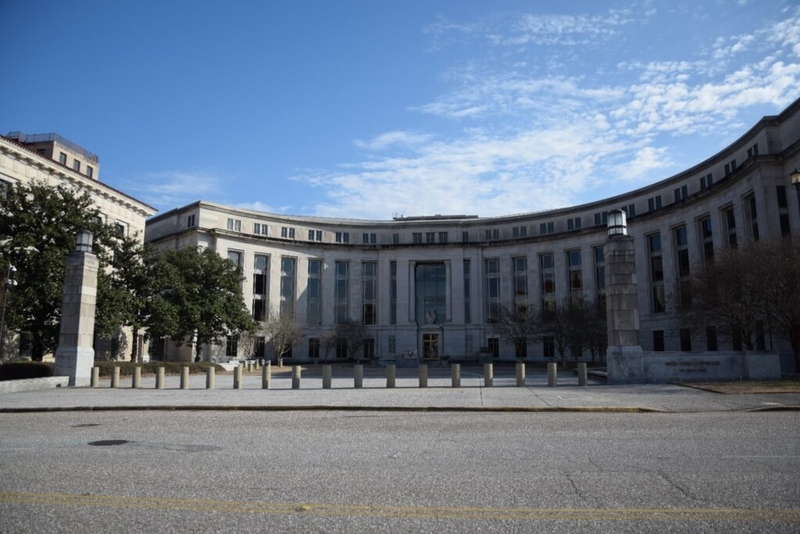
The Frank M. Johnson Jr. Federal Building and United States Courthouse in Montgomery, Alabama, seen on January 24, 2023. The 11th Circuit Court of Appeals reverses several of the orders that the Middle District of Alabama imposed in the Braggs case. (Brian Lyman/Alabama Reflector)
A three-judge panel of the 11th U.S. Circuit Court of Appeals on Thursday agreed that people incarcerated within Alabama’s prisons are not receiving adequate mental health care — but rolled back several requirements a lower court imposed to address the problem.
Judges Adalberto Jordan, Barbara Lagoa and Gerald Bard Tjoflat largely affirmed the ruling of the district court that the conditions within Alabama Department of Corrections prisons violate the Eighth Amendment, which prohibits cruel and unusual punishment.
Presidents Barack Obama, Donald Trump and Gerald Ford appointed each of the three respectively.
The case highlights the high rates of suicide within some of Alabama’s prisons, numbers that at times have been “staggering,” Jordan wrote in the opinion.
But the judges excused the department from having to configure stabilization and restricted housing units to prevent suicides in all of its prisons. They reversed the federal court’s order that Corrections “must fill all mandatory and essential posts” at levels required by staffing analyses.
The judges also exempted the Julia Tutwiler Prison for Women from the remedies the federal court ordered — a request from ADOC in its appeal.
A request for comment was sent Friday to the Alabama Attorney General’s Office and the state’s Corrections Department (ADOC).
The Southern Poverty Law Center (SPLC) represented the plaintiffs, people who were incarcerated in Alabama prisons who said they were not receiving adequate mental healthcare while in custody.
“The state must provide constitutionally adequate care for human beings in its prisons. Mental health needs must be acknowledged and addressed with proper treatment,” said Latasha Dejarnett, senior staff attorney with the SPLC.
The case has been in the courts for years, going back to 2014, and aspects of it are ongoing. The federal district court ruled in the plaintiffs’ favor in 2017.
To win in 2017, the plaintiffs had to prove that the allegations were serious and that ADOC was “deliberately indifferent.”
Given the complexity of the case, the federal court separated the claims into phases. The first dealt with violations of the Americans with Disabilities Act, the second pertained to Eighth Amendment violations, the ADA and Rehabilitation Act, while the third, which is still pending, involved alleged violations of cruel and unusual punishment regarding medical and dental care.
Alabama appealed the case in January 2022 and argued the lower court ordered remedies went beyond what is required to address the Eighth Amendment violations. The judges of the 11th Circuit only addressed those claims from the second phase.
Last week’s opinion acknowledged that the suicide rate for people imprisoned within ADOC was “more than double the national average among state and federal correctional facilities,” and stated that ADOC showed “deliberate indifference” to the serious mental healthcare needs of incarcerated people.
After the district court reviewed almost 1,000 pages of findings and convened two, seven-week, bench trials, the federal district court judge agreed with the plaintiffs that Alabama violated people’s Eighth Amendment rights by not providing them with adequate mental health care.
“In sum, the court found that the DOC’s mental healthcare is, ‘simply put, . . . horrendously inadequate,’” last week’s opinion said. The federal district court outlined several failures that it said violated protections against cruel and unusual punishment.
For example, ADOC did not identify people who had a serious mental illness, establish treatment plans, hire enough qualified staff and adequately care for people who are suicidal.
Twelve people died by suicide since 2017 while they were in ADOC custody.
Among them was Laramie Avery, who was found hanging from a ceiling vent in April 2020 when a corrections officer went to deliver his medication. The order states that corrections officers did not assist him until two minutes after they knew of the situation and not until they “took a picture of him hanging from the ceiling before they cut him down.” They then waited another 12 minutes before they administered CPR.
The federal district court ordered that ADOC hire more corrections officers and maintain a strict ratio of corrections officers to people in custody. It also required the department to hire additional mental health professionals.
The court also told the department to improve cell checks and make wholesale changes to its suicide protocols.
Those orders are still in place.
The Corrections Department appealed the ruling and said the district court made an error because it ‘“bypassed evidence of the Commissioners’ efforts to increase correctional staffing’ and ‘neglected’ to explain what they could have done to remedy the problem,” the order said.
ADOC also said the district court applied the wrong standard when it decided that people in prison received inadequate mental health care.
“The DOC says that the care it provided may not have been good, but it was not conscience-shocking. And it points out, several inmates received adequate care,” the order said.
The 11th Circuit judges disagreed and said, “When the system is viewed as a whole, we detect no error — factual or legal — in the district court’s finding of deliberate indifference.”
However, the 11th Circuit judges agreed that the actions to address the mental health issues may have gone too far in some instances, particularly when the federal court ordered that ADOC suicide-proof all the units that could house people who are suicidal.
In the ruling, the judges noted “there is no other system in the country where every restricted housing unit is suicide-proofed.”
The judges made a similar argument for staffing when it said that “the remedy requires the DOC to fill posts that don’t appear to be necessary for, and indeed seem to have little to do with, the provision of mental healthcare.”
Montgomery