Nessel issues guidance to law enforcement on ability to enforce tribal court-issued PPOs
Sep 25, 2026 | 1:35 pm ET
Description
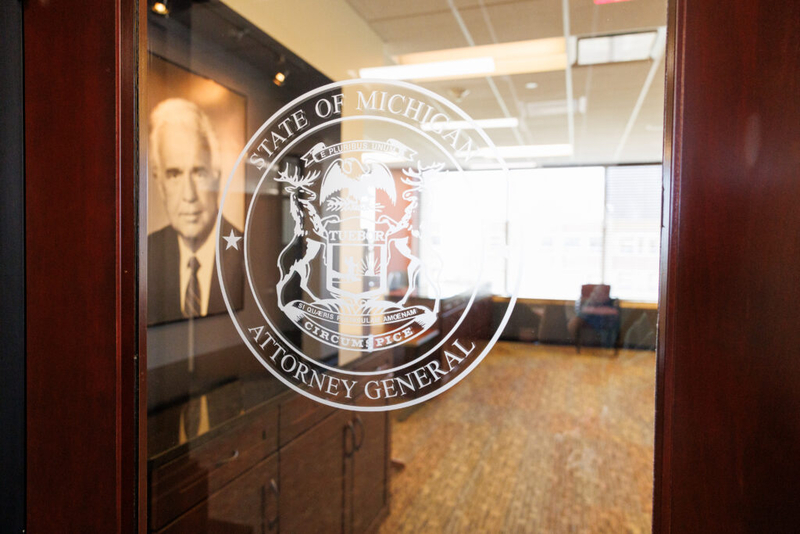
The office of Attorney General Dana Nessel in the G. Mennen Williams Building in Lansing, Mich., on May 15, 2025. (Photo by Andrew Roth/Michigan Advance)
Michigan Attorney General Dana Nessel issued new guidance to law enforcement officers on how to enforce personal protection orders, including those issued by Michigan’s tribal governments and courts.
Those personal protection orders, or PPOs, are categorized in Michigan law as “foreign protection orders,” which are defined as “an injunction or other order issued by a court of another state, Indian tribe, or United States territory for the purpose of preventing a person’s violent or threatening acts against, harassment of, contact with, communication with, or physical proximity to another person.” Foreign protection orders, including those from tribal courts, are subject to the same enforcement procedures as a protection order issued in the state of Michigan.
Nessel’s letter also noted that “Indian tribal courts may issue and enforce civil protection orders against any person—Indian or non-Indian, tribal member or non-tribal member—in matters arising in the Indian country of an Indian tribe.”
Nessel highlighted the disproportionate rates of violence experienced by Indigenous people — and questions that persisted among law enforcement agencies about their ability to enforce orders issued by tribal courts — as among her reasons for issuing the letter clarifying the responsibilities of Michigan police officers.
“A personal protection order may be a person’s only surety of their safety,” she said in a press release. “We want to ensure our law enforcement officers are prepared and informed on handling all valid PPOs, and for Michigan residents everywhere to know their protective orders can be faithfully upheld by public safety officers in any jurisdiction. With this letter and guidance to agencies across the State, we hope to raise awareness of the various venues that can grant and enforce PPOs and assure full enforcement of orders issued by our state courts as well as the tribal courts.”
Research shows that a significant majority, nearly 85%, of Indigenous women experience violence in their lifetime, and Indigenous men experience violence at only slightly lower rates, still above 80%. Additionally, murder is the third-leading cause of death among American Indian and Alaska Native Women on Tribal lands.
The new guidance was sent as the Michigan House of Representatives passed two bills that would make personal protection orders free for survivors of domestic abuse. Currently in Michigan, while actually filing a personal protection order in court generally does not have a fee, the cost to have that order served can include a service fee plus mileage traveled, which can easily cost almost $100.
Law enforcement officers are required to serve a personal protection order if they are responding to a call alleging a violation of a PPO, if the individual who is the subject of the PPO has not been served with the order prior to that time.
PPOs become effective and immediately enforceable anywhere in this state after being signed by a judge, and can be enforced by any law enforcement agency that has a copy of the order or has verified its existence on the state’s Law Enforcement Information Network.
House Bills 5120 and 5121 passed on a bipartisan basis through the chamber on Tuesday, and two bills with a similar purpose, Senate Bills 611 and 612, passed the Senate in December 2025, though they remain in committee in the House. The contents of the two sets of bills must now be reconciled by the two chambers before they can be sent to Gov. Gretchen Whitmer’s desk.
Lansing, MI