Morrisey talking a lot, but not giving evidence of clothing voucher fraud
Aug 11, 2026 | 5:55 am ET
Description
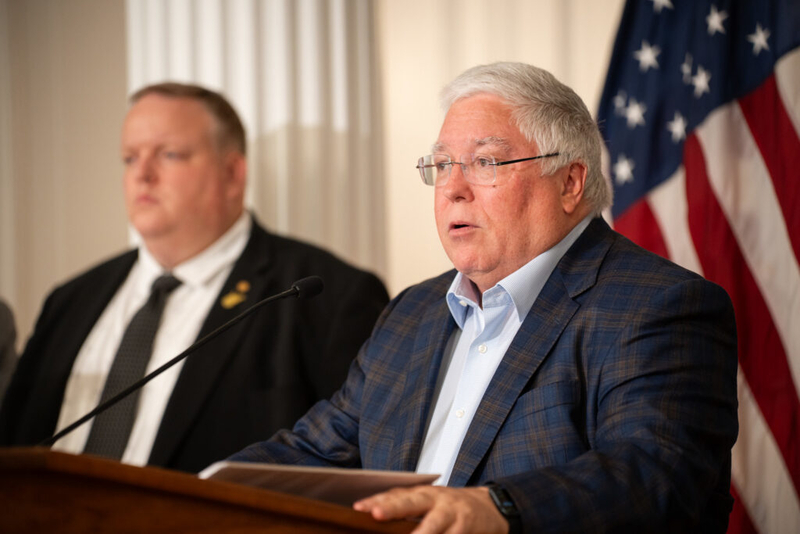
Gov. Patrick Morrisey speaks at a news conference on Monday, Aug. 10, 2026 at the state Capitol in Charleston, West Virginia. (Photo courtesy of the West Virginia Office of Gov. Patrick Morrisey)
Over the last week, Gov. Patrick Morrisey has gone from blaming the school clothing allowance program’s early closure on being out of funds, to alleging fraud.
During the opening of his “water listening tour” in Huntington last Tuesday, he claimed that people were using the $200 clothing allowance to buy “beer and cigarettes.” People can withdraw cash from the EBT cards at ATMs, as long as they’re not located in a liquor store or a casino.
“We can’t verify what’s being spent on clothing. Period. That’s a huge problem,” Morrisey said Wednesday at a public event in Princeton, West Virginia.
If that’s true, then he also can’t verify it was being spent on beer and cigarettes, right?
The governor posted an ugly AI graphic on his X account that states 49% of the EBT cards were redeemed for cash. There’s no explanation of how that money is used, or where that number comes from. The West Virginia Department of Human Services has not returned a request from West Virginia Watch for detailed data on spending in the school clothing allowance program.
National chains, like Walmart and Target, will accept the EBT cards. However, those stores aren’t always close to people in rural areas. Parents need other options to be able to buy clothing for their children, whether it be a small local consignment store or a yard sale. For clothing, $200 doesn’t go very far, so people have to find places where they can get the most out their money.
The school clothing program typically opens for registration on July 1, but because of Morrisey’s review of the Temporary Assistance for Needy Families program, it didn’t start until July 20 — giving parents almost three fewer weeks than usual to shop for deals. Because of the delay, some people still haven’t received their vouchers and they missed out on being able to shop during the tax free holiday at the end of July.
The state estimates about 57,000 families will receive the school clothing allowance this year.
When it comes to the school clothing fund, Morrisey says he doesn’t want the money to be abused and wants to make sure it goes to clothing, but when it comes to the Hope Scholarship, he’s singing a different tune.
“I will continue to defend this program and ensure that every family in our state has the freedom to choose the best educational option for their children,” Morrisey said in a March 3 news release.
The Hope Scholarship gives families up to $5,435.62 per child for the 2026-2027 school year to spend on tuition and fees for private schooling, homeschooling, microschools and tutoring services, school supplies, etc. However, the money has been spent on out-of-state schools, iPads, dance studio fees, piano lessons, iPads, water tables and other questionable items, according to annual reports released by the State Treasurer’s Office.
This school year, Hope is open to all school children in West Virginia, and is estimated to cost the state $230 million.
During this year’s legislative session, House Finance Chair Vernon Criss proposed guardrails on the Hope Scholarship, the country’s most broad school voucher program.
Criss, R-Wood wanted to decrease costs by banning its use at out-of-state schools and for tutoring services. None of the proposed changes passed.
Morrisey went on to support Criss’ opponent in the May primary. Pro-school choice political action committees tied to Morrisey spent hundreds of thousands of dollars opposing Criss, who lost to 23-year-old Charles Hartzog, who has no prior political experience.
What’s the biggest difference between these two programs? About 90% of Hope Scholarship recipients were already attending private schools, according to State Treasurer Larry Pack — meaning they could afford the tuition — while the school clothing allowance program is for low-income families.
Why does Morrisey seem more concerned with how about $11.4 million in clothing allowance money is being spent than the $230 million in Hope Scholarship funds?
Morrisey has also tried to meddle with another low-income benefits program, the Supplemental Nutrition Assistance Program. Last spring, the governor requested a SNAP waiver to restrict soda purchases. The USDA formally approved the SNAP waiver in August 2025, and the restrictions took effect Jan. 1. However, in June a federal judge struck down the ban, and the state paused it.
I understand not wanting the school clothing allowance money to be abused. But just because it can be, doesn’t mean that everyone who is withdrawing the funds is using it on something besides clothing.
“We are going to change it. I’m not going to accept this going forward,” Morrisey said of the clothing program. “I want to have the opportunity to talk to the Legislature. We’re going to look at ways that we can make sure they’re maximizing the money that goes for kids’ clothes.”
Instead of talking to the Legislature, the governor should talk to the people in the Department of Human Services Bureau for Family Assistance who award the money to families. He should ask them how families use the money, if they’re aware of any fraud and if there’s a better way to disburse the money so it’s easier to spend on clothing.
It sounds like a problem was created to cover the delayed opening of the program, that was then closed after seven days, not giving people enough time to apply for the much-needed funding. Morrisey should stop treating West Virginians like criminals and recognize that the state has one of the highest rates of poverty in the nation. When the government helps those who are experiencing poverty, it gives them a better chance at succeeding. And shouldn’t we want all West Virginians succeed?
Charleston, WV