Trump admin aims to shift homelessness grants toward addiction treatment, enforcement
Sep 16, 2026 | 9:50 am ET
Description
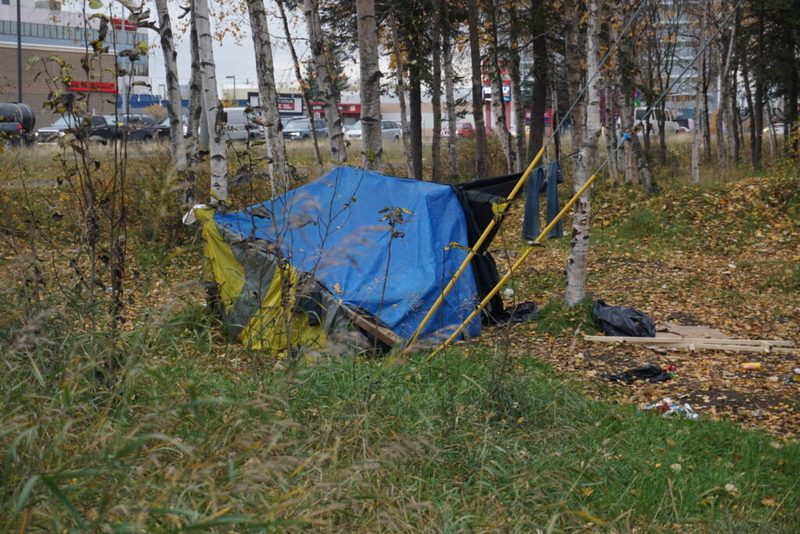
A campsite is seen in Anchorage, Alaska, last year. The Trump administration has proposed a major shift in homelessness grants. (Photo by Yereth Rosen/Alaska Beacon)
In its latest effort to overhaul federal homelessness funding, the Trump administration is proposing to provide more money to localities that prioritize treatment-first policies such as sober living, more cooperation with law enforcement and more temporary and transitional housing.
It’s a reversal from a decade-long federal approach known as Housing First that sought to permanently house people experiencing homelessness without requiring sobriety or participation in treatment programs as a condition.
The Trump administration has been attempting to overhaul federal funding for homelessness programs in this direction over the past two years but had suffered defeats in court that stalled its efforts to do so in 2025 and 2026.
In a notice posted in the Federal Register on Sept. 11, the Department of Housing and Urban Development argued that current policies aren’t working and said some states and localities have already shifted toward a treatment-based approach to homelessness. The agency will take public comments through Oct. 13.
Under the proposal, the department would change the bonuses it gives to state and local areas that participate in the Continuum of Care program, a federal grant initiative to fight homelessness. The department would incentivize efforts to provide transitional housing with services “concentrating on improving employment income and meeting behavioral healthcare needs.” It would also incentivize addiction treatment and recovery services, sober housing and partnerships with law enforcement.
With homelessness rising, new federal rules could benefit states that take tougher approaches
HUD pointed to policies in Anchorage, Alaska; Houston; Portland, Oregon; and San Francisco as evidence that states and cities are already shifting their homelessness responses toward public camping restrictions with emphasis on treatment and recovery as a condition to housing support.
That shift was made possible by the U.S. Supreme Court’s City of Grants Pass v. Johnson decision in 2024, which allowed local governments to enforce public camping bans. Since then, more than 350 cities and 14 states have adopted laws or measures to crack down on street homelessness.
HUD had tried twice previously to change the application process for grants along similar lines, but a federal court ruled against the attempts, saying they violated required procedures.
One lawsuit against HUD’s efforts was brought by a coalition of 22 states and the District of Columbia, while another was filed by local governments and homelessness organizations, including the National Alliance to End Homelessness and the National Low Income Housing Coalition.
State officials joining the lawsuit were from Arizona, California, Colorado, Connecticut, Delaware, Illinois, Kentucky, Maine, Maryland, Massachusetts, Michigan, Minnesota, New Jersey, New Mexico, New York, Oregon, Pennsylvania, Rhode Island, Vermont, Virginia, Washington and Wisconsin, plus the District of Columbia.
The Obama administration made Housing First initiatives the predominant federal homelessness policy. The Trump administration argues that it hasn’t worked and that chronic homelessness has increased since 2013.
But housing advocacy groups say that Housing First initiatives are a proven, bipartisan strategy that can lead to better outcomes and reduce taxpayer spending on emergency services and the criminal legal system.
The National Low Income Housing Coalition pointed to a 2020 review of 26 studies that found Housing First programs decreased homelessness by 88% and improved housing stability by 41% compared with Treatment First programs.
Stateline reporter Robbie Sequeira can be reached at [email protected].