The public health insurance option isn’t the great choice you think it is
Sep 16, 2026 | 7:00 am ET
Description
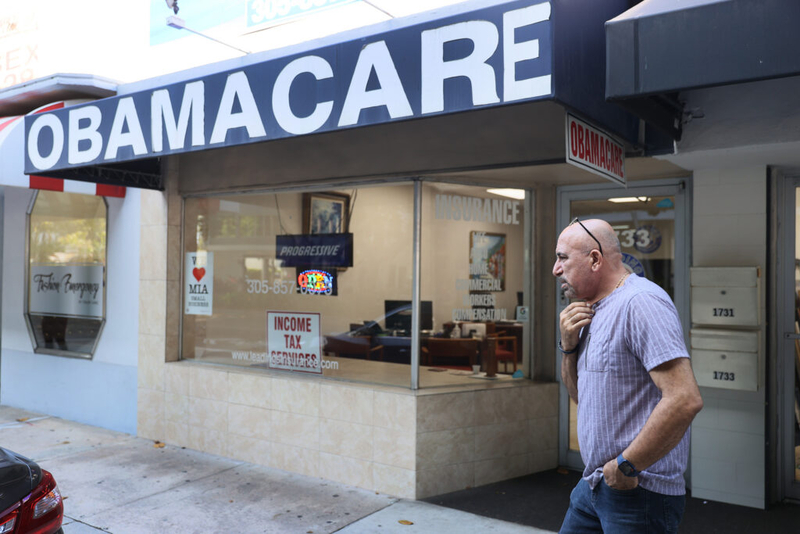
The owner of an insurance agency that offers Obamacare plans stands outside his storefront in Miami, Fla, in 2021. The author argues an Obamacare-era proposal called the public option is not the solution to our health insurance woes. (Photo by Joe Raedle/Getty Images)
Moderate Democrats have frequently been returning to an old Obamacare debate-era proposal called the public option. They often label it “Medicare for all who want it” in order to piggyback off the better known single-payer proposal.
Those who desire reform but get anxious about a universal and single-payer insurance system dubbed “Medicare for All” understandably appreciate the public option because it seems like a safe compromise. As a health economist, I feel obligated to warn that the public option is not as safe as many think it is. Not only does it have far worse prospects than a single-payer system, but it may even be worse than the status quo, too.
The public option’s core premise is that by offering a publicly-run competitor to private insurance, like an option for Americans of all ages to buy into traditional Medicare, private insurance will have to reduce healthcare costs or go out of business. At least, that’s the theory behind it.
Introducing a public option would indeed introduce competition, but not how one might expect. To understand why, it’s helpful to conceptually divide those not already on Medicare or Medicaid into two groups: those who expect to need little healthcare soon, and those who expect to need more.
Currently, all these people — most of whom are working age adults — jump from insurer to insurer based on what their employer offers them or what they find on Minnesota’s ACA marketplace, known as MNSure. These private insurers compete by seeking to design their plans so they attract healthy beneficiaries while repelling those who will cost them because they are at a higher risk for sickness and disease. This constant churn means none of them face a disproportionate patient cost burden for long, but they must always be tightening controls that patients despise, such as high cost sharing, narrow networks, and frequent prior authorization reviews, to do so.
The public option would offer a much more comprehensive plan to all these people. This sounds great, but it’s unfortunately also where the problems start. Those who expect to have higher healthcare needs would immediately gravitate towards this public option, driving up its costs to beneficiaries and accelerating depletion of the Medicare trust fund. As a result, healthier individuals would increasingly avoid it and its growing premiums. They’ll turn to the private market, which will now be able to offer what patients not expecting to need care often think they want: bare bones policies with minimal monthly premiums. In short, the public option encourages patients to naturally sort themselves into or out of an unsustainably high-cost risk pool until it collapses. Economists call this an insurance death spiral.
Minnesota actually tried a public option of sorts once called the Minnesota Comprehensive Health Association. Its role was to insure those who otherwise couldn’t get coverage when it was still legal for private insurers to deny applicants based on pre-existing conditions. Despite requiring subsidies from the other insurers and high cost-sharing burdens for beneficiaries, the program still exhibited classic death-spiral symptoms. Over time, the plan’s costs per person accelerated past other insurers’, and it required periodic state cash injections to stay afloat. It quietly disappeared when the ACA began.
Insurance of all types only works when it can spread out risk among a broad variety of people. With healthcare, that means that the majority of us who don’t have significant health needs in a given year pay for the care of the minority of us who do, so that when we all eventually have a health problem of some sort, there’s money to make sure we get care, too. The public option breaks this linkage, and thereby threatens to make public health insurance look artificially expensive and dysfunctional.
Think of this analogy: Imagine if each neighborhood had its own fire insurance company. If one neighborhood burns down, their company would likely go bankrupt and the neighborhood would be left without protection. Now imagine if all the houses most likely to burn down were also moved to the same neighborhood. That’s exactly what the public option does by encouraging individuals to self-select into high- versus low-risk pools.
This in turn would give those who wish to privatize or otherwise eliminate public health insurance programs plenty of ammunition. For those on traditional Medicare now, that means your health coverage. Congress used exactly these kinds of arguments to slash and burn Medicaid in the Big Beautiful Bill Act, and many representatives would gladly do so again to traditional Medicare if given the chance.
At the same time, single-payer reform proposals at both the national level (Medicare for All) and state level (the Minnesota Health Plan) lack this fatal flaw, making them much more realistic and pragmatic despite the higher degree of public anxiety around the idea. Single-payer puts everyone in one risk pool, regardless of age or health needs. By doing so, it allows the health system flexibility to address the root causes of our excessive healthcare costs by cutting unnecessary administrative functions, putting hospitals on global budgets, and negotiating fair drug prices with manufacturers. Our legislators would be much wiser to implement that than a public option.

Saint Paul, MN