Moore signs energy executive order, aiming to attract power developers to Maryland
Dec 19, 2025 | 8:20 pm ET
Description
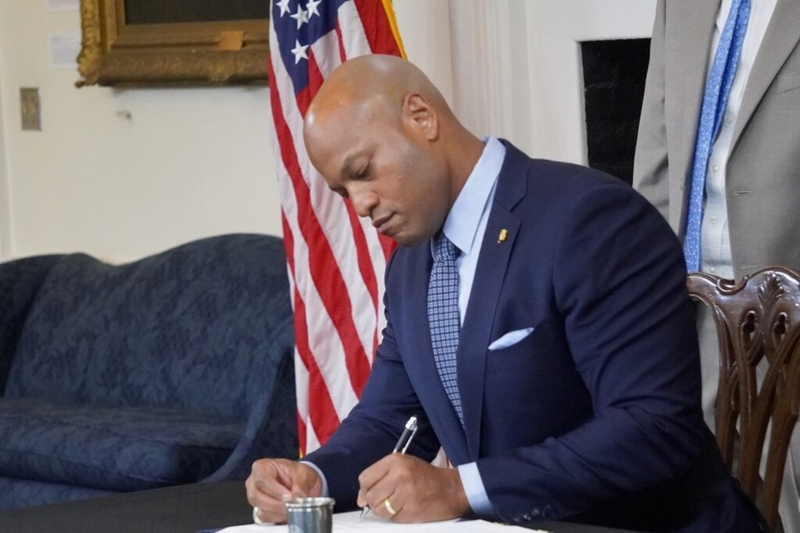
Gov. Wes Moore (D) signs an executive order Friday that includes a range of potential solutions to energy generation and transmission issues in Maryland. (Photo by Christine Condon/Maryland Matters)
Gov. Wes Moore (D) signed an executive order on energy Friday, with a focus on streamlining state procedures to attract new energy generation to the state.
Moore acknowledged during Friday’s news conference that the executive order would not lower Marylanders’ rising energy rates in the short term. But by attracting more power developers to the state, the goal is to eventually bolster energy supply and lower bills, he said.
“There is no governor who can turn around and say, ‘Energy prices are down,’ because there is no governor who is forcing energy prices to spike. No governor can lower prices,” Moore said. “But here in Maryland, we will do everything in our power to bring relief to the people.”
Moore’s order includes a to-do list for state agencies, including his Energy Administration. For example, by late 2027, state government will develop an inventory of sites that could be ripe for power development. Brownfields and industrial sites are to be prioritized, according to the governor’s order, and state government should entice developers with grants and technical assistance.

Moore also established a new energy sub-Cabinet, made up of his department secretaries, and led by the newly minted director of the Maryland Energy Administration, Kelly Speakes-Backman. The governor also created a Maryland Energy Advisory Council, made up of legislators, utilities, the regional grid operator PJM, consumer advocates and more.
The sub-Cabinet will serve as the “nerve center for driving energy policy in the state,” Moore said Friday, and the advisory council will “give experts from throughout the state and the region a stronger voice in Maryland’s energy decisions.”
Moore’s order comes just a few days after the legislature overturned many Moore vetoes during a special session, including a bill that created a strategic energy planning office for the state.
Moore opposed the creation of that office because it would have been funded by utilities — which would use ratepayer dollars. By contrast, his new sub-Cabinet and advisory council can be funded using existing state resources, administration officials say.
PJM remains in the crosshairs
During his remarks Friday, Moore again had stern words for PJM Interconnection, the operator of the electric grid that includes Maryland, Washington, D.C., and a dozen other states. Moore called PJM “a multistate conglomerate led primarily by a board consisting of big business executives,” and he argued the entity’s policies are to blame for rising prices.
Environmental advocates have faulted PJM for a logjammed queue of power-generation applications that has slowed renewable energy projects hoping to come online. PJM argues that it is clearing the backlog, and it also recently created a fast-track for “shovel-ready” projects.
“We cannot build a 21st century economy on an energy market that continues to block new supply,” Moore said Friday. “The system’s incentives are upside down.”
Climate study, energy planning, data center bills become law after Moore vetoes are overriden
Moore’s order requires his MEA to work with the Public Service Commission “to advocate for market reforms at PJM.”
Earlier this week, PJM held a major energy auction, which cleared at a price 1.3% higher than the previous auction. PJM estimates that the auction will have little effect on bills, but the effect would have been significant if it weren’t for a cap imposed on the auction at the request of Pennsylvania Gov. Josh Shapiro (D) and other governors, including Moore. That cap will lift for the next auction, held next summer, unless further action is taken.
But more alarmingly, the auction — which covers the 2027-2028 delivery year — did not procure quite enough energy to meet a standard set by PJM. That occurred largely because of projections that large data centers will demand a significant amount of additional power from the grid by 2027.
PJM officials said during a news conference Wednesday that they expect conditions to improve by that year, because of new restraints placed on data centers, among other reasons, meaning the energy supply procured during the auction will come closer to reaching the proper standard.
Maryland climate and consumer advocates argued in a news release that PJM is to blame for the imbalance in the auction.
Brittany Baker, Maryland director of the Chesapeake Climate Action Network said this week’s auction is “another example that PJM’s failure to connect clean energy to the grid is driving up our energy bills.”
“PJM is trying the same thing over and over, and they keep getting the same result, higher energy prices for all of us,” said Del. Lorig Charkoudian (D-Montgomery), in the news release.
Transmission lines and power affordability programs also a focus
The governor’s executive order also includes provisions focused on power transmission infrastructure.
Moore requested that the Maryland Public Service Commission require transmission owners to study advanced transmission technologies before they approve the construction of new lines.
Moore appoints PSC members, but the body is a state agency that otherwise acts independently to regulate the state’s electric and gas utilities, such as Baltimore Gas & Electric, Pepco and Potomac Edison.

Moore’s request comes amid an ongoing fight, led by rural Marylanders, against a transmission line, the Maryland Piedmont Reliability Project, that would run through Baltimore, Carroll and Frederick counties.
Opponents of the line have long argued that grid officials should have considered technological upgrades to existing infrastructure, before proposing an entirely new line that would disrupt homeowners and natural lands.
Moore also directed his administration to create an inventory of state-owned rights-of-way, such as highway medians, that could be used for power lines or energy-storing batteries, and create a streamlined permitting process for those sites.
Several provisions simply call on Moore’s administration to petition the PSC, asking it to consider certain policy changes for utilities and transmission owners.
In his order, Moore requests that the commission evaluate the efficacy of utilities’ budget billing programs, which allow customers to make even monthly payments for their energy, and avoid seasonal price spikes.
Moore’s order argues that the commission should “assess whether current practices adequately protect customers from large true-up balances and clearly disclose program terms, risks, and benefits,” among other topics.
Under the order, Moore’s Energy Administration will also deliver a new report on the state’s energy assistance programs for ratepayers, due in 120 days.
“For a lot of people, what I was just talking about might sound very technical, but I know for that family who that bill is about to arrive, and they don’t know why it just doubled, policy stops being technical. Policy gets real personal real quick,” Moore said. “And that is what this administration thinks about every single day.”

Annapolis, MD