Montclair State University has extraordinary responsibility overseeing NJ PBS
Sep 10, 2026 | 7:00 am ET
Description
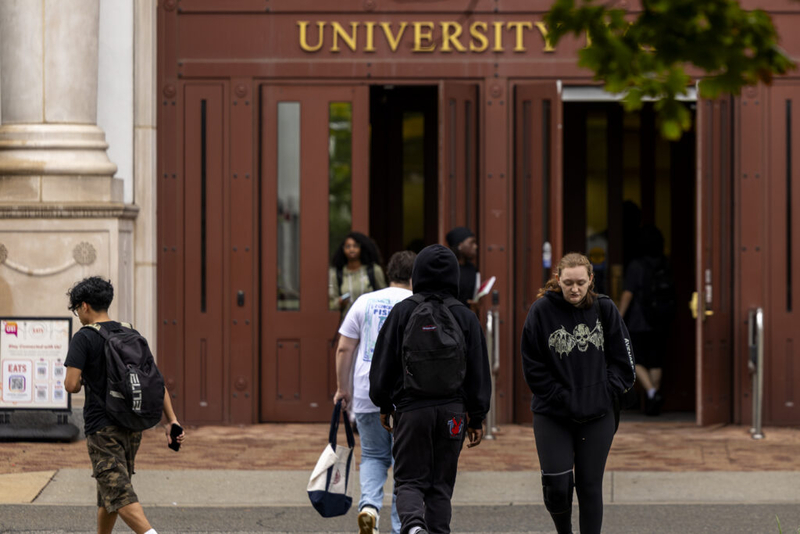
Students walk on the Montclair State University campus. The school is embarking on a new role as operator of NJ PBS. (Photo by Anne-Marie Caruso/New Jersey Monitor)
New Jersey has long had an unusual problem for a state of nearly 10 million people: We live in the shadow of two of the largest media markets in the country, yet neither is primarily responsible for covering us.
New York looks east across the Hudson. Philadelphia looks west across the Delaware. In between are 564 municipalities, hundreds of school districts, a state government in Trenton, and millions of residents whose daily lives are shaped by decisions that rarely make the evening news in either neighboring city.
The Center for Cooperative Media has described this as a structural problem for New Jersey journalism. Our position between New York and Philadelphia siphons away advertising revenue, audience attention, and journalistic talent.
Last month, New Jersey took an intriguing step toward addressing that problem.
Montclair State University announced that it will acquire NJ Spotlight News, the statewide policy and government news organization founded in 2010. The acquisition from the WNET Group includes the NJ Spotlight News name, its website, and an archive of more than 26,000 articles. Founding editor John Mooney has been retained to help lead the transition.
By itself, preserving a respected New Jersey newsroom would be significant. But this acquisition comes barely a month after Montclair State assumed operation of NJ PBS, the state’s public television network.
Taken together, these developments have created something considerably more consequential.
A New Jersey public university now sits at the intersection of statewide public television, public-policy journalism, journalism education, and a network of hundreds of local news organizations.
Montclair State has an opportunity to build something New Jersey desperately needs: a genuine statewide civic-information institution.
We frequently speak about universities as civic institutions. We tell students that higher education prepares citizens, strengthens communities, and contributes to democracy. Those claims can sometimes feel abstract.
Montclair State now has the chance to make them tangible.
The university enters this role with an asset few universities could replicate. Its Center for Cooperative Media already coordinates the NJ News Commons, connecting more than 300 local news and information providers across New Jersey. The university therefore has the potential to connect statewide reporting with local outlets, public television, students, faculty and communities across the state.
But that opportunity comes with an equally extraordinary responsibility.
For this experiment to work, Montclair State must protect the independence of the journalists now operating under its institutional umbrella, including when their reporting becomes uncomfortable for the school itself.
A public university is hardly a neutral observer in New Jersey politics. Its leadership deals with state appropriations, elected officials, unions, employees, students, donors, and competing public interests. Universities experience protests, personnel controversies, budget disputes, and questions about how public money is spent.
Eventually, one of those stories will involve Montclair State.
When that day comes, the real test of this arrangement will begin.
Could an NJ Spotlight News reporter aggressively investigate the university president’s administration? Could NJ PBS scrutinize Montclair’s finances or employment practices? Could journalists pursue a story that embarrasses the institution housing their newsroom or creates problems for university leaders in Trenton?
The answer has to be yes.
Fortunately, Montclair appears to recognize this tension. When the state selected the university to operate NJ PBS, Montclair State committed to a code of journalism ethics, an independent ethics committee with external appointments, and a community advisory board. As a public university, it is also subject to New Jersey’s Open Public Records Act.
Those safeguards should now become central to the NJ Spotlight News transition.
They should be strong enough that editorial decisions cannot be quietly influenced by university administrators, political officials, or institutional priorities. The ethics committee should have meaningful independence. The public should understand how complaints about editorial interference can be raised. Journalists should know that scrutinizing their institutional home will be protected rather than merely tolerated.
This matters because the greatest danger here is also what makes the experiment so promising: Montclair State is becoming powerful within New Jersey’s civic-information ecosystem.
That power should be welcomed, but accompanied by transparency and accountability.
There is a larger lesson here for higher education, too.
At a moment when universities are frequently asked to justify their civic value, Montclair State may be developing a compelling answer. A public university can educate students while also helping citizens understand the institutions governing their communities. It can prepare future journalists while sustaining journalism in the present. It can convene communities while providing them with the information necessary to govern themselves.
That is a more meaningful contribution to democracy than another campus statement about the importance of civic engagement.
New Jersey should want this experiment to succeed.
But success should ultimately be measured by something more demanding than whether NJ PBS remains on the air or whether NJ Spotlight’s archive remains online.
Years from now, New Jerseyans should be able to look to this institution and find rigorous reporting about their governor, Legislature, schools, towns, public agencies and universities.
Including Montclair State.
If Montclair can build a newsroom strong enough to hold even itself accountable, New Jersey will have gained something far more important than a new owner for a news organization.
It will have gained civic infrastructure.
Alejandro J. Ramos is the founder and executive director of the Ramos Research Institute, a New Jersey-based nonpartisan research organization focused on democracy, civic education, media literacy, and public leadership. He is a doctoral student at Vanderbilt University, holds an M.P.A. from Cornell University’s Jeb E. Brooks School of Public Policy.

Trenton, NJ